
If you have been searching for an Algarve travel guide for US retirees, you are in the right place. Whether you want a two-week vacation in the sun or you are seriously thinking about packing up and moving to Portugal for good, this guide covers everything — in plain English, with real numbers. No hype, no complicated jargon. Just the kind of practical information that helps you make a confident decision.
The Algarve is Portugal’s southernmost region. Think long golden beaches, whitewashed fishing villages, world-class golf courses, and seafood fresh enough to make your eyes water. For Americans over 55, it consistently ranks among the best retirement and travel destinations in Europe — and for very good reason.
⚡ Quick Answer: Is the Algarve worth it for US retirees in 2026?
Yes — by almost every measure. The cost of living runs 30–45% lower than comparable US coastal cities. English is widely spoken throughout the region. Private healthcare is excellent and affordable. The weather delivers more than 300 sunny days per year. And Portugal ranks 7th safest country in the world on the Global Peace Index. A couple can live well for $2,500–$3,200 per month — including rent, healthcare, dining out, and entertainment.
📋 What’s in This Guide
- Real Cost of Living: What $3,000 a Month Gets You
- Where to Stay: The 4 Towns That Suit Retirees Best
- Senior-Friendly Beaches: Sun Without the Struggle
- Healthcare: What Happens If You Get Sick?
- Visa & Residency: Can You Actually Move Here?
- Food & Restaurants: Where to Eat Like a Local
- Getting Around Without a Car
- Honest Pros & Cons (The Things Other Guides Skip)
- Frequently Asked Questions
1. Real Cost of Living in the Algarve: What $3,000 a Month Actually Gets You
The number one question we hear from American retirees is: “Can I actually afford to live there?” Here is a straightforward breakdown.
| Monthly Expense | Algarve, Portugal | Sarasota, Florida |
|---|---|---|
| 1-Bedroom Apartment (modern, furnished) | $1,100 – $1,600 | $2,200 – $3,200 |
| Groceries (couple, 1 month) | $350 – $450 | $600 – $800 |
| Dinner for Two (restaurant, wine included) | $35 – $55 | $80 – $130 |
| Private Health Insurance (per person) | $100 – $180 | $400 – $900+ |
| Utilities (electric, water, internet) | $120 – $180 | $250 – $400 |
| Comfortable Monthly Total (couple) | $2,500 – $3,200 | $5,000 – $7,500+ |
The bottom line: if you receive Social Security plus a modest pension or investment income, the Algarve is genuinely affordable — not just “cheaper if you sacrifice everything,” but comfortable, with dining out, occasional travel, and the odd luxury still fitting in the budget.

2. Where to Stay: The 4 Algarve Towns That Suit Retirees Best
The Algarve stretches across about 100 miles of Portugal’s southern coast. Not every town is right for every person. Here is an honest look at the four most popular choices for American retirees, with no sugarcoating.
Lagos — Best for: History-lovers who enjoy walking
Lagos is the Algarve’s crown jewel for good reason. The old town is compact, mostly flat, and absolutely beautiful — cobbled streets, tiled churches, a Roman-era market. You can walk from the marina to the clifftop viewpoint in about 20 minutes. For anyone who has mobility concerns, this walkability is a genuine plus. Taxis and rideshares are easy to find for longer distances.
Hotel Pick: Tivoli Lagos Algarve Resort — upscale, walkable to both the marina and the old town, with a pool and attentive staff who speak excellent English.
Vilamoura — Best for: Golf enthusiasts and resort-style living
If your idea of a good day involves 18 holes followed by a sundowner at the marina, Vilamoura was designed for you. It is manicured, modern, and very much oriented toward international visitors. It has less authentic local character than Lagos or Tavira, but compensates with exceptional facilities, smooth roads, and a large English-speaking community. Medical clinics are close by.
Hotel Pick: Anantara Vilamoura Algarve Resort — quiet, spacious rooms, and direct views over the golf fairways.
Tavira — Best for: Those who want authentic Portugal

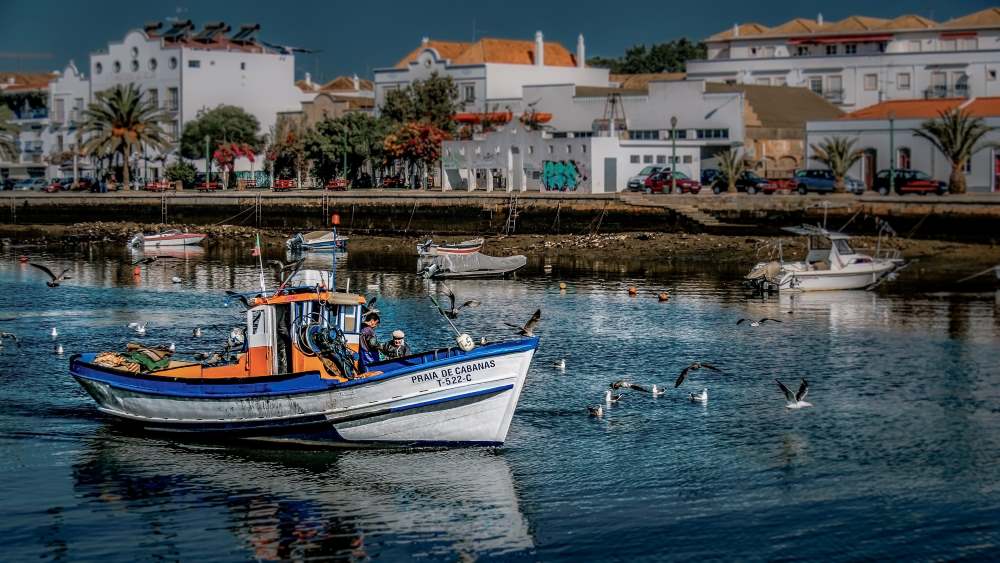
Located in the eastern Algarve, Tavira is genuinely different. It feels less like a tourist town and more like a real Portuguese city — medieval castle ruins, a Roman bridge, a working fishing port, and a quiet pace of life that most visitors find deeply relaxing. It is also notably cheaper than Lagos or Vilamoura. The trade-off: fewer English speakers in shops and restaurants, and a smaller range of international conveniences.
Hotel Pick: Pousada Convento de Tavira — a historic convent converted into a luxury hotel. Atmospheric, beautiful, and reasonably priced by American standards.
Albufeira — Best for: Those who want a familiar, tourist-friendly base
Albufeira is the most “international” town in the Algarve. English is spoken everywhere. There are American-style restaurants if you need a familiar meal. The beach is long, and access is good. The honest downside: it is crowded in summer (June–August) and loses some of its charm in peak season. For a first visit, it is a safe, comfortable starting point. For long-term living, most retirees eventually prefer Lagos or Tavira.
3. Senior-Friendly Beaches: How to Find the Sun Without Climbing 200 Steps
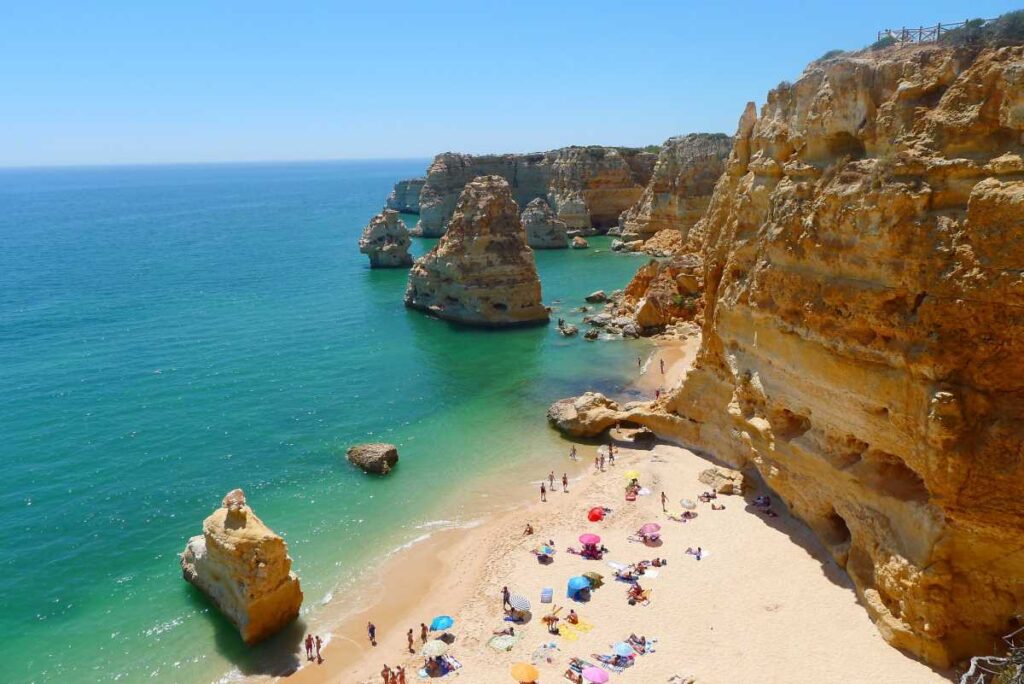
Many of the Algarve’s most famous beaches involve steep cliff stairs — beautiful from a photograph, but a real challenge if your knees are not what they used to be. Here are three beaches that are genuinely easy to reach and enjoy.
| Beach | Why It Works for Seniors | Nearest Town |
|---|---|---|
| Praia da Rocha | Long wooden boardwalk along the entire beachfront; no stairs required; beach clubs with loungers | Portimão |
| Meia Praia | 4 km of flat, wide sand; gentle slope from parking area to water; never overcrowded | Lagos |
| Praia do Anção | High-end beach clubs with accessible ramps and sun loungers included; calm, quiet atmosphere | Quinta do Lago |
Tip: Visit in May, early June, or September. The weather is still warm (75–82°F / 24–28°C), but the crowds are far smaller and parking is easy. July and August are beautiful but packed — beaches feel very different from a peaceful retirement retreat.
4. Healthcare in the Algarve: What Happens If You Get Sick?

This is the question that matters most, and it deserves a straight answer. Here is what you actually need to know — no scary stories, no false reassurances.
Short-term visitors (up to 90 days)
Purchase comprehensive international travel insurance before you leave the US. Medicare does not cover you abroad — not even for emergencies. A solid travel insurance policy covering medical evacuation costs roughly $100–$200 for a two-week trip, depending on your age and coverage level. This is non-negotiable. Do not skip it.
Good options to compare: Squaremouth (a comparison tool for travel insurance) and GeoBlue (specializes in international coverage for Americans).
Long-term residents
Once you hold a Portuguese residency visa, you can access Portugal’s public healthcare system (SNS). In practice, many English-speaking retirees use private insurance because wait times in the public system can be long for non-emergency care. Private coverage in Portugal is affordable — typically €100–€200 per month per person, which covers doctor visits, specialist referrals, and hospital stays at private facilities.
The hospital you want to know about
The HPA Health Group operates private hospitals in Alvor (near Lagos) and Faro, the regional capital. Both locations have English-speaking doctors, modern equipment, and accept many international insurance plans. Many American retirees consider this their primary healthcare provider in the Algarve.
🔒 Safety First: Before booking anything online — hotels, apartments, tours — make sure you know how to spot travel scams. Read our guide: Cyber Safety for Seniors: Avoiding Online Scams. Fraudulent rental listings are particularly common in popular European destinations.
5. Visa and Residency: Can You Actually Move to the Algarve?
This section is for anyone thinking beyond a vacation — considering the Algarve as a permanent home or a place to spend six or more months of the year.
Option A: The 90-Day Tourist Visit (No Visa Required)
As an American citizen, you can visit Portugal — and the entire Schengen Area — for up to 90 days out of any 180-day period with no visa at all. Many retirees do exactly this: spend the spring in the Algarve, return home for a few months, then come back. It is a legal, simple, and low-commitment way to test whether this is really the life you want before making any permanent decisions.
Option B: The D7 Passive Income Visa (The Most Common Route for Retirees)
The D7 Visa is designed specifically for people who have stable passive income — Social Security, a pension, dividends, rental income — and do not need to work. It is the most common path for American retirees and is considered relatively straightforward by immigration lawyers.
✅ D7 Visa: What You Need (2026)
- Proof of passive income: minimum €920 per month (approximately $1,000) for the primary applicant
- A valid US passport
- Criminal background check
- Proof of accommodation in Portugal (rental contract or property deed)
- Private health insurance covering Portugal
- Application filed at the Portuguese Consulate in your US jurisdiction before you move
Processing typically takes 60–90 days. Once approved, the D7 grants a two-year residency permit, renewable for three more years. After five continuous years of legal residency, you can apply for permanent residency or Portuguese citizenship.
Option C: The Golden Visa (For Those With Significant Investment Capital)
The Golden Visa allows you to gain residency through approved investments, historically including real estate and investment funds. The rules have changed significantly in recent years — direct real estate purchases in most Portuguese cities no longer qualify. If you have significant capital and want to explore this route, consult a qualified Portuguese immigration lawyer before making any decisions. This is not a path for most retirees on fixed incomes.
A Word on Taxes
Portugal has a tax treaty with the United States specifically designed to prevent double taxation. This means you generally will not pay taxes on the same income in both countries. However, tax law is complex and your specific situation — the type of income you receive, the amounts involved, whether you receive Social Security — affects the outcome. Before you move, hire a tax professional who understands both US expat tax law and Portuguese tax law. This is worth every cent of their fee.
6. Food and Restaurants: Where to Eat in the Algarve (And What to Order)

Portuguese food is one of the underrated pleasures of life in the Algarve. It is fresh, simple, healthy, and remarkably affordable. Here are three restaurants worth making a trip for.
Restaurante O Camilo — Lagos
Perched on a cliff above Praia do Camilo beach, this is one of the finest fish restaurants in the entire Algarve. The setting is dramatic, the fish is caught the same morning, and the grilled sea bream (dourada) with local olive oil is exactly what good food should taste like. Expect to pay around $40 per person including a glass of local wine. The parking lot at the top of the cliff means no stairs to navigate.
Noélia & Jerónimo — Cabanas de Tavira
If you only eat at one restaurant in the eastern Algarve, make it this one. Chef Noélia is locally legendary, and her creative take on traditional dishes — particularly the lemon risotto with sea bass — is unlike anything you will find at home. Budget $35–$45 per person. Reservations are essential, especially in summer.
Pastelaria Gago — Faro
Not every great experience needs to be a big dinner. A morning coffee and a warm pastel de nata (Portugal’s famous custard tart) at a neighbourhood bakery is one of the great simple pleasures of life here. The total cost for two people: under $6. This is the kind of daily routine that makes expat life feel genuinely different from home.
Grocery Shopping: The main supermarket chains are Pingo Doce and Continente. Both are clean, well-stocked, and have prices that will make an American grocery bill feel very reasonable. Local markets (mercados) operate most mornings in larger towns and offer fresh fish, fruit, and vegetables at even lower prices.
7. Getting Around the Algarve Without a Headache

Transport is one area where the Algarve works very well for retirees — you have several good options depending on how much independence you want.
Rental car: The most flexible option for exploring beyond the main towns. The Algarve has good roads, and renting a small automatic car (note: always specify automatic — manual transmission is still the default in Europe) gives you access to beautiful mountain villages like Monchique and Silves that are impossible to reach comfortably any other way. US driving licenses are valid for the first six months of residency.
Uber and Bolt: Both apps work throughout the Algarve and are surprisingly affordable — a ride from Lagos town center to a beach 10 minutes away typically costs $5–$8. For those who prefer not to drive, this combination of apps provides genuine independence.
The train: The regional train (Comboio) connects Faro, Tavira, Olhão, Lagos, Portimão, and most major towns along the coast. It is clean, reliable, and cheap. A one-way ticket from Faro to Lagos costs around $10. It is not fast, but the views are pleasant and there are no parking issues.
Flying in: Faro Airport receives direct flights from several US cities via connecting hubs. The most common route from the US is a connection through Lisbon (TAP Air Portugal) or London/Amsterdam. From Lisbon, Faro is a 3-hour drive or a direct train connection.
8. Honest Pros and Cons (The Things Other Travel Guides Skip)
Every destination has trade-offs. Here is the unvarnished version.
The Real Pros
- Weather: Over 300 sunny days per year. Winters are mild — daytime temperatures in January average 59°F (15°C). This is not Miami, but it is incomparably gentler than most of the US Northeast or Midwest.
- Safety: Portugal ranks 7th globally on the Global Peace Index. Violent crime in the Algarve is genuinely rare.
- English: In Lagos, Vilamoura, Albufeira, and the larger towns, English is spoken widely in restaurants, shops, medical offices, and banks. You will not feel isolated.
- Healthcare quality: Private hospitals in the Algarve are modern and well-staffed. For serious conditions, Lisbon — with Portugal’s top academic hospitals — is three hours away.
- Pace of life: This is harder to quantify, but almost every American who spends time in the Algarve mentions it: things move more slowly, meals last longer, stress levels drop. For many retirees, this is the point.
The Real Cons
- Bureaucracy is genuinely slow: Visa processing, opening a bank account, getting a Portuguese tax number (NIF) — all of these take longer than you expect. Patience is not optional; it is required.
- Housing costs are rising: The Algarve has become noticeably more expensive over the past three years as international demand has increased. It is still far cheaper than comparable US locations, but the gap has narrowed. Budget conservatively.
- Language outside the tourist areas: In smaller inland villages, English is less common. This is not a crisis — pointing and a few words of Portuguese go a long way — but it is worth knowing before you choose where to live.
- Far from family: This is the hardest thing for most retirees. Transatlantic flights from Faro are indirect. A round trip to the US typically costs $600–$1,200 and takes 10–15 hours including connections. If being close to grandchildren is a priority, this deserves serious thought.
- No NHR tax benefit for new arrivals: Portugal’s popular Non-Habitual Resident tax regime — which offered significant tax breaks for foreign retirees — was ended on January 1, 2024. Its replacement targets researchers and educators, not retirees. If you had NHR in your financial plan, speak with a tax advisor who understands both US and Portuguese law.
Frequently Asked Questions – Algarve Travel Guide For US Retirees
A couple can live comfortably for roughly $2,500–$3,200 per month. That covers a modern one-bedroom apartment, groceries, dining out twice a week, private health insurance, and transportation — about 30–45% less than a comparable lifestyle in coastal Florida. A single person can live well for $1,500–$2,000 per month in a less touristy area.
For visits up to 90 days, Americans need no visa at all. For longer stays or permanent retirement, the D7 Passive Income Visa is the most common route. It requires proof of at least €920 per month in stable passive income — Social Security, a pension, or investment income all qualify. Apply at the Portuguese Consulate in your US city before you move.
No. Medicare does not provide any coverage outside the United States. Before you travel or relocate, you need either comprehensive international travel insurance (for short visits) or a private Portuguese health plan such as Multicare or Médis (for longer stays). Private coverage is affordable — often €100–€200 per month for a retiree in good health.
Portugal ranks 7th on the Global Peace Index, making it one of the safest countries in the world. The Algarve in particular has a large, established English-speaking expat community and very low violent crime rates. Normal precautions — keeping your wallet secure, not leaving valuables visible in a parked car — are sensible, as they are anywhere.
Yes, tap water meets EU drinking-water standards and is completely safe. Many residents still prefer bottled water because the local water has a mineral taste from the limestone geology — but this is a preference, not a health concern.
May, early June, and September are the sweet spots. The weather is warm and sunny (typically 75–85°F), the beaches are accessible without crowds, restaurant reservations are easy to get, and prices are noticeably lower than peak summer. October and November are also pleasant for those who enjoy quieter travel and do not mind slightly cooler evenings.
Your Next Step
The Algarve is not perfect — no place is. But for an American retiree who values sunshine, safety, great food, a manageable cost of living, and a pace of life that actually feels like retirement, it is genuinely hard to beat. The smartest move: book a 3–4 week trip in May or September. Experience it for yourself before making any permanent decisions. If you love it, the visa process is navigable and the expat community is welcoming and helpful.
If you found this guide useful, you might also enjoy these articles from Senior Gig Guide:
Don’t Miss Our Next 2026 Travel Guide!
Every week we explore a new destination for the modern retiree. Stay updated with our latest tips.
Explore More Travel GuidesFor official travel and visa information, always verify with the Visit Portugal website .
Last reviewed and updated: April 29, 2026 by the SeniorGig Team.