
Earning a side income is great, but understanding social security and freelance income for seniors is crucial to protect your benefits. Many retirees worry about penalties, but the 2026 rules offer more flexibility than you might think.
One of the most common fears seniors have about earning money online is this: “Will I lose my Social Security benefits if I start freelancing?”
The short answer is: it depends on your age. And once you understand the rules, you will likely find that earning income as a senior is far less risky to your benefits than you feared.
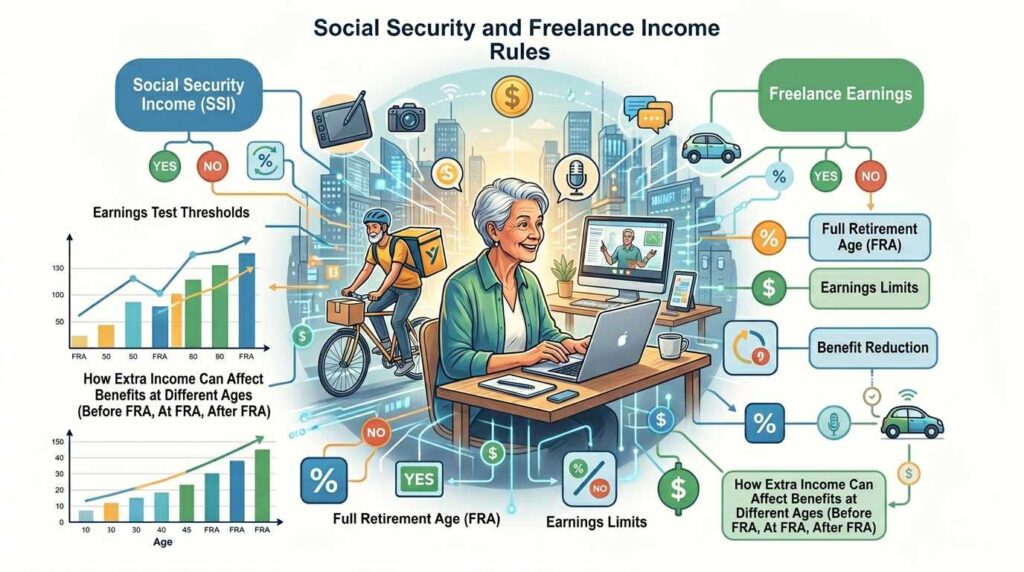
This guide explains exactly how freelance and self-employment income interacts with Social Security benefits in 2026 — in plain English, with no jargon.
Note: This guide provides general educational information. Social Security rules are complex and change annually. Always verify current limits at ssa.gov or consult a financial advisor for advice specific to your situation.
Your Full Retirement Age and Social Security and Freelance Income for Seniors
Everything about Social Security and earned income comes down to one number: your Full Retirement Age (FRA). This is the age at which you are entitled to 100% of your Social Security benefit.
| Birth year | Full retirement age |
|---|---|
| 1943–1954 | 66 |
| 1955 | 66 and 2 months |
| 1956 | 66 and 4 months |
| 1957 | 66 and 6 months |
| 1958 | 66 and 8 months |
| 1959 | 66 and 10 months |
| 1960 and later | 67 |
If You Are At or Above Your Full Retirement Age
Great news: there is no earnings limit once you reach full retirement age.
You can earn $10,000, $50,000, or $200,000 from freelancing, consulting, or any other work — and your Social Security benefit will not be reduced by a single dollar. The SSA does not care how much you earn after FRA.
In fact, continuing to earn income after FRA can actually increase your future Social Security benefits. If your current freelance earnings are higher than some of your earlier working years, the SSA will recalculate your benefit upward.
If you are at or above your FRA, you can pursue remote work, consulting, or any online income opportunity with complete freedom. See our Make Money Online After 50 Guide for the best places to start.
If You Are Below Full Retirement Age and Already Collecting
If you claimed Social Security early and are still below your FRA, an earnings limit applies.
The 2026 earnings limit for those below FRA all year: $22,320
For every $2 you earn above this limit, $1 is withheld from your Social Security benefits.
Example: You are 64, collecting Social Security early, and earn $30,000 from freelance consulting in 2026. That is $7,680 above the $22,320 limit. The SSA will withhold $3,840 from your benefits ($7,680 ÷ 2).
The Year You Reach Full Retirement Age
A higher limit applies in the calendar year you reach your FRA — but only for the months before your birthday.
The 2026 earnings limit for the year you reach FRA: $59,520
In this transition year, $1 is withheld for every $3 earned above $59,520. And only earnings from January through the month before your birthday count toward this limit.
The Good News: Withheld Benefits Are Not Lost Forever
Many seniors panic when they hear that benefits can be withheld. But here is what the SSA does not advertise loudly enough: withheld benefits are credited back to you.
Once you reach your FRA, the SSA recalculates your monthly benefit upward to account for the months benefits were withheld. The adjustment is permanent and continues for the rest of your life. It is not a loss — it is a delay.
What Counts as “Earned Income” for the Earnings Limit?
Not all income counts toward the Social Security earnings limit. Understanding the distinction can save you from unnecessary anxiety about your other income sources.
| Income type | Counts toward earnings limit? |
|---|---|
| Freelance / self-employment income | Yes |
| Part-time or remote job wages | Yes |
| Consulting fees | Yes |
| Pension or retirement account withdrawals | No |
| Investment income (dividends, capital gains) | No |
| Rental income (passive) | No |
| Interest income | No |
This means a senior earning $15,000 from a pension, $10,000 from investments, and $20,000 from freelancing has only $20,000 counting toward the earnings limit — well under the $22,320 threshold.
2026 Limits for Social Security and Freelance Income for Seniors
Yes — and this is a separate issue from the earnings limit. Regardless of your age, your Social Security benefits may become partially taxable when your total income exceeds certain thresholds.
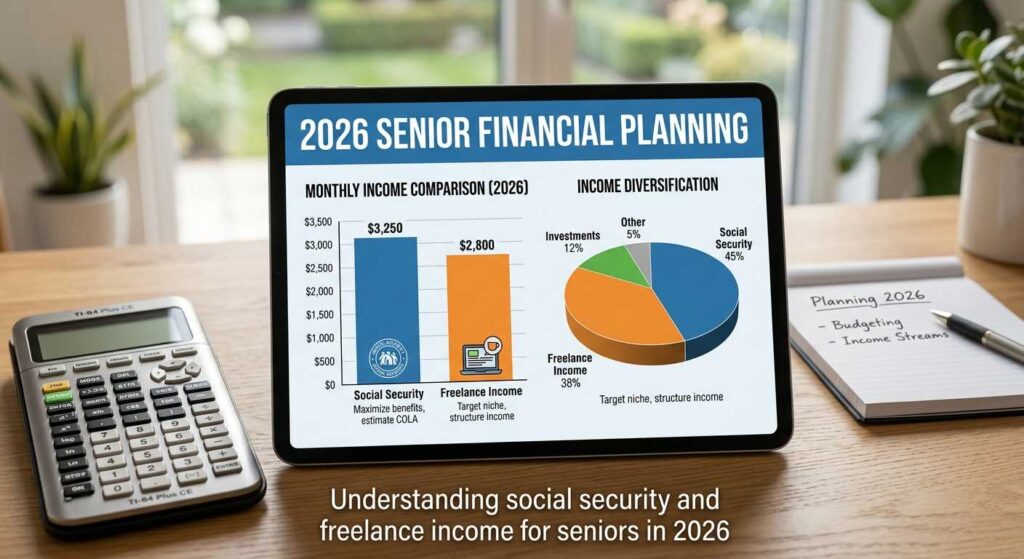
The IRS uses a calculation called “combined income” to determine how much of your Social Security is taxable: your Adjusted Gross Income + Non-taxable interest + 50% of your Social Security benefits.
| Filing status | Combined income | SS benefits taxable |
|---|---|---|
| Single | Under $25,000 | 0% |
| Single | $25,000–$34,000 | Up to 50% |
| Single | Over $34,000 | Up to 85% |
| Married filing jointly | Under $32,000 | 0% |
| Married filing jointly | $32,000–$44,000 | Up to 50% |
| Married filing jointly | Over $44,000 | Up to 85% |
“Up to 85% taxable” does not mean you pay 85% tax. It means up to 85% of your benefits are included in your taxable income — then taxed at your regular rate, which for most seniors is 12–22%.
4 Smart Strategies to Minimize the Impact
When planning your career after retirement, staying informed about social security and freelance income for seniors helps you avoid unexpected benefit reductions.
1. Track Your Earnings Monthly
Keep a running total of your earned income throughout the year. If you are approaching the $22,320 limit, you can pause or slow down work for the rest of the year rather than trigger benefit withholding.
2. Focus on Passive Income Sources
Passive income — investment returns, rental income, digital product royalties from previously created products — does not count toward the earnings limit. Shifting toward passive sources reduces your exposure while maintaining your overall income. See our Passive Income for Seniors Guide for the best options.
3. Maximize Business Deductions
The earnings limit is based on net self-employment income — income after business deductions. Maximizing legitimate deductions reduces your net income and therefore reduces how much counts toward the limit. Read our Tax Tips for Senior Freelancers guide for a complete deduction list.
4. Consider Delaying Benefits
If you have not yet claimed Social Security and are actively earning freelance income, it may make sense to delay claiming until FRA — or until age 70, when benefits reach their maximum (124–132% of your FRA amount). This eliminates the earnings limit concern entirely while you are in your most productive earning years.
How to Report Earnings to Social Security
If you are below FRA and expect to earn more than the annual limit, notify the SSA proactively at ssa.gov or by calling 1-800-772-1213. If the SSA discovers unreported excess earnings later, they will require repayment — sometimes months or years after the fact. Proactive reporting is always better than an unexpected repayment notice.
Frequently Asked Questions
Yes. Once you have reached your full retirement age, there is no earnings limit whatsoever.
Yes. Net self-employment income from any source — Etsy, consulting, freelance writing, digital products — counts toward the earnings limit if you are below FRA.
No. The earnings limit applies only to your own earned income.
No. The SSA increases your monthly benefit at FRA to credit back withheld amounts permanently.
It depends on your health, financial needs, and projected longevity. Delaying increases your monthly benefit by approximately 8% per year between FRA and age 70. A financial advisor can help you model the best timing for your situation.
By following these steps, you can effectively manage your social security and freelance income for seniors without losing your financial peace of mind.
Your Action Plan
- Find your FRA using the table above or confirm at ssa.gov
- If you are at or above FRA — earn freely with zero restrictions
- If you are below FRA — track your net self-employment income monthly against the $22,320 limit
- Maximize deductions to reduce your net self-employment income
- Consider shifting toward passive income sources that do not count toward the limit
- Consult a financial advisor if your situation involves multiple income streams or you are deciding when to claim benefits
The earnings limit is manageable — and for the majority of seniors at or above full retirement age, it simply does not apply. Do not let fear of Social Security rules stop you from building the income and financial security you deserve in retirement.
Ready to start earning? Explore the best opportunities in our Remote Jobs for Seniors Guide, our Consulting Guide for Seniors, or our Best AI Tools for Seniors to find the right path for you.
I worked 14 years at Luckys from 1978 to 1992, Then as a freelance court reporter from 1991 to 1998, and then a full time official court reporter with LA Superior Court from September 1998 to February 2022, and now I’ve started freelancing as a court reporter again from March 2022 and still freelancing. I’ve been hurt in the past too and shattered my right foot. I’ve had spinal surgery, and my right pinky finger is numb. I have a handicap placard. What would I qualify for, I am 64 and will be 65 on May 1, 2027. Thank you for your help and guidance. Have a wonderful week.