
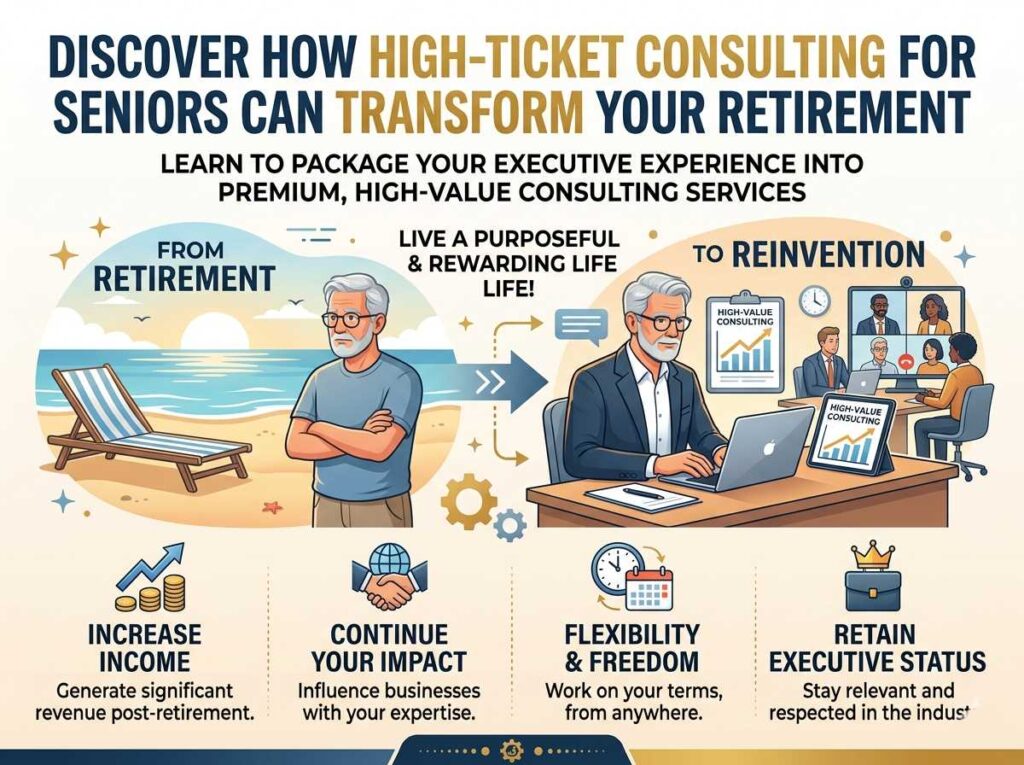
Here is a question worth sitting with: What if the most valuable thing you own is not in your savings account — it is stored in your head?
If you have spent 20, 30, or even 40 years building expertise in any professional field, you are sitting on knowledge that businesses will pay serious money for right now. That is the core idea behind high-ticket consulting for seniors — packaging your lived experience into premium services that solve real, expensive problems for companies and individuals who cannot afford to get it wrong.
This guide walks you through everything, step by step. No jargon, no fluff. Just a practical roadmap for anyone over 55 who wants to earn meaningful income without returning to a 9-to-5 grind.
📋 In This Guide
- What Is High-Ticket Consulting — In Plain English?
- Why Seniors Have a Built-In Advantage
- Finding Your Consulting Niche (Without Overthinking It)
- How to Package Your Offer So Clients Say Yes
- Pricing Your Consulting Package Without Guilt
- Getting Your First Premium Client
- Using AI Tools to Deliver Like a Big Firm
- 5 Mistakes Seniors Make (And How to Avoid Them)
- Frequently Asked Questions
What Is High-Ticket Consulting — In Plain English?

Let’s break this down simply because the term can sound intimidating.
Consulting means someone pays you for your advice, guidance, or expertise to help them solve a specific problem. A high-ticket consulting package means you charge a significant fee — typically starting at $3,000 and often reaching $25,000 or more per engagement — because the problem you are solving is expensive if left unsolved.
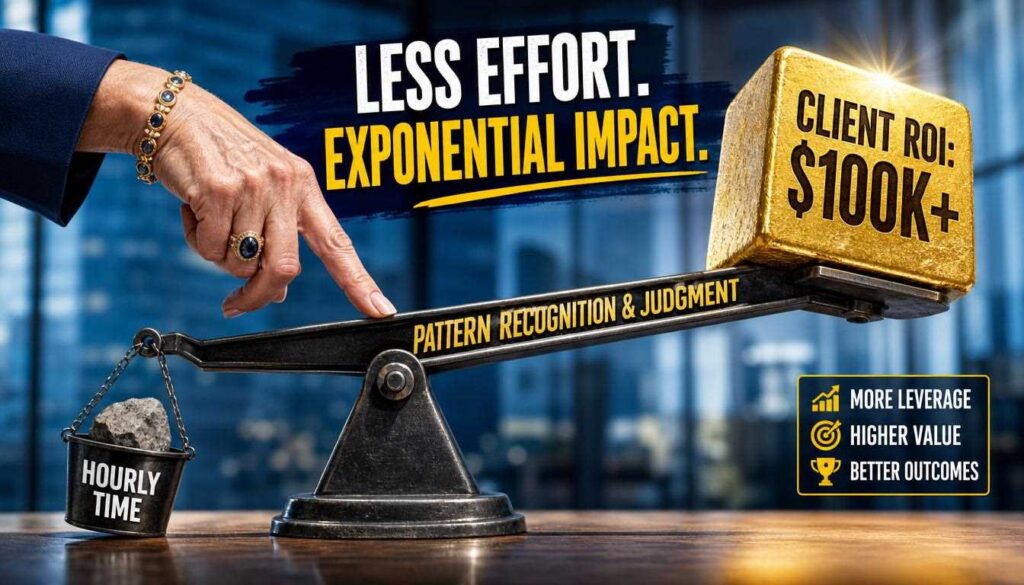
The key difference from hourly freelancing is this: you are not being paid for your time. You are being paid for your judgment, pattern recognition, and the irreplaceable perspective that comes from decades of real-world experience. A company does not pay $10,000 for your 10 hours — they pay it because your recommendation could save or generate $100,000 or more.
This is why high-ticket consulting for seniors is so well suited to people over 55. The more experience you have, the more valuable your judgment becomes.
Why Seniors Have a Built-In Advantage in 2026
You might be wondering: “With all the young consultants out there, why would anyone pay a premium for someone my age?” The honest answer is — because smart clients have learned their lesson the hard way.
Here is what younger consultants cannot fake, no matter how sharp they are:
- Crisis memory. You have lived through recessions, industry disruptions, regulatory changes, and market collapses. You know what the morning after a company crisis feels like — and that institutional memory is worth a fortune to anyone trying to avoid one.
- Network depth. After 30+ years, you likely know people at every level of your industry. One phone call from you can open a door that a 32-year-old consultant cannot even find.
- Pattern recognition. Problems that look new to everyone else often look familiar to you. Recognizing a pattern early and knowing what to do about it is exactly what companies pay premium prices for.
- Credibility without effort. When you walk into a room and your resume shows 30 years in the field, you start every conversation ahead. Younger consultants spend years trying to build the credibility you already have.
If you are curious about the broader landscape of opportunities for experienced professionals, our guide on making the transition from corporate to consulting covers the full picture of how this shift works in practice.
Finding Your Consulting Niche (Without Overthinking It)
The most common trap seniors fall into at this stage is thinking they need to figure out something entirely new. You do not. Your niche already exists — it is the intersection of what you know deeply, what problems you have solved repeatedly, and what someone will pay to have solved.
Ask yourself these three questions and write down the first honest answers that come to mind:
- “What did people always come to me for at work, even when it wasn’t my official job?” This is often your real specialty.
- “What mistakes have I watched companies or colleagues make that I knew were avoidable?” Preventing expensive mistakes is one of the highest-value things a consultant can offer.
- “What problems in my old industry keep me up at night even in retirement?” Passion for a problem makes you a far better — and more credible — consultant.
Below is a snapshot of consulting niches where seniors with specific backgrounds are earning premium fees right now:
| Your Background | High-Ticket Niche | Typical Client | Example Project Fee |
|---|---|---|---|
| HR / People Operations | Employee retention strategy | Mid-size companies 50–500 employees | $8,000–$20,000 |
| Finance / Accounting | Fractional CFO services | Growing startups, family businesses | $4,000–$8,000/month |
| Operations / Logistics | Supply chain optimization | E-commerce, manufacturing firms | $15,000–$50,000 |
| Healthcare Administration | Compliance & regulatory consulting | Clinics, medical practices | $10,000–$30,000 |
| Sales / Business Development | Revenue growth consulting | B2B companies entering new markets | $7,500–$25,000 |
| Education / Training | Corporate learning design | Large companies building internal programs | $5,000–$15,000 |
| IT / Cybersecurity | Security risk assessment | Financial services, healthcare orgs | $12,000–$40,000 |
For a deeper look at how to identify and validate the right niche before you invest time building offers, our article on choosing your consulting niche as a senior walks through a simple three-step validation process.
How to Package Your Offer So Clients Say Yes
Here is one of the most important ideas in this entire guide: Stop selling your time. Start selling a result.
When you charge by the hour, you put an invisible ceiling on your income and you signal to clients that your value is measured in minutes. When you package your service as a defined outcome — a deliverable, a transformation, a system — you are selling something with a clear ROI (return on investment) that clients can justify to their boss, their board, or themselves.
Give your packages a name. “The 90-Day Operations Reset” is more memorable and more credible than “consulting services.” A named package tells a client exactly what they are getting and signals that you have done this before.
Before you pitch any package, make sure you have the paperwork in order. Our guide on consulting contracts for seniors gives you a simple template that protects you and looks professional to clients — even if you have never written a contract before.
Pricing Your Consulting Package Without Guilt
Let’s have an honest conversation about money, because this is where many seniors get stuck.
If your best day at work earned you $400, it can feel deeply uncomfortable charging a client $5,000 for a week of your attention. That discomfort is understandable — and it is also a pricing mistake that will keep you small.
Here is the framework that makes pricing feel logical instead of awkward:
The ROI Anchoring Method
Before you name a price, identify the financial value of solving the client’s problem. Ask yourself:
- How much does this problem cost the client each month it goes unsolved? (Lost revenue, wasted labor, compliance fines, customer churn?)
- How much money does a solved version of this problem generate or save annually?
A reasonable consulting fee is typically 10–20% of the annual value your work delivers. If your operational audit will save a client $200,000 per year in wasted costs, a $20,000–$40,000 project fee is not just reasonable — it is a bargain for them.
| Package Type | Typical Price Range | What You’re Delivering | Best For |
|---|---|---|---|
| Diagnostic Audit | $3,500 – $12,000 | Assessment + written action plan | New clients, first engagement |
| Monthly Retainer | $2,500 – $7,000/mo | Ongoing strategic access (4–8 hrs) | Long-term advisory relationships |
| Transformation Project | $15,000 – $75,000+ | Full project delivery with defined outcome | Mid-size companies with complex needs |
| Group Workshop / Training | $5,000 – $15,000/day | Facilitated session for leadership teams | Companies building internal skills |
For a complete breakdown of how to set your rates based on your specific background and local market, see our dedicated guide on pricing consulting services as a senior — it includes a step-by-step worksheet you can complete in about 20 minutes.
Getting Your First Premium Client
The question every senior asks at this point is: “This all makes sense, but where do I actually find clients who will pay these fees?” The answer, for most people over 55, is simpler than you think — because you already know them.
Start With Your Warm Network
Your warm network includes former colleagues, managers who respected your work, vendors you built relationships with, competitors who knew your reputation, and industry contacts you met at conferences over the years. These people already trust you. You do not need to “sell” to them — you need to have a conversation.
- Write down 20 names of people who have seen your work up close. Former direct reports, peers, vendors, clients, industry contacts. Do not filter — just list.
- Send a personal message — not a mass email — to each one. Something like: “I’ve been thinking about offering advisory work to a handful of companies. Would you be open to a 20-minute call to catch up? I’d love to hear what challenges your company is navigating right now.”
- Listen more than you talk on that call. Ask what keeps them up at night. When their problem sounds like something you have solved before, share one specific story of how you handled it. Do not pitch — just be helpful.
- Follow up with a short written summary of what you discussed and one or two ideas they could implement right away. This positions you as someone who delivers value before they have paid you a dollar — which is the highest-trust thing you can do.
- When the timing is right, mention that you have structured a consulting engagement for exactly this kind of challenge and ask if they would like to hear about how it works. By this point, they are rarely surprised — because you have already demonstrated that you know what you are doing.
LinkedIn is the most powerful platform for reaching premium consulting clients, and most seniors significantly underuse it. Our guide on getting consulting clients on LinkedIn as a senior shows you the exact profile setup and outreach approach that works without feeling pushy or awkward.
Using AI Tools to Deliver Like a Big Firm — Without the Overhead
One of the biggest concerns seniors have when moving into independent consulting is this: “How do I look credible and professional when I’m working by myself from home?”
This is where modern AI tools have changed the game entirely. You do not need a team of analysts, a research department, or a graphic design team. With the right AI tools, a solo consultant over 55 can produce the same quality of deliverables as a major consulting firm — in a fraction of the time.
Here is how senior consultants are using AI to punch above their weight:
- Research synthesis: Before a client call, ask an AI tool to summarize the last three years of news, trends, and challenges in your client’s specific industry. You walk in knowing more than most people who work there full-time.
- Proposal writing: Describe your client’s problem to an AI tool and ask it to draft a consulting proposal structure. You edit it to sound like you — which takes 20 minutes instead of 3 hours.
- Report creation: After your engagement, turn your recorded notes and observations into a formatted, professionally structured report with clear sections, executive summaries, and action items.
- Email communication: Draft clear, confident follow-up emails that reinforce your positioning as a senior advisor without sounding stiff or overly formal.
If you are completely new to AI tools, our beginner-friendly guide on AI tools for senior consultants walks through each tool with zero assumed technical knowledge. And if you want to see how AI fits into a broader digital income strategy, making money with AI as a senior is worth reading alongside this guide.
5 Mistakes Seniors Make When Starting High-Ticket Consulting
These are the patterns that show up again and again. Knowing them in advance can save you months of frustration.
Mistake 1: Waiting Until Everything Is “Ready”
Many seniors spend six months building a website, writing a brochure, and designing a logo before ever having a conversation with a potential client. Your first clients will not care about any of that. They care about whether you understand their problem and whether they trust you to help solve it. Have the conversations first. Build the supporting materials after you have seen what actually works.
Mistake 2: Underpricing to “Test the Waters”
Setting a low price to see if anyone bites is a strategy that backfires. Premium clients associate low prices with low expertise — it is a signal, not a bargain. If you charge $500 for something, the client subconsciously wonders why it is so cheap. Start at a price that reflects the real value of the problem you solve, and trust that the right clients will see it clearly.
Mistake 3: Targeting the Wrong Level of Decision-Maker
If you are pitching to someone who does not have the authority to approve a $10,000 purchase, you are in the wrong room. High-ticket consulting decisions are made by owners, CEOs, COOs, and VPs — not department coordinators or administrative staff. Make sure your outreach and conversations are aimed at people who can actually say yes.
Mistake 4: Over-Delivering Without Clear Scope
One of the traps that comes from a lifetime of being a great employee is the habit of saying yes to every request. In consulting, undefined scope is where profitable projects turn into unprofitable ones. Before you start any engagement, define exactly what is and is not included. This protects you, and it also signals professionalism to the client.
Mistake 5: Doing It Alone Without Any Visibility
High-ticket consulting is not just about what you know — it is also about who knows that you know it. Sharing short, insightful posts on LinkedIn about problems in your industry, writing a brief article, or even recording a simple audio message about a trend you are noticing builds what is called “thought leadership.” It makes clients come to you rather than the other way around. Our guide on building and monetizing your personal brand shows you exactly how to do this without it feeling like self-promotion.
Once you land your first client and deliver strong results, the next challenge is building a system so that your reputation and testimonials do the selling for you. See our article on collecting testimonials as a senior consultant for a simple, non-awkward way to ask for social proof that actually converts new leads.
Your Digital Presence: The One Page You Actually Need
You do not need a 10-page website, a podcast, or a YouTube channel to attract high-ticket clients. What you do need is one clear, professional page that answers four questions a prospect will ask the moment they Google your name:
- Who is this person and what do they specialize in?
- What specific results have they helped others achieve?
- What is the offer and how does it work?
- How do I reach them to explore working together?
That page can live on a simple personal website, a well-optimized LinkedIn profile, or both. For seniors who want a professional web presence without the technical headache, our step-by-step guide on building a consulting website as a senior walks through the simplest path from zero to live — no coding required.
What About Taxes? A Quick Note on Income and Social Security
This is not a tax guide, but it would be irresponsible not to mention it. If you are collecting Social Security and also earning consulting income, there are rules you need to be aware of — specifically around how much you can earn before your benefits are affected, depending on your age and status.
Our guide on earning income while on Social Security covers the key rules in plain language, and our article on tax tips for senior freelancers in 2026 explains how to handle self-employment taxes as a new consultant — including deductions most people miss that significantly reduce what you owe.
Frequently Asked Questions About High-Ticket Consulting for Seniors
Almost certainly, yes — and the concern you are having is actually a sign that you are thinking about this the right way. Industries move, but the fundamentals of how people make decisions, how teams function, how crises unfold, and how businesses grow and contract do not change nearly as fast as headlines suggest. Spend a week reviewing recent news and trade publications in your field. You will likely find that the core problems have not changed — they just have new names. Your deep understanding of the root causes is precisely what younger consultants lack.
In most cases, no — not to begin having conversations and landing your first client. Depending on your industry (law, financial advice, healthcare), there may be licensing requirements for specific types of advice. But general management consulting, operations advisory, leadership coaching, and most other types of senior expertise do not require certification. You do want to set up a simple business structure (a sole proprietorship or LLC) before you receive payment, and that is usually a straightforward process. Consult a local accountant or attorney for advice specific to your state.
Price negotiation is normal, and a small adjustment is often reasonable. But there is a difference between a client who asks for a modest reduction and one who is trying to cut your price by 50%. When someone dramatically undervalues your fee, it is often a signal about how they will value your time and advice throughout the engagement. You can hold your price by explaining the value clearly: “I understand this is a significant investment. Based on the savings we discussed, I expect this project to return at least 5x the fee in the first year. Would it help to start with a smaller diagnostic engagement so you can experience the value firsthand?” That often resolves the objection more effectively than discounting.
Yes — and many senior consultants prefer it this way. Video calls via Zoom, Google Meet, or Microsoft Teams have become completely standard for consulting relationships, even at the highest fee levels. Senior consultants routinely manage retainer clients they have never met in person. What matters is the quality of communication, the clarity of your deliverables, and the results you produce — none of which require a physical meeting room.
That is a completely sensible approach. Some seniors start with shorter, lower-risk micro-consulting calls or project-based work to rebuild confidence and get their first testimonials. Our guide on micro-consulting for seniors walks through exactly that path — how to start with smaller engagements and systematically move toward premium packages as your confidence and client base grows.
Ready to Get Started? Here Is Your First Step
High-ticket consulting for seniors is not a fantasy or a shortcut. It is a real business model that thousands of people over 55 across the United States are using right now to earn significant income, contribute their expertise, and stay professionally engaged on their own terms.
The path is simpler than it looks from the outside. You do not need to rebuild your entire professional identity. You need to identify the specific problem you solve, give it a clear package and price, and have honest conversations with people who already know and trust your judgment.
You have already done the hard work — 30 years of it. Now it is time to decide what it was worth.
If you are ready to take the next concrete step, start by reading our guide on landing your first consulting client as a senior — it maps out the first 30 days in a practical, day-by-day format that removes all the guesswork.
Discover How to Land Your First Client →
This article is for informational purposes only and does not constitute financial, legal, or tax advice. Consulting income may affect Social Security benefits depending on your age and circumstances. Consult a licensed professional for advice specific to your situation.
Last reviewed and updated: May 14, 2026 by the SeniorGig Team.