Americans over 60 lose more than $3.4 billion to fraud every year — and the FBI estimates only 1 in 44 cases is ever reported. This guide covers the 10 most dangerous scams targeting seniors in 2026, the exact warning signs for each, and what to do if you or someone you love has been targeted.
When it comes to senior scams how to protect yourself 2026 should be your top priority. Before we get into the scams, let’s address the most damaging misconception: that scam victims are simply gullible. They’re not. The people running these operations are sophisticated criminals who have spent years perfecting psychological techniques designed to bypass rational thinking — techniques that work on intelligent, educated, financially experienced people. The FBI’s own data shows that higher levels of education and financial literacy do not protect against fraud. What protects you is knowing specifically what these scams look like before you encounter them.
Share this guide with your family. The people who most need it are often the least likely to seek it out on their own.
📋 Contents
Why Seniors Are Specifically Targeted
Understanding why you’re a target is the first step in mastering senior scams how to protect yourself 2026 strategies. Criminals target seniors for specific, calculated reasons:
| Reason | What Criminals Exploit |
|---|---|
| Accumulated assets | Retirement savings, home equity, and inheritance make seniors the wealthiest demographic per capita |
| Social isolation | Seniors who live alone are more responsive to friendly contact — even from strangers |
| Trusting nature | Grew up in higher-trust era; less inherently suspicious of institutional-sounding contacts |
| Cognitive changes | Even mild cognitive decline increases vulnerability to high-pressure tactics and complex deception |
| Medicare/SS data | Benefit enrollment creates government contact patterns that scammers convincingly mimic |
| Underreporting | Shame and fear of losing independence prevent many victims from reporting — reducing risk for criminals |
The 10 Most Dangerous Scams Targeting Seniors in 2026
🚨 Scam #1: The Grandparent Scam
Average loss: $9,000 | FBI reports 2,000+ cases per month
How it works: You receive a frantic call from someone claiming to be your grandchild (or a lawyer/bail bondsman calling on their behalf). They’re in trouble — arrested, in an accident, in the hospital abroad. They need money immediately. They beg you not to tell their parents. The “official” on the line confirms the story and explains how to wire money or send gift cards.
Real case: A 74-year-old retired teacher in Ohio received a call from someone who sounded exactly like her grandson — his voice distorted by what she was told was a broken nose from the car accident. She sent $11,000 in gift cards before her real grandson called to check in that evening.
🛡️ How to protect yourself:
- Hang up and call your grandchild directly on a number you already have
- Establish a family “code word” for genuine emergencies
- No legitimate emergency ever requires gift cards as payment — ever
- Never send money to someone who tells you to keep it secret from family
🚨 Scam #2: Medicare and Social Security Imposters
#1 most reported scam to the FTC | Average loss: $5,800
How it works: You receive a call, email, or text from someone claiming to be from Medicare, Social Security, or the IRS. They claim your Medicare card has been compromised, your Social Security number has been used in a crime, or you owe back taxes. They need your Medicare number, Social Security number, or bank information to “verify” your identity or “protect your benefits.” Some threaten arrest if you don’t cooperate immediately.
🛡️ How to protect yourself:
- Social Security and Medicare will never call you first — they communicate by mail
- The IRS never demands immediate payment by phone or threatens immediate arrest
- Hang up on any caller claiming to be a government agency asking for personal information
- If concerned, call the official number: SSA: 1-800-772-1213 | Medicare: 1-800-633-4227
- Never give your Medicare or Social Security number to an unsolicited caller
🚨 Scam #3: Tech Support Scams
Average loss: $24,048 (highest per-incident loss of any senior scam)
How it works: A pop-up appears on your computer warning that your device is infected. It shows an alarming error message with a Microsoft or Apple logo and a phone number to call immediately. When you call, the “technician” asks for remote access to your computer to “fix the problem.” They may find “evidence” of hacking and convince you to pay for repairs — or worse, once they have remote access, they quietly steal financial account information, passwords, and funds directly.
🛡️ How to protect yourself:
- Microsoft and Apple never send unsolicited pop-ups with phone numbers to call
- Close the pop-up by pressing Ctrl+Alt+Delete (PC) or Force Quit (Mac) — don’t call the number
- Never allow remote access to your computer to someone who contacted you first
- If you already gave access: disconnect from the internet immediately and contact your bank
🚨 Scam #4: Romance Scams
Average loss: $50,000 | Often months or years in development
How it works: You connect with someone on a dating site, social media, or even email who is attractive, articulate, and intensely interested in you. The relationship develops over weeks or months — calls, messages, gifts. Then a crisis: they need money to get home, for a medical emergency, to access a blocked business deal. They promise to repay everything when they arrive. They never arrive. The “person” is often a team of criminals operating overseas, often using AI-generated photos and voices.
Why it’s so devastating: Beyond the financial loss, victims experience profound grief — they’ve lost what felt like a real relationship. Many don’t report because they’re ashamed, or because part of them still doesn’t want to believe it wasn’t real.
🛡️ How to protect yourself:
- Reverse image search their profile photo (right-click → “Search image” in Google)
- Never send money to someone you haven’t met in person — no matter how long you’ve “known” them online
- If they consistently avoid video calls or in-person meeting, that’s a red flag
- Tell a trusted friend or family member about any online relationship before money is ever discussed
- Report to the FBI’s IC3 at ic3.gov
🚨 Scam #5: The “Bank Investigator” Scam
Fastest-growing senior scam in 2025–2026 | Average loss: $35,000
How it works: You receive a call from someone claiming to be a fraud investigator at your bank. They say they’ve detected suspicious activity on your account and need your help catching the fraudulent employee or criminal. They ask you to withdraw cash, buy gold, or transfer funds to a “safe account” to protect your money during the investigation. They may stay on the line with you for hours to prevent you from calling anyone who might stop the transaction. This scam is devastatingly effective because it triggers the desire to protect your money rather than suspicion.
🛡️ How to protect yourself:
- Real banks never ask you to withdraw cash or transfer funds to “protect” them
- Hang up and call your bank directly using the number on the back of your card
- Tell a family member before taking any financial action urged by an unsolicited caller
- Banks will never ask you to keep an investigation secret from family
To effectively navigate modern senior scams how to protect yourself 2026 requires knowing the exact tactics cybercriminals use today.
Additional High-Risk Scams in 2026
| Scam | How It Works | Key Warning Sign | Avg. Loss |
|---|---|---|---|
| #6: Investment/Crypto Fraud | “Pig butchering” — builds trust over time, then introduces a fake investment platform with guaranteed high returns | Guaranteed returns; urgency to invest more; can’t withdraw funds | $70,000+ |
| #7: Home Repair Scams | Door-to-door contractors offer suspiciously cheap repairs, demand upfront payment, do shoddy work or disappear | Unsolicited approach; demands cash only; “today only” pricing | $3,000–$15,000 |
| #8: Lottery/Sweepstakes Scams | “You’ve won!” but must pay taxes/fees upfront to claim prize. No legitimate lottery requires fees to claim winnings. | Must pay to receive winnings; prize you never entered | $800–$5,000 |
| #9: Charity Scams | Fake charities, especially after natural disasters, use emotional appeals and names similar to legitimate organizations | Pressure for immediate cash/gift card donations; no paper trail | $400–$2,000 |
| #10: Medicare Advantage Mis-selling | Aggressive agents misrepresent coverage, enroll seniors in plans without explaining network restrictions or costs | Unsolicited contact; “free” plans that sound too comprehensive; rushed enrollment | Ongoing healthcare costs |
The Universal Red Flags — Memorize These
Across all scam types, these warning signs appear consistently. In the world of senior scams how to protect yourself 2026 checklists, remembering these red flags will save your savings:
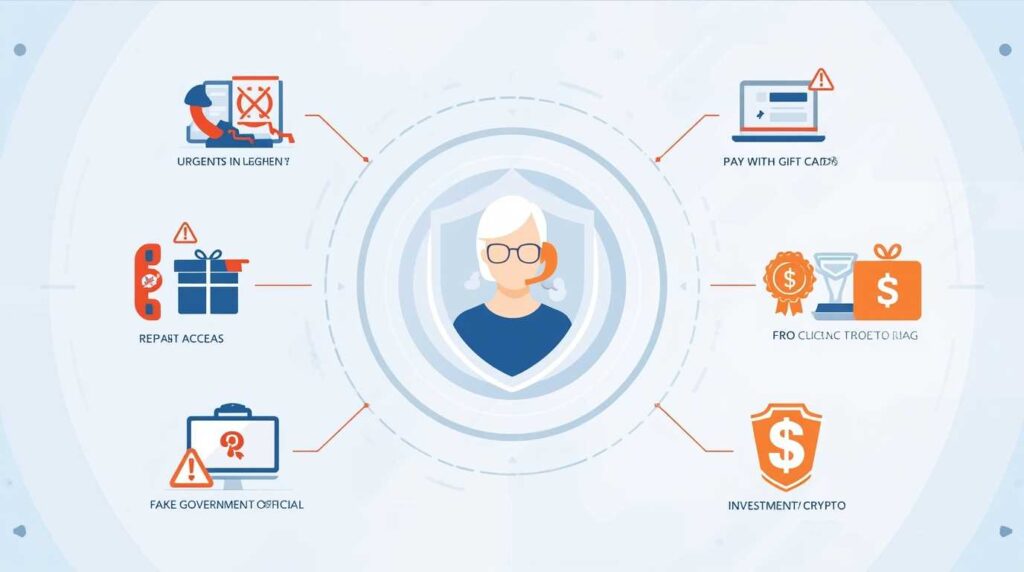
🚩 If ANY of these are present, STOP and verify independently:
- 🚩 Urgency — “You must act NOW”
- 🚩 Secrecy — “Don’t tell anyone”
- 🚩 Gift cards as payment method
- 🚩 Wire transfer to an unknown account
- 🚩 Cryptocurrency payment requested
- 🚩 Request for remote computer access
- 🚩 Government agency calls you first
- 🚩 Threat of arrest or legal action
- 🚩 Prize you never entered
- 🚩 “Too good to be true” investment returns
- 🚩 Can’t hang up to verify independently
- 🚩 Emotional appeal bypassing rational thought
The single most important rule: Legitimate organizations give you time to verify. Anyone demanding immediate action without allowing you to hang up and call back is running a scam.
As you can see, all modern frauds share similar traits. In this video, see exactly how scammers leverage hope, fear, and high-pressure tactics to bypass your defenses:
If You Think You’ve Been Targeted: Exactly What to Do
If you’ve already sent money, shared financial information, or given remote computer access, act immediately. Every hour matters.
⚡ Immediate Action Steps (Do These Today)
- If you gave bank/financial account information:
Call your bank immediately — ask to freeze the account and issue new account numbers. Time is critical for wire transfers (which can sometimes be recalled if reported within hours).
- If you gave remote computer access:
Disconnect from the internet immediately (unplug the ethernet cable or turn off WiFi). Have the computer professionally wiped and restored. Change ALL passwords from a different device before reconnecting the original computer.
- If you sent gift cards:
Call the gift card company immediately — the number is on the back of the card. Report it as fraud. Recovery is possible but not guaranteed; the faster you call, the better the chance.
- If you sent a wire transfer:
Call your bank and ask them to contact the receiving bank to recall the transfer. This works if reported quickly. If international, the FBI’s IC3 (ic3.gov) may be able to assist.
- Tell a trusted family member:
I know this is hard. But they can help you navigate next steps, and the shame of telling someone you trust is far preferable to the ongoing vulnerability of handling this alone.
- Report the fraud
— see the section below. Your report helps protect others.
The Family Protection Plan

The most effective fraud protection for seniors involves the whole family — not surveillance, but open communication and agreed-upon protocols. Have this conversation with your family now:
Establish a Family Code Word
Choose a code word that family members use to confirm their identity in emergency situations. If someone calls claiming to be your grandchild in trouble and can’t provide the code word — it’s not them. Keep this word private and don’t share it with anyone outside the immediate family.
The $1,000 Rule
Agree as a family that any financial transaction over $1,000 that is initiated by an unsolicited contact (call, email, text from someone you didn’t contact first) requires a 24-hour waiting period and a conversation with a family member before proceeding. No legitimate offer disappears in 24 hours. Any offer that does was a scam.
Trusted Contact at Your Financial Institution
Most banks and investment firms now allow you to designate a “trusted contact” — a family member or trusted friend who can be notified if the institution sees unusual financial activity. They cannot access your accounts, but they can be contacted to help verify unusual transactions. Set this up now at every financial institution you use.
Where to Report Fraud
Please report fraud even if you didn’t lose money. Your report may prevent someone else from becoming a victim — and in some cases, may help you recover losses.
| Agency | What They Handle | Contact |
|---|---|---|
| FTC (Federal Trade Commission) | Most consumer fraud, including phone scams, identity theft, online fraud | reportfraud.ftc.gov |
| FBI Internet Crime Complaint Center (IC3) | Internet fraud, romance scams, investment fraud, tech support scams | ic3.gov |
| CFPB (Consumer Financial Protection Bureau) | Financial product fraud, bank account issues | consumerfinance.gov/complaint |
| Your State Attorney General | State-specific fraud, contractor scams, local scams | Search “[your state] attorney general report fraud” |
| AARP Fraud Watch Network | Senior-specific fraud reporting, free helpline | aarp.org/money/scams-fraud | 1-877-908-3360 |
| Social Security Administration OIG | Social Security imposter scams | oig.ssa.gov/report |
Frequently Asked Questions – Senior Scams How To Protect Yourself 2026
Recovery depends entirely on the method of payment and how quickly you act. Credit card payments have the most protection — dispute the charge immediately and the card company will often reverse it. Wire transfers can sometimes be recalled if reported within hours. Gift cards are generally unrecoverable once redeemed. Cryptocurrency is almost never recoverable. The faster you report to your bank and the relevant authorities, the higher the chance of any recovery. Don’t wait out of shame — every hour matters.
Data breaches from companies you’ve done business with are the most common source — your name, email, phone number, and sometimes partial financial data are sold on criminal marketplaces. Public records (voter registration, property records, obituaries) provide additional detail. Social media profiles reveal family relationships, locations, and life events that scammers use to personalize their approach. You can check if your email has been in known data breaches at haveibeenpwned.com — a legitimate and free service.
Yes — AI tools like Claude or ChatGPT can be genuinely helpful for evaluating suspicious contacts. If you receive an email or message that feels off, you can paste it (removing any personal information) into an AI tool and ask “Does this appear to be a scam?” The AI can often identify phishing language, suspicious patterns, and common scam structures that you might miss. Just be careful not to paste in any personal information, account numbers, or sensitive details when doing this.
Frame it as sharing information you learned, not as questioning their judgment. “Mom, I read something really alarming about a new scam that’s targeting people in our area — can I show you what to watch out for?” is very different from “I’m worried you might fall for a scam.” Share this article. Discuss the real cases. Make it about the criminal’s sophistication, not the potential victim’s vulnerability. And share your own family code word — making it mutual rather than one-directional removes any implication that only one person needs protection.
A security freeze (also called a credit freeze) prevents anyone from opening new credit accounts in your name — even you. It’s free to place and free to lift. You must freeze your credit at all three bureaus separately: Equifax, Experian, and TransUnion. You can temporarily lift the freeze when you legitimately need to apply for credit. For seniors who are not actively applying for new credit, a permanent freeze is one of the most effective identity theft protections available.
Knowledge Is the Best Protection
Every senior who reads this guide is harder to scam. Not impossible — these operations are sophisticated. But significantly harder. The scammers are counting on the element of surprise, on triggering fear or excitement before your rational mind can engage. Knowing the scripts in advance is the most effective counter to that strategy.
Share this guide with someone you care about. Forward it to your parent, your sibling, your friend who lives alone. The conversation about scams — the code word, the $1,000 rule, the universal red flags — is one of the most valuable conversations you can have with someone you love.
And if you or someone you know has been victimized: please report it, please get support, and please know that the shame belongs entirely to the criminals who ran the operation — not to the person they targeted.
Protect your retirement from every angle: