
Frank retired at 62 after spending 31 years managing the finances of a mid-size construction company in Phoenix. He wasn’t a CPA, and he didn’t have an accounting degree. What he had was a mind for numbers and a desire for a flexible second career. Today, Frank is a prime example of how bookkeeping from home for seniors can turn decades of experience into a thriving, part-time business.
When a former colleague mentioned that small business owners were desperately looking for part-time bookkeepers who actually understood how businesses work—not just how to enter data—Frank was skeptical. “I thought bookkeeping was something you hired a young person to do,” he told me. “I didn’t realize how many small businesses were struggling to find someone reliable who showed up every month and didn’t make them feel stupid for asking questions.”
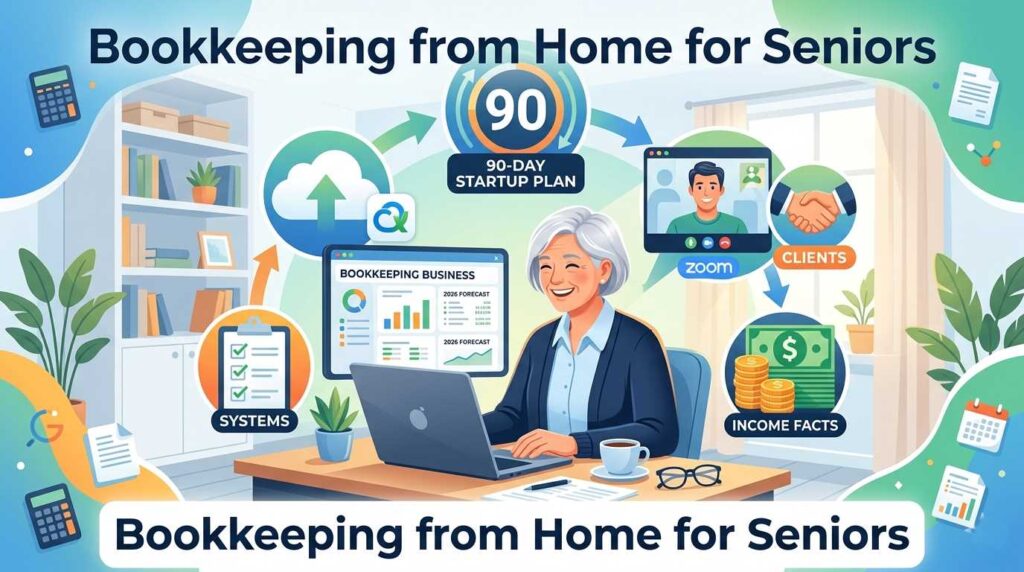
Frank now manages the books for seven small businesses from a home office in Scottsdale. His schedule involves working 22 hours per week at a rate of $55 per hour. Currently, the demand is so high that he even has a waitlist.
This guide is for seniors like Frank — people with financial experience, organizational skills, or simply a mind that’s comfortable with numbers — who want to turn those skills into a real, sustainable income stream from home.
Why Bookkeeping from Home Is One of the Best Remote Income Options for Seniors in 2026
Bookkeeping sits in an interesting position in the remote work landscape. It’s not glamorous. It doesn’t trend on LinkedIn. Nobody’s writing breathless articles about how bookkeeping is “the future of work.”
And yet the demand for qualified remote bookkeepers has never been stronger — and it keeps growing.
Here’s why bookkeeping from home works particularly well for seniors:
Small Businesses Are Desperate for Reliable Bookkeepers
There are approximately 33 million small businesses in the United States according to the Small Business Administration. The vast majority of them — particularly those with fewer than 20 employees — cannot justify a full-time bookkeeper. What they need is someone reliable, experienced, and trustworthy who handles their books part-time each month.
That description fits a retired senior professional almost perfectly. You’re not going to suddenly quit for a better offer. You’re not going to miss a month because you got distracted by another opportunity. You understand how businesses work because you’ve worked in one for decades. These qualities are genuinely rare in the freelance bookkeeping market — and small business owners will pay a premium for them.
Bookkeeping Income Is Predictable and Recurring
Unlike project-based freelance work where income fluctuates month to month, bookkeeping clients pay on a consistent monthly retainer. Once you have five clients each paying $400–$800 per month, you have $2,000–$4,000 in reliable, recurring income arriving every single month — regardless of whether you hustled particularly hard that month or took a week off for a family visit.
This predictability is especially valuable for seniors managing retirement budgets. For how this income fits alongside Social Security and retirement accounts, see our guide on Earning Income While on Social Security.
The Technology Has Made Remote Bookkeeping Genuinely Simple
The most common objection seniors have to bookkeeping from home is technological: “I’m not sure I can learn the software.” This concern was more valid ten years ago. Today’s bookkeeping platforms — QuickBooks Online, Xero, Wave — are designed for non-accountants and are significantly more intuitive than the software you likely used in your career. Most seniors who approach the learning process with patience and consistency report feeling genuinely comfortable within four to eight weeks.
What Bookkeeping from Home Actually Involves — Day to Day
Before going further, it’s important to be clear about what bookkeeping is — and what it isn’t — because the distinction matters for understanding what you’re getting into.
Bookkeeping is: Recording financial transactions, reconciling bank and credit card accounts, categorizing income and expenses, generating financial reports (profit and loss statements, balance sheets), managing accounts payable and receivable, and preparing records for tax filing.
Bookkeeping is not: Preparing tax returns (that’s a tax preparer or CPA), providing financial advice (that’s a financial advisor), or conducting audits (that’s a CPA firm). Understanding this distinction matters both for what you offer clients and for what certifications you need — or don’t need.
A typical month for a remote bookkeeper with five small business clients might look like this:
- Week 1: Download and reconcile bank and credit card transactions for two clients. Review any unusual items with the client by email. Generate monthly reports.
- Week 2: Same process for remaining three clients. Handle any accounts payable or receivable questions. Respond to client questions about their numbers.
- Week 3–4: Lighter week — catch-up items, answering client questions, preparing quarterly reports if applicable, client communication.
Most bookkeepers with five to eight small business clients work between 15 and 25 hours per month per client — meaning a full bookkeeping practice of five clients often requires 20 to 30 hours of work per month total, not per client.
Do Seniors Need a Certification to Work as a Remote Bookkeeper?
This is the question that stops many seniors before they even get started. The short answer is no — bookkeeping from home for seniors is not a licensed profession in the United States. There is no legal requirement to hold a certification to offer these bookkeeping services.
The longer answer is that certification helps — particularly when you’re starting out and don’t yet have a client portfolio to demonstrate your competence.
The Two Certifications Worth Considering for Senior Bookkeepers
QuickBooks ProAdvisor Certification: This free certification from Intuit — the company behind QuickBooks — demonstrates proficiency with the software used by the majority of small businesses in the U.S. The exam covers core bookkeeping concepts and QuickBooks Online functionality. Most seniors with financial backgrounds pass after 10–20 hours of study. Becoming a certified ProAdvisor also lists you in QuickBooks’ online directory, where small businesses actively search for bookkeepers. Start at quickbooks.intuit.com/accountants/proadvisor.
NACPB Certified Bookkeeper (CB): The National Association of Certified Public Bookkeepers offers a Certified Bookkeeper credential that carries genuine market credibility. The exam costs $100 for members and covers accounting principles, payroll, and financial reporting. For seniors targeting higher-paying clients or wanting to charge premium rates, this credential provides meaningful differentiation. Learn more at nacpb.org.
For seniors with existing financial backgrounds — accounting, banking, finance, office management — neither certification may be strictly necessary to attract first clients. Your professional history speaks for itself. But for seniors without direct financial experience, the QuickBooks ProAdvisor certification is the fastest and most cost-effective way to establish baseline credibility.
The Software Senior Bookkeepers Need to Know
Remote bookkeeping runs entirely through cloud-based software. You don’t need to install anything, store files locally, or worry about backups — everything lives in the cloud and is accessible from any computer with internet access.
QuickBooks Online — The Industry Standard
Approximately 80% of small businesses that use accounting software use QuickBooks. Learning QuickBooks Online thoroughly is the single most valuable technical investment a senior bookkeeper can make. Intuit offers free training through its ProAdvisor program. YouTube has thousands of tutorials. Most senior bookkeepers report that QuickBooks Online’s current interface is significantly more intuitive than earlier desktop versions they may have encountered in their careers.
Xero — The Growing Alternative
Xero is increasingly popular with small businesses, particularly those in e-commerce and professional services. Its interface is clean and modern — many users find it more visually intuitive than QuickBooks. Knowing both QuickBooks and Xero effectively doubles your potential client pool.
Wave — For Very Small Clients
Wave is a free accounting platform popular with freelancers, sole proprietors, and very small businesses. It’s simpler than QuickBooks or Xero and requires less bookkeeping sophistication to manage. Some senior bookkeepers use Wave as an entry point — working with very small clients to build experience before moving to more complex QuickBooks-based businesses.
Supporting Tools Worth Learning
Beyond accounting software, remote bookkeepers benefit from familiarity with: receipt scanning apps like Dext or AutoEntry, payroll platforms like Gusto or ADP Run, and time-tracking tools if you bill hourly. None of these are required from day one — add them as your practice grows and clients request them.
How Much Senior Remote Bookkeepers Actually Earn in 2026
Bookkeeping income varies based on your pricing model, the complexity of your clients’ businesses, and how many clients you manage. Here’s an honest breakdown:
Hourly Rate vs. Monthly Retainer — Which Is Better?
New bookkeepers often start with hourly pricing because it feels safer — you’re paid for exactly the time you work. Experienced bookkeepers almost universally move to monthly retainers because retainers provide predictable income, encourage efficiency, and are easier for clients to budget for.
Typical hourly rates for remote bookkeepers in 2026: $25–$75/hour depending on experience, certification, and client complexity. The national average sits around $40–$45/hour for certified independent bookkeepers.
Typical monthly retainer rates: $200–$800/month per client for small businesses with straightforward bookkeeping needs. More complex businesses — those with inventory, multiple revenue streams, or payroll — command $800–$1,500/month or more.
What a Real Bookkeeping Practice Earns
| Number of Clients | Average Retainer | Monthly Revenue | Hours/Month |
|---|---|---|---|
| 3 clients | $400/month | $1,200/month | ~15 hours |
| 5 clients | $500/month | $2,500/month | ~25 hours |
| 8 clients | $550/month | $4,400/month | ~35 hours |
| 10 clients | $600/month | $6,000/month | ~45 hours |
Most senior bookkeepers targeting part-time income aim for four to six clients — enough to generate $1,500–$3,000/month without consuming more than 20 hours per week. For how to price your services across all freelance and consulting work, see our guide on Freelance Rates for Seniors: Pricing Guide.
How Senior Bookkeepers Find Their First Clients
This is where many seniors get stuck — the work itself feels manageable, but finding clients feels uncertain. The good news is that the market for reliable bookkeepers is genuinely strong, and seniors have specific advantages in the client acquisition process that younger bookkeepers don’t.
Start With Your Professional Network — Every Time
Before creating profiles on any platform or sending any cold outreach, start with the people who already know you. Former colleagues who now run their own businesses. Former employers who might need part-time financial support. Members of professional associations you belong to. Friends who own small businesses and have complained about their bookkeeping situation.
A simple LinkedIn post announcing that you’re offering bookkeeping services to small businesses — written with specificity about your background and what you offer — often generates the first two or three clients without any additional effort. See our guide on LinkedIn Profile Secrets for how to write that post effectively.
The QuickBooks ProAdvisor Directory
Once certified, your listing in QuickBooks’ Find-a-ProAdvisor directory puts you in front of small business owners who are actively searching for bookkeeping help. This is entirely inbound — clients find you. Many senior bookkeepers report that their first paying client came directly from this directory within weeks of completing certification.
Local Business Communities
Your local chamber of commerce, small business development center, and industry associations are active communities of exactly your target clients. Attending one local business networking event per month — or participating in the online equivalent through LinkedIn groups or industry forums — consistently produces bookkeeping client leads for seniors who show up and engage genuinely.
Freelance Platforms as a Starting Point
Upwork, Freelancer.com, and Fiverr all have active bookkeeping categories. The rates on these platforms are lower than direct client relationships, and competition from lower-cost international providers is real. However, these platforms provide a structured way to start bookkeeping from home for seniors as you land your first clients and build professional reviews while establishing your practice. Once you have a client base from direct relationships, you can retire your platform profiles or maintain them selectively. See our guides on Upwork for Seniors and Fiverr for Seniors for setup guidance.
Step-by-Step: How Seniors Can Start a Bookkeeping Practice from Home in 90 Days
Ninety days is a realistic timeline to go from zero to first paying client for a senior with financial background. Here’s what that looks like broken into concrete phases:
DDays 1–30: Foundation
- Complete the free QuickBooks Online ProAdvisor certification (10–20 hours of study at your own pace).
- You should create a simple one-page description of your services — what you offer, who you serve, and what it costs.
- Make sure to set up a dedicated email address for your bookkeeping practice.
- Your LinkedIn profile needs to be updated or created to reflect your bookkeeping services clearly.
- Compile a list of 20 people in your network who own or work at small businesses.
Days 31–60: Outreach and First Client
- Start by reaching out personally to your list of 20 contacts — individually, not via mass email.
- Weekly LinkedIn posts about your services will help build your professional presence.
- Setting up your ProAdvisor directory listing is a crucial step during this month.
- Try creating a profile on one freelance platform, such as Upwork, to find more opportunities.
- Offer your first client a discounted first month in exchange for a valuable testimonial.
Days 61–90: Systemize and Scale
Reviewing your pricing is essential; if your first client accepted without hesitation, your rates may be too low.
Develop a standard onboarding checklist to make signing new clients seamless.
Building a simple monthly workflow document ensures the exact steps are followed for each client.
Don’t forget to ask your first satisfied client for at least two referrals.
Evaluate whether to pursue the NACPB Certified Bookkeeper credential based on your target market.
What Senior Bookkeepers Need to Know About Taxes and Legal Structure
Running a bookkeeping practice means being self-employed — which brings tax obligations that differ from traditional employment. The good news is that as a bookkeeper, you’re better positioned than most to manage this correctly.
Key points for senior bookkeepers:
- Self-employment tax: You’ll owe both the employee and employer portions of Social Security and Medicare taxes on your net bookkeeping income — currently 15.3% combined. Budget for this quarterly.
- Quarterly estimated taxes: The IRS requires self-employed individuals earning more than $1,000 annually to pay taxes quarterly rather than at year-end. Missing estimated payments triggers penalties.
- Business deductions: Software subscriptions (QuickBooks, Xero), home office space, professional development, equipment, and internet costs are all potentially deductible business expenses.
- LLC consideration: Many independent bookkeepers operate as sole proprietors initially and form a single-member LLC as their practice grows, primarily for liability protection. Consult a CPA or attorney about what makes sense for your situation.
For a complete guide to the tax considerations for senior freelancers, see our article on Tax Tips for Senior Freelancers in 2026. The IRS provides current self-employment tax guidance at irs.gov.
Next Steps: Build Your Bookkeeping Practice the Right Way
Bookkeeping connects naturally to several other income and professional development paths seniors are building in 2026:
- If you want to expand beyond bookkeeping into broader financial consulting, read How to Choose Your Consulting Niche as a Senior.
- To set up a strong professional online presence before clients start searching for you, see LinkedIn Profile Tips for Professionals 50+.
- Use AI tools to make your bookkeeping practice more efficient — read Best AI Tools for Seniors.
- Protect your client engagements with proper agreements — see Consulting Contract Template for Seniors.
- For the complete picture of online income options after 50, visit our Make Money Online After 50 Master Guide.
Frank now turns away more clients than he accepts. He charges $65 per hour — up from the $45 he started at eighteen months ago — and he’s considering raising rates again to manage demand. “I spent 31 years making sure someone else’s numbers were right,” he says. “Turns out I’m pretty good at it. I just needed someone to pay me directly for it.”
Your financial skills have real market value. The small business owner who needs exactly what you offer is out there right now — searching, struggling, and willing to pay well for someone reliable. That someone could be you.
Frequently Asked Questions: Bookkeeping from Home for Seniors
Anladım, tam bir “hızlı okuma” (skimmable) formatına getiriyoruz. Gereksiz tüm dolgu kelimeleri attım, sadece en can alıcı bilgiler ve linkler kaldı:
Frequently Asked Questions (FAQ)
No. It is not a licensed profession. Clients value experience and reliability over degrees. The QuickBooks ProAdvisor certification is the best way to prove your competence quickly.
Typically 4 to 8 weeks for those with basic computer skills. The software is intuitive, and free training is available. Without a finance background, expect 8 to 12 weeks to feel fully confident.
Start with your professional network and LinkedIn. Personal outreach to 10–15 contacts is usually enough. Once certified, the QuickBooks ProAdvisor directory will also send clients your way.
Bookkeeping is daily record-keeping; accounting is high-level tax and audit work. Bookkeeping doesn’t require a CPA license, making it the perfect entry-point for a home business.
Yes. It provides recurring monthly income and long-term client relationships. It’s intellectually stimulating, physically easy, and scales exactly how you want it.
Definitely. It pairs perfectly with consulting or payroll services. For more options, see our Passive Income for Seniors guide and Make Money Online After 50 master guide.