
Learning how to get first consulting client seniors is the most critical hurdle in building a post-retirement practice. Getting that initial win isn’t about complex marketing; it’s about leveraging the decades of professional relationships you’ve already built.
The truth is simple: your first consulting client almost certainly already knows you. They are in your existing network — a former colleague, a business owner you know socially, a friend who has been asking for your advice for years without ever paying for it.
This guide shows you exactly how to land your first paying consulting client at 60+ — without cold calling, without a website, and without spending a dollar on advertising.
Why Learning How to Get First Consulting Client Seniors is Easier Than You Think
Senior consultants have a massive advantage over younger competitors when it comes to finding clients: a lifetime of professional relationships.
Over a 30–40 year career, you have worked with hundreds — possibly thousands — of people. Former managers, colleagues, direct reports, vendors, clients, industry contacts, and community connections. Any one of them could become your first client or refer you to one.The demand for experienced independent professionals is stronger than ever, with the global consulting market projected to grow by 5.7% in 2026, according to industry growth reports.
The research consistently shows that over 80% of consulting engagements come through personal relationships and referrals — not cold outreach, advertising, or social media. Your existing network is your most valuable business development asset.
Before You Start: The 3 Things You Need Ready
You do not need a website, a brochure, or a business card to land your first client. But you do need these three things ready before you start reaching out:
1. Your Positioning Statement
A one or two sentence description of who you help, what problem you solve, and what outcome clients can expect. If you have not yet developed this, read our guide on How to Choose Your Consulting Niche before continuing.
2. Your Rate
Know your hourly rate and a rough project rate before any conversation. You do not need to publish it anywhere — but when a prospect asks “what do you charge?”, you need a confident answer ready. Starting at $75–$100/hour is reasonable for most senior consultants new to independent practice.
3. A Simple Way to Receive Payment
Set up PayPal, Venmo for Business, or a simple bank transfer arrangement before your first client conversation. Being unable to receive payment is an embarrassing obstacle you can eliminate in 15 minutes.
Step 1: Build Your Target List
Set aside 30 minutes and create a list of 30–50 people in your network who fit one of these categories:
- Business owners or executives you have worked with or for
- Former colleagues who now run their own businesses
- People who have asked for your professional advice in the past
- Community members, neighbors, or social contacts who run businesses
- Members of professional associations or industry groups you belong to
- Former clients, vendors, or suppliers from your working years
Do not filter the list yet. Write down every name that comes to mind. You can prioritize later. Most seniors are surprised to discover they can easily name 40–60 people once they start writing.
Step 2: Prioritize Your Outreach
Once you have your list, divide it into three tiers:
Tier 1 — Warm leads: People who already know and respect you, who run businesses in your niche, or who have asked for your help before. Start here. These conversations will be easiest and most likely to result in a client or referral.
Tier 2 — Connectors: People who may not need your services themselves but who know many business owners. A well-connected attorney, accountant, banker, or community leader who trusts you can be worth ten direct prospects.
Tier 3 — Longer shots: People you have not been in contact with for several years or who work in adjacent industries. Reach out to these after you have gotten momentum from Tier 1 and 2.
Step 3: Reach Out — The Right Way
When executing your strategy on how to get first consulting client seniors, personal outreach is your most powerful tool.
The most effective outreach for senior consultants is personal, direct, and low-pressure. Avoid anything that sounds like a sales pitch. The goal of your first message is simply to have a conversation — not to close a deal.
For Tier 1 contacts (direct prospects), use this approach:
“Hi [Name], I’ve started a consulting practice helping [specific type of business] with [specific problem]. Given your background in [their industry], I thought you might know someone who could benefit from this kind of help — or you might have some thoughts on whether this is something companies in your space are dealing with. Would you have 20 minutes for a quick call this week?”
For Tier 2 contacts (connectors), use this approach:
“Hi [Name], I hope you are doing well. I’ve recently started a consulting practice focused on [specific niche]. I know you work with a lot of [business owners / executives / professionals] in [industry or area]. If you ever come across someone who is struggling with [specific problem], I would genuinely appreciate an introduction. Happy to return the favor whenever I can.”
Send 5 of these messages per day — by email, LinkedIn, or text depending on your relationship with each person. Within two weeks, you will have had several conversations. Within four weeks, the odds are strong that one will convert to a client or referral.
Step 4: Run a Great Discovery Call
When someone agrees to a conversation, your goal is not to sell — it is to understand their situation well enough to know if you can genuinely help them.
Structure your 30-minute discovery call like this:
- First 5 minutes: Warm up. Ask about their business, what’s going well, what has changed recently.
- Next 15 minutes: Ask about their challenges. “What’s the biggest operational challenge you’re dealing with right now?” “What would make the biggest difference in your business over the next 12 months?” Listen far more than you talk.
- Next 5 minutes: Share 2–3 specific ways you have helped similar businesses with similar challenges. Use concrete examples and real outcomes.
- Final 5 minutes: If there is a genuine fit, suggest a next step — a proposal, a second call, or a small paid diagnostic project to start.
Do not be afraid of silence. Senior consultants who talk too much in discovery calls lose clients. The prospect needs to feel heard before they will trust you with their business.
Step 5: Make an Offer They Can Say Yes To
Many seniors overthink the proposal stage and lose momentum. Keep your first engagement simple and easy to say yes to.
Three types of first engagements that work well:
The Diagnostic Project
A focused 2–4 week assessment of a specific problem, delivered as a written report with recommendations. Price: $1,500–$3,000. This is low-risk for the client and gives both of you a chance to work together before committing to a larger engagement.
The Monthly Retainer
An ongoing advisory relationship — typically 4–8 hours per month of calls, reviews, and recommendations. Price: $500–$2,000/month. Retainers provide predictable income and deepen the client relationship over time. This is the model most senior consultants eventually prefer.
The Project Engagement
A defined deliverable with a clear timeline — a new hiring process, a financial reporting system, a sales strategy. Price: $3,000–$15,000 depending on scope. Larger projects require more detailed proposals but generate more significant income per engagement.
For guidance on writing a compelling proposal, read our guide on Using ChatGPT to Write Winning Consulting Proposals.
What If Your Network Is Not Enough?
For most seniors, a focused outreach campaign through their existing network is sufficient to land their first client within 4–8 weeks. But if you have exhausted your immediate network without results, here are additional channels to try:
Update your LinkedIn profile to clearly reflect your consulting niche and start publishing short posts about the problems your target clients face. Consistent, helpful content builds visibility with the right audience over 60–90 days. See our LinkedIn Profile Guide for 50+ for how to position yourself effectively.
Industry and Professional Associations
Rejoining the professional associations from your career puts you in direct contact with potential clients at events, committees, and online forums. These relationships warm up much faster than cold outreach because you already share professional context.
Local Business Groups
Chambers of commerce, BNI groups, and local business networking events are rich with small business owners who need exactly the kind of experienced guidance senior consultants provide. Attend consistently for 2–3 months before expecting results.
Upwork and Consulting Platforms
Platforms like Upwork, Catalant, and Expert360 match consultants with businesses looking for project-based help. These platforms are more competitive but can supplement your direct outreach, especially in the early months when your network pipeline is still developing.
While these platforms offer variety, they should remain a secondary strategy compared to your personal outreach for how to get first consulting client seniors.
The Mindset Shift That Changes Everything
The most common reason senior consultants fail to land their first client is not lack of expertise or a weak network. It is a mindset issue: they do not fully believe that their experience is worth paying for.The biggest barrier in how to get first consulting client seniors is often internal, not external.
Decades of working for an organization condition us to see our skills as ordinary — because everyone around us had similar skills. In the consulting world, those same skills are rare and valuable.
When you have a conversation with a potential client, you are not asking for a favor. You are offering a solution to a real problem that is costing them money, time, or peace of mind. Approach every conversation from that position of genuine value — and clients will sense it immediately.
Frequently Asked Questions
Below are the most common questions professionals ask when navigating the process of how to get first consulting client seniors for the first time.
Most senior consultants who follow a structured outreach process land their first client within 4–8 weeks. Seniors who take a passive approach — setting up a website and waiting — often wait 6 months or more.
A free 30-minute discovery call is standard and appropriate. Avoid offering free ongoing work — it attracts the wrong clients and undervalues your expertise from the start. If you want to reduce perceived risk, offer a small paid diagnostic project at a modest fee rather than working for free.
Always ask for a referral. “I completely understand — do you know anyone else who might be dealing with this kind of challenge?” A no from the direct prospect often leads to a yes from a referral within a few weeks.
Yes — always. Even a simple one-page agreement protects both parties and sets clear expectations. At minimum, it should specify the scope of work, timeline, payment terms, and a simple termination clause. ChatGPT can help you draft a basic consulting agreement in minutes.
This is normal. Start with a smaller engagement — a diagnostic project or a short retainer — that gives you time to build confidence before committing to a large project. Almost every successful consultant describes their first client as their best learning experience.
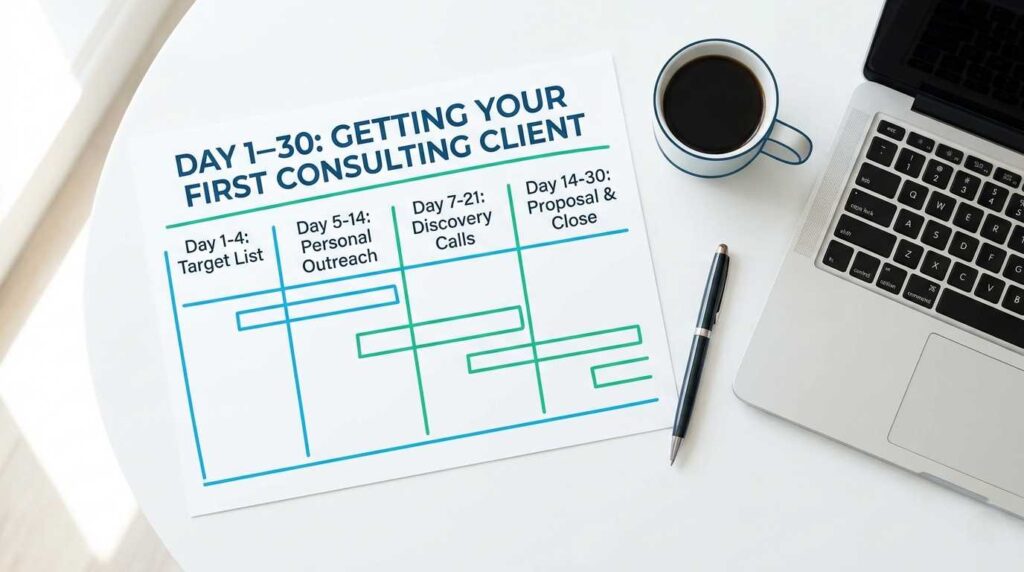
Your Action Plan: How to Get First Consulting Client Seniors in 30 Days
- Day 1–2: Finalize your positioning statement and set your rate
- Day 3–4: Build your target list of 30–50 contacts
- Day 5–14: Send 5 personalized outreach messages per day
- Day 7–21: Conduct discovery calls with interested contacts
- Day 14–30: Send your first proposal and close your first engagement
Thirty days is enough time to land your first client if you are consistent and focused. The seniors who succeed are not the ones with the most impressive backgrounds — they are the ones who start reaching out before they feel completely ready.
For the complete roadmap to building a consulting practice from scratch, read our Corporate to Consulting Ultimate Guide. And once your first client is on board, our High-Ticket Consulting Guide will show you how to scale your rates and take on premium engagements.