
The rules around Medicare and working as a senior are more confusing than they need to be — and the mistakes people make are almost always preventable. This guide tells you exactly what changes, what doesn’t, and what to do before you accept any job offer.

Patricia is 67. She retired two years ago, enrolled in Medicare, and started collecting Social Security. Last spring, a former colleague called with a part-time consulting opportunity — 15 hours a week, good hourly rate, completely remote. Patricia almost turned it down because she was terrified of losing her Medicare coverage. Her neighbor had told her that working while on Medicare “messes everything up.” Her son-in-law had warned her about “clawbacks.” A quick Google search gave her five different answers.
She almost left $24,000 of annual income on the table because of misinformation.
Here’s the truth: Medicare and working can coexist, and for most seniors the rules are far more manageable than the fear suggests. But there are genuine complications — particularly around employer insurance, Part B premiums, and the coordination between Medicare and a new employer’s health plan — that you absolutely need to understand before you accept any job offer. Getting it wrong costs money. Getting it right is just a matter of knowing the rules.
This guide covers everything, in plain English, with real scenarios at every stage.
The Most Important Thing First: Working Does NOT Cancel Medicare
Let’s put this to rest immediately because it’s the most common misconception: taking a job does not cause you to lose Medicare. Full stop. Medicare is a federal health insurance program you’re entitled to based on your age and work history. No employer can take it away from you. No income level eliminates it. Working, earning money, consulting, freelancing — none of these activities cancel your Medicare eligibility or coverage.
✅ Bottom Line: You can work at any age, earn any amount of money, and keep Medicare. The complications are not about losing coverage — they’re about how Medicare coordinates with employer insurance, and how your Part B premiums may adjust based on income. Both are manageable once you understand them.
What does change when you work while on Medicare? A few specific things, depending on the type of work and whether your employer offers health insurance. Let’s go through each scenario.
Scenario 1: You Take a Remote or Freelance Job With No Employer Health Insurance
This is the simplest scenario — and the most common for seniors reading this site. You take on contract work, freelance consulting, a part-time remote position, or self-employment. Your new income doesn’t include health insurance from an employer.
What happens to Medicare: Nothing changes with your coverage. Medicare Parts A and B continue exactly as before. You keep your existing Medicare Supplement or Advantage plan. Your doctor relationships stay intact.
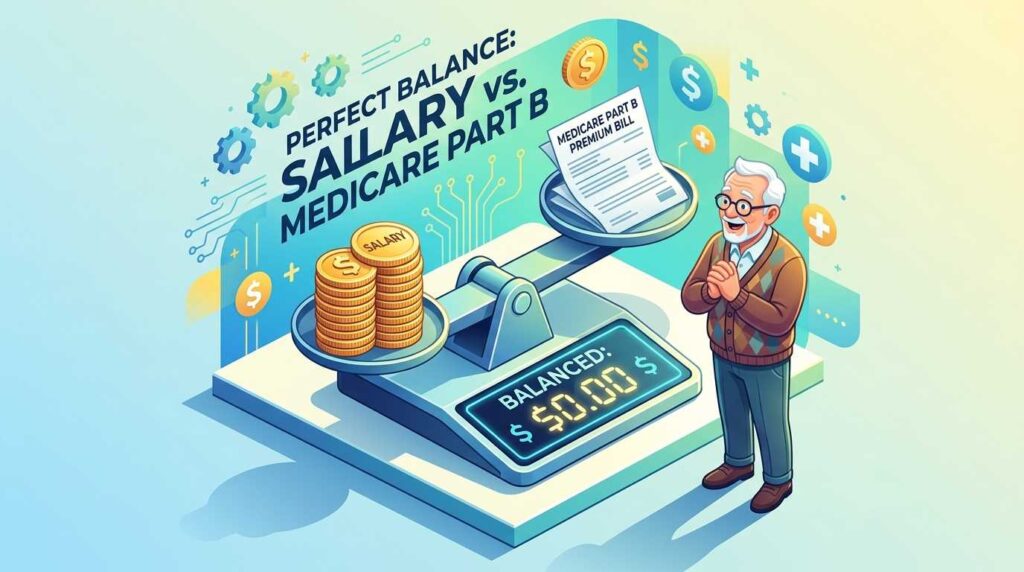
What might change: Your Part B premium. Medicare Part B premiums are income-adjusted through a system called IRMAA — Income-Related Monthly Adjustment Amount. Most people pay the standard Part B premium ($185/month in 2026). But if your income — specifically your Modified Adjusted Gross Income from two years ago — exceeds certain thresholds, you pay more.
| 2026 Individual Income (MAGI) | 2026 Monthly Part B Premium | Additional Monthly Cost |
|---|---|---|
| $106,000 or less | $185.00 | $0 — standard rate |
| $106,001 – $133,000 | $259.00 | +$74/month |
| $133,001 – $167,000 | $370.00 | +$185/month |
| $167,001 – $200,000 | $480.90 | +$295.90/month |
| $200,001 – $500,000 | $591.90 | +$406.90/month |
| Above $500,000 | $628.90 | +$443.90/month |
Two critical things to understand about IRMAA. First, it’s based on your income from two years ago — so 2026 premiums are based on your 2024 tax return. If you retired in 2024 with high income, you may be paying elevated premiums in 2026 even though your current income is much lower. Second, you can appeal IRMAA if your income dropped significantly due to a life-changing event (retirement, divorce, death of spouse). The form is SSA-44, available at ssa.gov.
For most remote workers and freelancers earning under $106,000, IRMAA simply isn’t an issue. Patricia’s consulting income of $24,000/year combined with her Social Security puts her comfortably below the threshold. She pays the standard rate and nothing changes.
Scenario 2: You Take a Job at a Company With 20 or More Employees That Offers Health Insurance
This is where it gets more complicated — and where the decisions you make have real financial consequences.
When you work for a company with 20 or more employees and they offer health insurance, the law treats the employer’s plan as your primary insurance and Medicare as secondary. This means the employer plan pays first, and Medicare picks up some of what remains.
You now have a choice. You can:
- Enroll in the employer plan and keep Medicare as secondary. Good if the employer plan has excellent coverage and low premiums. Medicare Part B can often be delayed (and its premiums avoided) during this period without penalty.
- Decline the employer plan and keep Medicare as primary. Makes sense if Medicare + your supplement gives you better coverage at lower cost than the employer plan.
- Take both and use them together. This can minimize out-of-pocket costs but you’re paying two sets of premiums.
⚠️ Important: If you decide to delay Part B enrollment while covered by an employer plan, you must enroll in Part B within 8 months of losing that employer coverage when you eventually leave the job. Miss this Special Enrollment Period and you’ll face a permanent late enrollment penalty of 10% for every 12-month period you delayed. This penalty lasts for life.
Real Scenario: Robert, 65, Takes a Full-Time Remote Job
Robert turns 65 in March 2026. He’s just been offered a full-time remote position at a company with 400 employees that provides health insurance. His employer’s plan has good coverage with a $150/month premium contribution from Robert.
Robert’s best move: enroll in Medicare Part A (free — hospital coverage), but delay Part B enrollment since he has qualifying employer coverage. He saves $185/month in Part B premiums while working. When he eventually leaves the job, he has an 8-month window to enroll in Part B without penalty.
Total monthly premium during employment: $150 (employer plan) instead of $150 + $185 = $335 for both. Annual savings: $2,220.
Scenario 3: You Work for a Small Employer With Fewer Than 20 Employees
This is the scenario that trips people up most often.
When your employer has fewer than 20 employees, Medicare becomes your primary insurance — even if your employer offers a health plan. The small employer’s plan is secondary. This creates a specific risk: if you’re enrolled in a small employer’s health plan and you haven’t enrolled in Medicare Part B, you may end up with a gap where neither plan covers you adequately, because the small employer plan was designed to work alongside Medicare as secondary, not to function as standalone primary coverage.
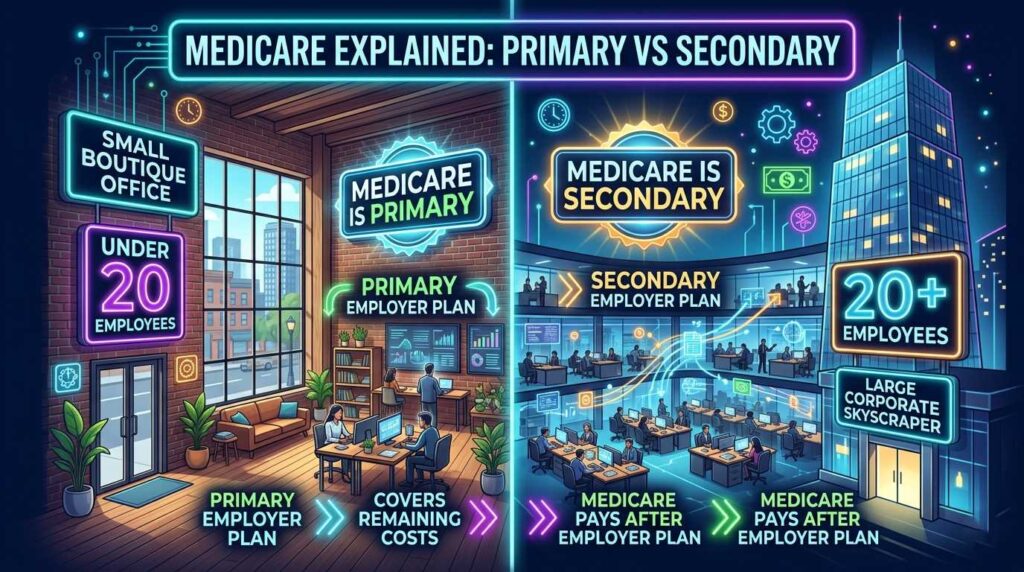
🚨 The Small Employer Trap: If you’re 65+, already on Medicare, and you take a job at a company with under 20 employees — keep Medicare Part B. Do not drop it thinking the employer’s plan is your primary coverage. It isn’t. Medicare is primary. The employer plan is secondary. If you let Part B lapse in this situation, you’ll owe the full cost of services that Medicare would have covered, out of pocket.
Scenario 4: You’re Self-Employed or Do Consulting/Freelance Work
Self-employment — including consulting, freelancing, running a small business, or any 1099 work — is the cleanest scenario from a Medicare perspective. There’s no employer insurance to coordinate with. Medicare stays your primary coverage, nothing changes with your enrollment, and the only variable is whether your new income pushes you into an IRMAA bracket (see the table above).
Self-employment does introduce a tax consideration that’s separate from Medicare: self-employment tax. As a sole proprietor or independent contractor, you pay both the employee and employer portions of Social Security and Medicare taxes — 15.3% on net self-employment income up to the Social Security wage base. This is deductible, but it’s real money, and it should factor into how you price your services. The tax guide for senior freelancers covers this in full detail.
What About Social Security? The Income Limits You Actually Need to Know
Medicare and Social Security are separate programs with separate rules, and they’re often confused with each other. Medicare has no income limits — you keep it regardless of what you earn. Social Security has income limits that only apply before your Full Retirement Age.
| Your Situation | 2026 Annual Earnings Limit | What Happens If You Exceed It |
|---|---|---|
| Under Full Retirement Age all year | $22,320 | $1 withheld for every $2 earned above the limit |
| Reaching Full Retirement Age during 2026 | $59,520 (for months before FRA) | $1 withheld for every $3 earned above the limit |
| At or past Full Retirement Age | No limit | No reduction — earn as much as you want |
Three things to understand about Social Security withholding that most people don’t realize:
It’s temporary, not permanent. Any benefits withheld because you earned too much are recalculated when you reach Full Retirement Age. Social Security increases your monthly benefit to account for the months they withheld. You don’t lose that money permanently — it comes back to you over time through higher monthly payments.
Only earned income counts. Investment income, rental income, pension income, and capital gains do not count toward the Social Security earnings limit. Only wages from a job or net self-employment income count. If you earn $30,000 from rental properties and $15,000 from a part-time job, only the $15,000 is evaluated against the limit.
Working can increase your future benefit. If your current work years are among your highest-earning years, Social Security will recalculate your benefit upward. This is rare for most part-time work, but worth knowing for anyone taking on well-paying consulting work.
For the complete picture on how earning income interacts with Social Security, the guide on earning income while collecting Social Security covers every scenario in detail.
Medicare Advantage vs. Original Medicare When You Return to Work
If you’re on Medicare Advantage (Part C) rather than Original Medicare with a supplement, the rules work the same way — but there’s one additional consideration worth knowing.
Medicare Advantage plans are sold by private insurance companies and often have provider networks. If you take a job that requires you to see specific doctors, or if you travel significantly for work, the network restrictions of a Medicare Advantage plan may become more limiting. Original Medicare with a supplement gives you more flexibility to see any Medicare-accepting provider nationwide — relevant if your work situation changes where or how you access healthcare.
Switching from Medicare Advantage back to Original Medicare is allowed at certain times of year — generally during the Annual Enrollment Period (October 15 – December 7) or the Medicare Advantage Open Enrollment Period (January 1 – March 31). If your work situation changes your healthcare needs, this is worth evaluating.
The Checklist: Before You Accept Any Job Offer
Before you sign anything, answer these five questions. They determine which of the scenarios above applies to you and what actions you need to take.
📋 Pre-Job Medicare Checklist
- Does this employer offer health insurance? (Yes/No — if No, skip to #5)
- How many total employees does this employer have? (Under 20 vs. 20 or more — this determines primary vs. secondary coverage)
- Is this employer coverage considered “creditable coverage”? (Ask HR directly — this matters for delaying Part D drug coverage without penalty)
- Does accepting employer insurance save me money compared to keeping Medicare + supplement alone? (Run the actual monthly numbers — don’t guess)
- Will my total income push me above $106,000 MAGI this year? (If yes, expect an IRMAA premium increase — factor this into the income math)
The Types of Remote Work That Create Zero Medicare Complications
For seniors who want to earn income without navigating any of the employer insurance complexity above, the good news is that most of the remote and freelance opportunities most relevant to seniors fall into the cleanest possible category: self-employment with no employer insurance component.
Consulting. Freelance writing. Virtual assistant work through platforms like Boldly or Belay. Selling digital products. Teaching online. These are all 1099 income streams with no employer insurance coordination to worry about. Your Medicare stays exactly as it is. The only variable is IRMAA if your income rises significantly — and for most seniors earning supplemental income in the $20,000–$50,000 range, even that isn’t a factor.
If you’re exploring what those opportunities look like in practice, the complete guide to remote jobs for seniors in 2026 covers the full landscape — including which types of work are most accessible for different backgrounds.
When to Call Medicare Directly
Some situations are complex enough that a direct conversation with Medicare is worth the time. Specifically, call Medicare (1-800-MEDICARE, or 1-800-633-4227) before making any decisions about:
- Dropping Part B coverage while working — the Special Enrollment Period rules are strict and the penalty for missing the window is permanent
- Coordinating Medicare with a new employer’s COBRA coverage after leaving a job
- Appealing an IRMAA premium increase after a significant income change
- Understanding how a Health Savings Account (HSA) contribution interacts with Medicare enrollment (there are strict rules here)
The Medicare helpline is staffed 24 hours a day, 7 days a week. Representatives are generally knowledgeable and patient. For questions specific to your plan or premium, have your Medicare number handy when you call.
Frequently Asked Questions – Medicare and Working Seniors What to Know
No — and this catches people off guard. Once you enroll in any part of Medicare (including Part A), you can no longer contribute to an HSA. However, you can still spend down existing HSA funds on qualified medical expenses tax-free, including Medicare premiums, deductibles, and copays. If you’re still working and delaying Medicare enrollment, you can continue HSA contributions — but the moment you enroll in Medicare, contributions must stop.
If you’re still employed with employer health insurance from a company with 20 or more employees at age 65, you can delay Medicare enrollment without penalty while you remain covered. Your Initial Enrollment Period (the 7-month window around your 65th birthday) can be skipped, and you’ll use a Special Enrollment Period when you eventually leave your employer coverage. If your employer has fewer than 20 employees, enroll in Medicare at 65 regardless — it becomes your primary coverage automatically.
Original Medicare covers emergency care anywhere in the US, but generally does not cover care outside the United States. If your work involves international travel, a travel insurance policy or international health supplement is worth considering. Medicare Advantage plans may have even more limited coverage during domestic travel outside their network area — check your specific plan’s out-of-area coverage before taking any job that involves regular travel.
No. Employer health insurance is never mandatory — you always have the option to decline it and keep Medicare as your primary coverage. Whether to take it or decline it comes down to a cost-benefit comparison: what does the employer plan cost you monthly, what does it cover, and how does that compare to your current Medicare + supplement combination? Run the actual numbers for your specific situation before deciding either way.
Part A is hospital insurance — covers inpatient hospital stays, skilled nursing facilities, and some home health care. Most people get it free. Part B is medical insurance — covers doctor visits, outpatient care, preventive services. You pay a monthly premium ($185/month standard in 2026). Part C is Medicare Advantage — a private insurance alternative that bundles A, B, and usually D into one plan. Part D is prescription drug coverage — separate plans that cover medications. When people talk about “delaying Medicare enrollment” while working, they’re usually talking specifically about Part B, since Part A is generally free and most people take it at 65 regardless.
Back to Patricia
Patricia took the consulting job. She confirmed it was 1099 contract work — no employer insurance involved. Her income from consulting plus Social Security came to about $42,000 for the year, well below the $106,000 IRMAA threshold. Her Medicare Part B premium stayed at the standard rate. Her Medicare Supplement continued unchanged.
She earned $24,000 that year doing work she found genuinely satisfying — work that used skills she’d spent three decades building. Medicare didn’t complicate it at all.
What almost stopped her wasn’t the rules. It was the fear of rules she didn’t understand. That’s the most common Medicare-and-work mistake seniors make, and it costs far more than any premium adjustment ever would.
Now you know the rules. Go find the work.
Ready to find your remote income opportunity?