
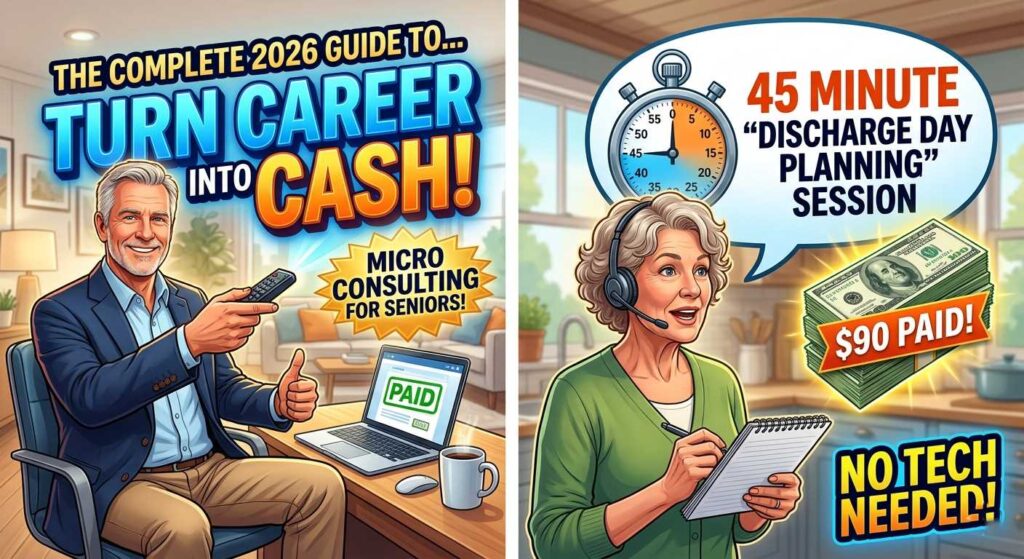
Micro consulting for seniors is one of the fastest-growing income models for Americans over 55 — and it’s built entirely around something you already have: real-world experience that took decades to earn. This guide is not theory. It’s a practical, step-by-step walkthrough for anyone who wants to offer short, focused advice sessions, get paid well for them, and do it all from home with nothing more than a phone or a laptop.
If you’ve spent years in healthcare, education, retail management, finance, law, logistics, HR, or almost any other field — you have knowledge that younger professionals, startup founders, and small business owners are actively searching for right now. They can’t afford to hire a full-time executive, but they can absolutely afford one focused hour of your time. That’s the gap that micro consulting fills.
Before we dive in, it’s worth knowing how this fits into the broader landscape of working online after retirement. If you’d like that bigger picture first, you can explore our overview of making money online after 50. But if you’re ready to focus specifically on consulting, let’s get started.
- What Is Micro Consulting for Seniors?
- Who Already Qualifies (You Might Be Surprised)
- How to Find Your Niche in 30 Minutes
- Crafting an Offer That Clients Actually Buy
- The Best Platforms for Senior Consultants
- Getting Your Very First Client (Step-by-Step)
- Running a Session That Gets You Referrals
- The 5 Fears Seniors Have (And Why They’re Wrong)
- Frequently Asked Questions
What Is Micro Consulting for Seniors? (Plain English Explanation)
Think of a regular consultant as a long-term employee you rent. They come into your company for months, attend meetings, write thick reports, and charge accordingly. Traditional consulting is expensive, time-consuming, and often out of reach for small businesses.
Micro consulting is the opposite. It’s a single, focused session—usually 30 to 90 minutes—where you provide specific answers based on your experience to a client’s targeted questions. This model requires no ongoing relationship, eliminating the need for a physical office or a daily commute. Simply by showing up virtually to help, you complete the task, and that’s it.
Micro consulting = A short, paid advisory session (typically 30–90 minutes) where an experienced professional answers one specific question or solves one specific problem for a client. Sessions are done via video call, phone, or email. No long-term commitment from either side.
Carol now offers 45-minute “Discharge Day Planning” sessions specifically for the adult children of elderly patients. By charging $90 per session and completing four calls a week, she generates a steady $360 weekly income. This results in roughly $1,500 a month — earned entirely by phone from her kitchen between 10 a.m. and noon on weekdays.
Carol didn’t need a website. She didn’t need to learn any coding. She posted a simple profile on a platform, wrote one clear sentence about what she does, and waited. Her first call came within 48 hours.

Who Already Qualifies? (More People Than You Think)
The most common thing seniors say when they first hear about micro consulting is: “That sounds great, but I don’t think my background is special enough.” This is the wrong way to think about it.
Fame is not a requirement here, and you certainly don’t need a PhD to be successful. The real value lies in having solved a problem — at work, in life, or in business — that someone else is struggling with right now.
| Your Background | What You Can Offer | Who Pays You |
|---|---|---|
| Teacher / School Principal | Curriculum design, parent communication, classroom management advice | Homeschooling parents, small tutoring businesses, new teachers |
| Nurse / Medical Professional | Wellness routines, navigating the healthcare system, medication organization (non-prescribing only) | Caregivers, seniors, families of patients |
| HR Manager / Recruiter | Resume reviews, interview coaching, conflict resolution at work | Job seekers, small businesses, startup founders |
| Accountant / Bookkeeper | Basic tax guidance, budget setup, QuickBooks help for beginners | Freelancers, micro-businesses, non-profits |
| Operations / Logistics Manager | Inventory systems, supply chain basics, workflow efficiency | Small retail owners, e-commerce entrepreneurs |
| Real Estate Agent | How to price a home, negotiation basics, what buyers actually look for | First-time sellers, people relocating after retirement |
| Restaurant / Hospitality Veteran | Menu costing, staff scheduling, kitchen setup, customer service standards | New restaurant owners, food truck operators, catering businesses |
The principle is simple: your “normal” is someone else’s “I have no idea what I’m doing.” Years of repetition have given you pattern recognition that you can now package and sell.
If you’re still unsure about what area to focus on, our dedicated guide on finding a consulting niche as a senior walks you through a specific exercise that takes under an hour.
How to Find Your Niche in 30 Minutes (A Simple Self-Audit)
Most people overthink this. Your niche doesn’t need to be clever or trendy. It just needs to be specific. The exercise below takes about 30 minutes and will give you a clear consulting topic to start with.
Step 1: The “People Always Came to Me About…” Question
Grab a piece of paper. Write down every time in the last 10 years someone asked you for professional advice — at work, at a family event, in your neighborhood. What were they asking about? These are your natural consulting topics.
Step 2: The “Problems I’ve Solved 10+ Times” Filter
From your list, highlight anything you’ve dealt with more than ten times in your career. Repetition builds deep expertise. If you’ve had the same conversation or solved the same type of problem repeatedly, that’s a consulting niche.
Step 3: The Google Test
Take your top two or three topics and type them into Google. Do other people search for help with this? If you see websites, YouTube videos, or online communities around the topic, that’s proof of demand. You don’t need to be the only person offering this — competition means there’s a market.
Gary, 63, spent 28 years managing municipal parks departments in Ohio. He found that local officials constantly asked him about grant applications for parks improvements — a process he knew inside and out. He now offers 60-minute “Parks Grant Readiness” consultations to small towns across the US at $150 per session. He books two to three sessions a week without any paid advertising.
Crafting an Offer That Clients Actually Buy
The biggest mistake new micro consultants make is describing what they do instead of what the client gets. Clients don’t buy your background. They buy a solution to a problem they’re facing right now.
Compare these two ways of describing the same service:
| ❌ What Most People Write | ✅ What Gets Bookings |
|---|---|
| “I’m a retired HR director with 25 years of experience.” | “I help small business owners fire an employee the right way so they don’t get sued.” |
| “I offer management consulting services.” | “I help new managers handle their first difficult team conflict in one session.” |
| “I was a logistics professional.” | “I help Etsy sellers set up a shipping system that saves them 5 hours per week.” |
Notice the pattern? Good offers are specific, they describe a problem, and they hint at a result. You’re not selling your resume. You’re selling relief from a specific pain that someone is experiencing.
The formula for a great micro consulting offer:
“I help [specific type of person] [solve specific problem] in [short timeframe or single session].”
Once you have your offer clear, you’re ready to choose where to put it. For a deeper look at pricing strategy specifically — including how to move from starter rates to premium rates — see our guide on how to price your consulting services as a senior.
The Best Platforms for Micro Consulting for Seniors (Compared)
You do not need to build a website to start. The platforms below already have clients looking for help. Each works differently, so the table below will help you decide which to start with based on your comfort level.
| Platform | Best For | Tech Required | Fee | Senior Friendly? |
|---|---|---|---|---|
| B2B, professionals, corporate contacts | Profile setup only | Free to start | ⭐⭐⭐⭐⭐ Best starting point | |
| Clarity.fm | Phone-based Q&A sessions by the minute | Smartphone only | 15% platform fee | ⭐⭐⭐⭐ Great for phone calls |
| Upwork | Project-based consulting, broader reach | Profile + video call app | 10–20% fee | ⭐⭐⭐ Bigger audience, more competition |
| Intro | Expert calls, thought leaders, niche knowledge | Email + video call | 20% fee | ⭐⭐⭐ Good for specialists |
| Your Own Network | Warm referrals, former colleagues, local businesses | Email or phone | 0% — no middleman | ⭐⭐⭐⭐⭐ Often the best first client source |
Our recommendation: start with LinkedIn and your personal network simultaneously. LinkedIn is free, has your existing professional audience, and allows you to simply update your headline or post a short message describing your new service. You’ll be surprised how many former colleagues are now running businesses or managing teams and need exactly what you know.
If you want detailed guidance on setting up a profile that attracts consulting clients, this walkthrough on optimizing your LinkedIn profile after 50 will be very useful.
Getting Your Very First Client: A Step-by-Step Walkthrough
The first client is always the hardest — not because it’s technically difficult, but because it requires overcoming the internal voice that says “who would pay me for this?” The answer: a lot of people. Here’s how to find one this week.
Use the formula from Section 4. Keep it to one or two sentences. Write it down on paper first — no need to type it yet.
Open your phone contacts or your LinkedIn connections. Write down everyone who now runs a business, manages a department, or works in a field related to your expertise. This is your prospect list.
Don’t blast everyone at once. Pick the top 5 people from your list and send a brief, personal note. Something like: “Hi [Name], I’ve started offering short consulting sessions to help [type of person] with [specific problem]. Given what you’re working on, I thought you might know someone who could use this — or you might yourself. Happy to tell you more.”
For your very first client, offer a 15-minute unpaid conversation to understand their problem. This removes all risk for them and gives you the confidence to show your value before any money changes hands.
Whether the session is free or paid, ask at the end: “Would you be willing to write two or three sentences about what was helpful?” A testimonial is worth more than any marketing. It’s what gets you the second client, and the third. See our full guide on collecting testimonials as a senior consultant.
There’s also a detailed 30-day plan in our article on landing your first consulting client if you want a calendar view of the whole process.
How to Run a Session That Gets You Referrals
A micro consulting session is not a lecture. It’s a conversation with a structure. Following this simple format will make every call feel professional and leave clients excited to recommend you.
Ask: “Tell me in one sentence what you were hoping to solve today.” This focuses the conversation immediately. Many clients come in with three problems but only need to solve one.
Let them explain. Ask two or three follow-up questions. Don’t jump to advice yet. The most valuable thing you do in this phase is identify the real problem, which is often different from the stated problem.
Share your experience. Tell a story if relevant. Give specific, actionable steps — not general ideas. The more concrete your advice, the more valuable you seem. “Try sending the invoice on Friday afternoon” is better than “improve your billing process.”
Summarize the three key takeaways. Ask: “Was this helpful? Is there one more thing before we wrap up?” Then offer to send a brief email recap afterward. A follow-up email takes five minutes and makes you look exceptionally professional.
After the session, you can use an AI tool to help turn your notes into a clean written summary to send the client. This “session recap” document dramatically increases the perceived value of your service. Our guide on AI tools for senior consultants shows you exactly how to do this in under 10 minutes.
The 5 Most Common Fears Seniors Have About Micro Consulting (And Why Each One Is Wrong)
Over the years, we’ve heard the same hesitations repeated again and again. Here’s the honest truth about each one:
If you’re transitioning out of a corporate role and unsure how to rebrand yourself as an independent consultant, our guide on going from corporate to consulting covers the mindset shift in detail. And if you want to understand the bigger picture of how consulting fits into a portfolio of income streams, see passive income strategies for seniors.
Frequently Asked Questions About Micro Consulting for Seniors
In most cases, no. Micro consulting is based on sharing your professional experience and opinions — it doesn’t require a license unless you’re giving regulated advice (such as medical diagnoses, legal representation, or financial securities advice). If you stick to “based on my experience, here’s what I’d consider,” you’re operating in perfectly legal territory. When in doubt, always consult an attorney for your specific situation.
Coaching typically focuses on helping someone discover their own answers through questions. Mentoring is usually an ongoing, relationship-based arrangement. Micro consulting is task-specific: the client comes with a problem, you apply your direct experience to solve it, and the session ends. It’s faster, clearer, and easier to price than either coaching or mentoring.
Micro consulting is entirely virtual. Your clients can be anywhere in the country — or the world. In fact, geography is completely irrelevant. A retired school administrator in rural Kansas can just as easily advise a charter school in Miami as one in their own county. Your physical location doesn’t limit your client base at all.
Most seniors start with two to four sessions per week. This is enough to learn the process, build confidence, and generate meaningful income without overwhelming yourself. As you get more comfortable, you can increase the number — or keep it at a comfortable level and focus instead on raising your rate per session.
Yes, but the rules depend on your age. If you’re under your Full Retirement Age (FRA), there are earning limits that can temporarily reduce your Social Security benefit. Once you reach FRA, you can earn unlimited income without any Social Security reduction. Our full breakdown of working while receiving Social Security covers these rules in plain language.
The Bottom Line: Your Experience Already Has a Market
Micro consulting for seniors isn’t a new trend — it’s simply a new delivery format for something that has always had value: lived experience, hard-won judgment, and the ability to help someone avoid a mistake you’ve already navigated yourself.
The barriers to entry are low. The income ceiling is high. The flexibility is complete. And the satisfaction of helping someone solve a real problem — in a single conversation — is unlike anything a passive income stream can offer.
Your next step is simple: write your one-sentence offer, make your list of 20 contacts, and send five personal messages this week. That’s the whole action plan. One of those five conversations will likely become your first paid session.
Learn how to turn your first consulting sessions into a structured income stream with predictable monthly revenue.
Discover the Micro Consulting Revenue Guide →Last reviewed and updated: May 13, 2026 by the SeniorGig Team.