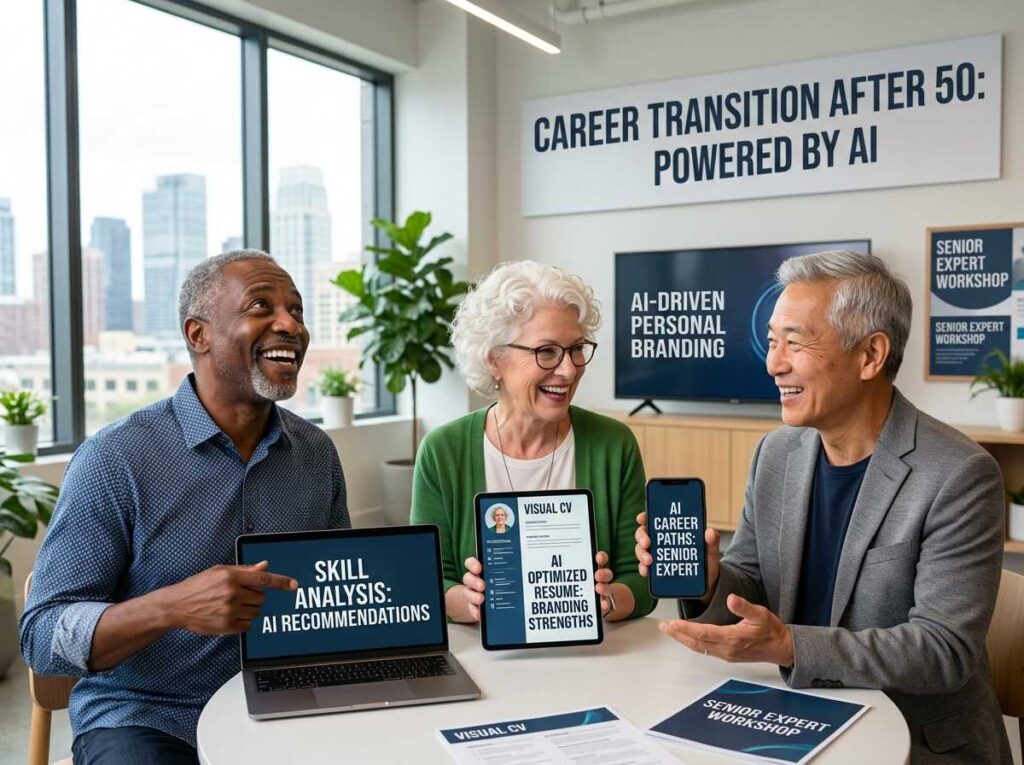
Making a career transition after 50 doesn’t mean starting over — it means starting smarter. You already own the hardest thing to fake: decades of real-world experience. This guide shows you, step by step, how to turn that experience into flexible work, steady income, and a professional life built around your schedule — not someone else’s.
📋 What You’ll Learn in This Guide
- Why 2026 Is the Best Year to Make Your Move
- A Real Story: From “Retired” to In-Demand Consultant
- Step 1 — Audit What You Already Have
- Step 2 — Choose the Right Career Path for You
- Step 3 — Build a Simple Digital Presence
- Step 4 — Use AI as Your Free Digital Assistant
- Step 5 — Land Your First Paid Work in 30 Days
- How to Handle Ageism and Legal Protections
- Common Mistakes Seniors Make (And How to Avoid Them)
- Realistic Timeline: What to Expect Month by Month
- Frequently Asked Questions
Why 2026 Is the Best Year to Make Your Career Transition After 50
The phrase “you’re too old to change careers” has never been less true. Right now, three forces are working in your favor simultaneously — and together, they create an opening that didn’t exist even five years ago.
The Experience Gap Is Real. Companies across America are struggling with a workforce that moves fast but lacks judgment. Younger employees bring tech speed; they often lack the calm, the pattern recognition, and the deep industry knowledge that only comes with 25 or 30 years of showing up and solving problems. Businesses — especially small and mid-size ones — are actively looking for that “steady hand.” That’s you.
Remote Work Is Now Normal. The pandemic-era shift to working from home has become permanent in most knowledge industries. This is significant for seniors: you no longer need to physically commute to an office, dress younger, or compete on energy. You compete on wisdom and results — delivered from your kitchen table.
AI Levels the Playing Field. Free and low-cost AI tools like ChatGPT and Google’s Gemini can now do in minutes what used to require a full-time staff member: draft professional emails, summarize long reports, create presentations, and research markets. You don’t need to be tech-savvy to use them. If you can send a text message, you can use AI.
💡 Quick Definition — What is the “Senior Gig Economy”? It simply means using your existing skills to take on flexible, paid work — either as a consultant, a freelancer, or a part-time remote employee — without the constraints of a traditional 9-to-5 job. You pick the clients, the hours, and the pace.
A Real Story: How Barbara Went From “Too Old to Hire” to $4,200 a Month
Barbara, 64, spent 28 years as an HR director at a mid-size manufacturing company in Ohio. When the company was acquired in late 2024, her position was eliminated. She spent four months sending resumes online — and heard almost nothing back.
Rather than continuing to compete in a system that seemed to be ignoring her, Barbara changed her strategy entirely. She stopped applying for jobs and started offering solutions. She noticed that small businesses were constantly struggling with the same HR problems she had solved for decades: employee retention, onboarding processes, and compliance documentation.
She set up a simple LinkedIn profile positioning herself as a “Fractional HR Director for small businesses.” She used ChatGPT to write her first three outreach messages to local business owners she found on LinkedIn. Within two months, she had two retainer clients paying a combined $4,200 per month. She works about 18 hours a week — entirely from home.
“I stopped thinking of myself as a job-seeker,” Barbara said. “I started thinking of myself as the solution to someone’s expensive problem. Everything changed.”
Step 1 — Audit What You Already Have
Before you look at any job board or update any profile, spend 30 minutes on this exercise. Grab a piece of paper and draw a line down the middle.
On the left side, list your “hard” skills — the technical things you have been paid to do. Examples: bookkeeping, project scheduling, supply chain management, medical coding, curriculum design, customer service management, technical writing.
On the right side, list your “wisdom” skills — the things that are harder to teach. Examples: managing difficult personalities, staying calm under pressure, seeing the big picture in a crisis, mentoring younger employees, building trust with clients, noticing when a project is going off track.
Your strongest opportunity for a career transition after 50 almost always sits at the intersection of these two lists. A retired school principal who has 30 years of curriculum design experience AND the wisdom to manage anxious parents and difficult board members? That person makes an exceptional education consultant. A retired supply-chain manager with logistics skills AND the wisdom to anticipate vendor problems before they happen? That’s a high-value fractional operations advisor.
✏️
No-Tech Required: This exercise takes 30 minutes and a pen. No computer needed. It is, without question, the most important thing you can do before anything else.
Step 2 — Choose the Right Career Path for You
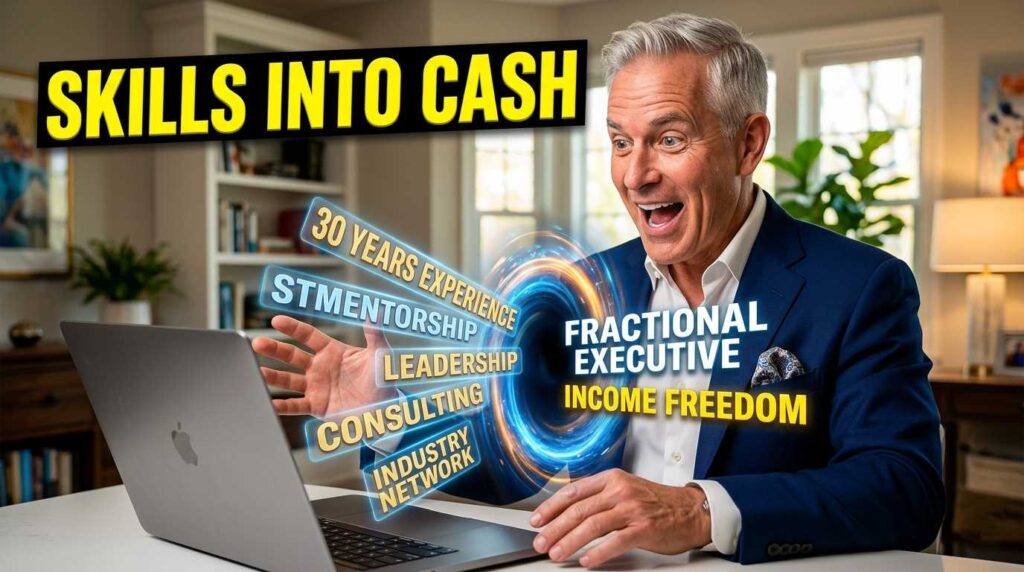
A career transition after 50 doesn’t mean picking one thing and hoping forever. Most seniors combine two or three of the following income streams to build a portfolio that feels right for them. Here are the most realistic paths — with honest notes about who each suits best.
| Career Path | What It Looks Like Day-to-Day | Best For | Typical U.S. Earnings |
|---|---|---|---|
| Fractional Consulting | You work part-time for 1–3 businesses as their “expert on retainer.” You solve strategic problems — they don’t need you full-time. | Former managers, directors, or senior specialists in any industry | $2,000–$8,000/month per client |
| Remote Freelancing | You take on specific, project-based work: writing, editing, bookkeeping, data analysis, transcription, virtual assistance. | Detail-oriented people who want total schedule control | $20–$75/hour depending on skill |
| Online Teaching / Coaching | You teach what you know via video calls, pre-recorded courses, or live workshops — one-on-one or in small groups. | Former teachers, trainers, coaches, or anyone with a deep, teachable specialty | $50–$200/hour; courses $97–$997 |
| Virtual Project Manager | You oversee remote teams and coordinate deliverables for companies that need experienced project leadership without a full-time hire. | Highly organized professionals from any industry | $45–$95/hour |
| Content & AI Editing | You review and refine AI-generated content for businesses, ensuring accuracy, tone, and quality — a rapidly growing need. | Writers, editors, former journalists, communications professionals | $25–$60/hour |
Not sure which path fits your background? Our guide on finding your consulting niche as a senior walks you through a simple decision process that takes about an hour.
Step 3 — Build a Simple, Credible Digital Presence
You do not need a website. You do not need to learn complicated software. For most seniors making a career transition after 50, a polished LinkedIn profile is enough to get started — and it’s completely free.
Your LinkedIn Profile: The Four Things That Matter Most
1. Your headline. This is the line directly under your name. Most people write their old job title here. That’s a mistake. Write what you can do for someone today. Instead of “Retired Operations Manager,” write: “Fractional Operations Advisor | Helping Small Businesses Cut Costs and Scale Without the Chaos.” That tells a potential client exactly what they get when they hire you.
2. Your profile photo. It should be recent, clear, and professional. You don’t need a studio — a well-lit photo taken near a window, with a plain background, works perfectly. Profiles with photos receive dramatically more views than those without.
3. Your “About” section. This is not a resume. It’s a short story about the problems you solve. Start with the client, not yourself: “Small business owners often come to me when their operations are growing faster than their systems can handle…” Then explain how you help, and end with a clear call to action: “Connect with me or send a message to explore how we might work together.”
4. Your work history — keep it focused. List only the last 10–15 years. For each role, write two or three bullet points that highlight results, not responsibilities. “Reduced vendor costs by 18% over two years” is far more compelling than “Managed vendor relationships.”
For a deeper dive into profile optimization, see our LinkedIn profile tips for professionals over 50 and our guide to LinkedIn outreach for seniors.
Step 4 — Use AI as Your Free Digital Assistant (No Tech Skills Needed)
Think of AI tools the way you think of a very fast, very well-read assistant who never sleeps and never charges you for the first conversation. That’s essentially what tools like ChatGPT or Google Gemini are.
You type a question or a request in plain English — the same way you’d ask a colleague for help — and the AI responds. Here’s how seniors are actually using these tools in their career transitions right now:
- Writing outreach messages to potential clients without spending hours staring at a blank page
- Translating old resume language into modern, results-focused language that speaks to today’s hiring managers
- Researching industries to understand what problems businesses are currently trying to solve
- Creating consulting proposals in a professional format, even if you’ve never written one before
- Summarizing long articles or reports so you stay informed without spending hours reading
Copy either of these prompts directly into ChatGPT to get started immediately:
Want a full walkthrough of the most useful AI tools for your situation? Our beginner-friendly ChatGPT guide for seniors explains every step in plain English, no prior tech experience needed.
Step 5 — Land Your First Paid Work in 30 Days
Analysis paralysis is real — especially for high-achievers who want to get everything perfect before taking action. Here’s the antidote: a concrete 30-day plan with specific actions for each week.
- Week 1 — Clarity (Days 1–7) Complete your skills audit (Step 1). Choose one primary income path from the table above. Write your LinkedIn headline and update your “About” section. Don’t overthink it — you can refine later.
- Week 2 — Visibility (Days 8–14) Connect on LinkedIn with at least 10 former colleagues, clients, or industry contacts. Message five of them — not to ask for work, but to catch up and mention you’re open to new projects. These warm conversations often lead directly to referrals.
- Week 3 — Outreach (Days 15–21) Identify 10 small businesses in your target area or industry. Use AI to draft personalized outreach messages. Send five messages. Apply to two or three relevant listings on platforms like trusted remote job boards for seniors.
- Week 4 — Conversations (Days 22–30) Follow up on all outreach. Aim to have at least two “discovery conversations” — even informal ones — this week. The goal isn’t to sell anything; it’s to understand their challenges. Most paid work comes directly from these conversations.
If you’re aiming for consulting specifically, our step-by-step guide to landing your first consulting client goes deeper on the outreach and proposal process.
How to Handle Ageism — and Your Legal Protections
Let’s be honest: ageism exists. Some employers and clients will make assumptions about your technology skills, your adaptability, or your energy level based solely on your age. Here’s how to neutralize those assumptions before they become rejections.
Lead with outcomes, not tenure. Don’t open a conversation with “I have 30 years of experience.” Open with: “I’ve helped three companies in your industry reduce their onboarding costs by 25% — I’d love to hear what challenges you’re currently facing.” When you lead with results, age becomes irrelevant.
Show curiosity, not defensiveness. In conversations and interviews, ask smart questions about their current problems. Demonstrate that you’re interested in where they’re going, not just where you’ve been. This signals adaptability far more effectively than any credential.
Choose platforms that judge by results. Freelance platforms and consulting arrangements evaluate you primarily on reviews, testimonials, and deliverables — not on the year you graduated. Starting in these environments gives you a level playing field.
Know Your Rights: The Age Discrimination in Employment Act (ADEA) protects all workers aged 40 and older from discrimination in hiring, pay, and training. If you believe you’ve been treated unfairly during a job process, you can file a complaint with the U.S. Equal Employment Opportunity Commission (EEOC) at eeoc.gov.
Common Mistakes Seniors Make During a Career Transition (And How to Avoid Them)
- Listing every job since 1985 on your resume. Recruiters spend an average of six seconds on an initial resume scan. Stick to the last 10–15 years and focus on results, not responsibilities.
- Waiting until everything is “perfect” to reach out. Your LinkedIn profile doesn’t need to be flawless to start conversations. A good profile today beats a perfect profile in three months.
- Setting rates too low because you feel like a beginner. You are not a beginner — you are an expert entering a new market. Research rates in your target field using sites like BLS Occupational Outlook Handbook and charge accordingly.
- Dismissing AI tools without trying them. Saying “I’m not a tech person” is closing a door that could save you hours every week. These tools use plain language — not code. Try one conversation with ChatGPT before writing it off.
- Trying to compete for the same roles as 30-year-olds. Don’t fight on their turf. Compete in arenas where your experience is the differentiator: fractional leadership, specialized consulting, mentorship, and senior advisory roles.
- Going it alone when community is available. Online communities, mastermind groups, and even LinkedIn groups for your target field can dramatically accelerate your transition through introductions, referrals, and morale.

Realistic Timeline: What to Expect Month by Month
One of the biggest sources of unnecessary anxiety is not knowing what “normal” progress looks like. Here’s an honest, experience-based timeline for a senior making a focused career transition after 50.
If you’re also thinking about how this work fits with your existing retirement income, our guide on earning income while on Social Security explains exactly what you need to know — including benefit thresholds and IRS rules that apply to freelance and consulting income.
Ready to Discover Your Best Income Path?
Learn how other seniors are using AI tools and remote platforms to build flexible, well-paying second careers — on their own terms.
Discover AI Income Paths for Seniors →Additional Resources From Senior Gig Guide
Your career transition after 50 is a journey with several moving parts. Here are the most relevant guides on this site, organized by where you are in the process:
| Where You Are | Recommended Guide |
|---|---|
| Just getting started, not sure what to do | Remote Job Plan for Beginners Over 50 |
| Want to consult but don’t know your niche | Finding Your Consulting Niche as a Senior |
| Need to update your LinkedIn profile | LinkedIn Profile Tips for Professionals 50+ |
| Ready to go corporate-to-consulting | Corporate to Consulting: A Senior’s Guide |
| Interested in remote work, not consulting | Remote Jobs for Seniors 55+ |
| Want to use AI to speed up your search | Best AI Tools for Senior Consultants |
Frequently Asked Questions – Career Transition After 50
Absolutely not. Research from the American Institute for Economic Research found that 82% of workers who changed careers after age 45 reported making a successful transition. The key distinction is approach: the most successful seniors don’t try to compete head-to-head with younger workers in traditional job markets. They leverage their experience in consulting, fractional roles, and specialized freelance work — where decades of knowledge is the competitive advantage, not a liability.
Most seniors who follow a clear plan and take consistent action land their first paid work within 4 to 12 weeks. Full income replacement — earning the equivalent of a previous salary — typically takes 6 to 12 months. The biggest variable is consistency: people who reach out to 5–10 potential clients per week move significantly faster than those who wait for the perfect opportunity.
Rarely, and almost never for consulting or freelance work. In the modern gig economy, a portfolio of real results and two or three strong testimonials carries far more weight than a new diploma. That said, if you’re moving into a field that requires specific credentials — real estate, financial advising, medical coding — short-term certifications (often 4–12 weeks, available online) can be valuable. Use the BLS Occupational Outlook Handbook to research exactly what your target field requires before investing in education.
Frame any gap as intentional, not involuntary. “I took time to care for a family member, and I’m now ready to bring my [X] years of experience back to focused work” is a confident, honest answer. If you used the time to learn new skills, take courses, or do any volunteer work — mention those. In consulting and freelancing especially, gaps matter far less than they do in traditional hiring. Clients care about what you can do for them today.
AI tools are genuinely useful — but they are tools, not magic. They work best when you know what you want and use them to move faster. ChatGPT, for example, can help you write a professional outreach message in two minutes instead of two hours, or restructure your resume in a way that speaks to modern employers. It does not replace the human relationships and follow-through that are essential in a career transition. Think of it as a highly efficient assistant — one that can dramatically reduce the time and energy each step requires.
Your Next Chapter Starts With One Step
A career transition after 50 is not a gamble. It’s a strategic repositioning of everything you’ve already earned — the experience, the perspective, the reliability, and the judgment that only comes from decades of real-world work.
You are not starting from zero. You are starting from a foundation that most of your competition simply does not have yet.
The seniors who succeed in this transition share one thing in common: they take one concrete action today, then another tomorrow. They don’t wait for the perfect plan. They build the plan by moving.
Your action step right now: Open LinkedIn. Update your headline to reflect what you can do for someone today — not what you did years ago. Then connect with three people you haven’t spoken to in the last year. That’s it. Three connections. That’s how most second acts actually begin.
Sources & References This article draws on data from the U.S. Bureau of Labor Statistics, the American Institute for Economic Research, AARP Work & Jobs, and the U.S. Equal Employment Opportunity Commission. Senior Gig Guide updates all guides regularly as platforms and market conditions change. For corrections or questions, contact us at info@seniorgigguide.com.
Last reviewed and updated: May 11, 2026 by the SeniorGig Team.