
“Nobody tells you this part. While the freedom of remote work sounds ideal, establishing a consistent work from home schedule for seniors is the real secret to success. They tell you about the flexibility—no commute, no dress code, no fluorescent lights. And all of that is true. But what they don’t tell you is that freedom without structure is its own kind of trap, and those who thrive are almost never the ones who ‘just go with the flow.’
I want to share something Margaret told me. Margaret is 68, a former school principal from Vermont who now runs a small educational consulting practice from a converted sunroom. She spent her entire career managing schedules for 400 students and 40 staff members. When she started working from home, she assumed scheduling would be the easy part.
‘The first three months were a disaster,’ she said. ‘I’d start working at 10, stop for lunch at 11:30, get distracted by the garden, realize it was 3pm, panic, work until 8pm, sleep badly, and do it all over again. I was exhausted and barely productive.’
What changed everything for Margaret — and what this guide is really about — wasn’t a productivity hack or an app. It was understanding that working from home after 60 requires a completely different relationship with time than any office job ever did.
Here is how you can build a sustainable work from home schedule for seniors that actually works in practice.”
Why a Work From Home Schedule for Seniors Over 60 Needs to Be Built Differently
Most work-from-home advice online is written by 30-year-olds for 30-year-olds. It assumes you have unlimited energy, that you sleep seven hours and bounce out of bed ready to crush your morning routine, and that your biggest scheduling challenge is avoiding Netflix.
Working from home after 60 involves a genuinely different set of variables:
Your energy isn’t linear. Most seniors over 60 have a distinct energy peak — usually two to four hours in the morning — followed by a natural afternoon dip that no amount of coffee fully overcomes. Building your schedule around this rhythm instead of against it isn’t laziness. It’s intelligence.
Your health appointments are real commitments. Doctor visits, physical therapy, medication schedules, and health management take real time in a way that simply didn’t apply in your 30s. A good work-from-home schedule for seniors accounts for these without treating them as interruptions to apologize for.
You may be managing family caregiving simultaneously. Many seniors working from home are also supporting aging parents, grandchildren, or spouses with health needs. This reality shapes your available hours in ways that a generic productivity template will never acknowledge.
Isolation is a real risk. Office environments provided involuntary social connection — the hallway conversation, the lunch break, the colleague who stopped by your desk. Working from home removes all of that. A thoughtful schedule builds social connection back in intentionally, or it erodes quietly over months.
The Senior Work From Home Schedule That Actually Holds Up Over Time
What follows isn’t a rigid minute-by-minute timetable. It’s a framework — a set of anchor points around which you build your own specific schedule. The anchor points matter. The exact times are yours to choose.
The Morning Anchor: Your Most Important Hour
The first hour after you wake up sets the cognitive and emotional tone for the entire day. This is well-documented in sleep research — the transition from sleep to wakefulness involves a period called sleep inertia that lasts 15 to 60 minutes, during which complex cognitive work is genuinely impaired. Seniors tend to experience this transition more gradually than younger adults.
What this means practically: don’t open email, LinkedIn, or client messages during your first hour awake. Don’t make important decisions. Don’t start complex work.
Instead, use that first hour for physical movement, a proper breakfast, and whatever mental preparation ritual works for you — reading, journaling, a short walk, a quiet cup of coffee without a screen. This isn’t indulgence. It’s priming your nervous system for the focused work that comes next.
Margaret’s morning anchor: wake at 6:30am, 20-minute walk, breakfast while reading a physical newspaper (not her phone), coffee at her desk by 7:45am. She starts actual work at 8:00am — ninety minutes after waking. “Those ninety minutes used to feel wasteful,” she says. “Now I understand they’re what makes the next four hours possible.”
The Deep Work Block: Protect It Like a Meeting
Identify your personal peak energy window. For most seniors, this falls between 8am and noon — but it varies. Some people are sharper from 9 to 1. Others peak from 7 to 11. Spend one week simply noticing when you feel most mentally sharp and use that data, not someone else’s schedule, to set yours.
Whatever your peak window, block it for deep work—the kind of work that requires real concentration. If you are a consultant, this involves writing proposals, analyzing client problems, and preparing presentations. Freelancers should use this time to execute their primary client deliverables. Similarly, remote employees can focus on the complex tasks that actually move projects forward.
During this block:
- Phone on Do Not Disturb
- Email closed — not minimized, closed
- One task at a time, not five tabs open
- No scheduling calls or meetings if you can avoid it
This block is the most valuable time in your workday. Protect it with the same firmness you’d protect a client meeting. Because in terms of actual output, it’s worth more than all your other hours combined.
The Mid-Morning Check-In: 15 Minutes, Not 90
Around mid-morning — 10am or so — build in a 15-minute communication check. Read and respond to emails that genuinely require a response. Check messages. Return a call if needed. Then close everything and return to deep work.
The reason for this specific structure is that open email is the enemy of deep work. Every new email notification is a context switch — and research on context switching consistently shows that recovering full concentration after an interruption takes an average of 23 minutes. If you’re checking email continuously while trying to do complex work, you are never actually doing complex work. You’re doing a degraded version of it, constantly interrupted.
Fifteen intentional minutes of communication is more productive than six hours of half-attention to both email and work simultaneously.
The Midday Reset: The Anchor Most Seniors Skip
Lunch is not a logistics problem to solve in ten minutes at your desk. It is a biological reset that directly affects your afternoon productivity, your evening mood, and your long-term health.
Build a genuine 45-minute to one-hour midday break into your schedule. Eat away from your screen. Go outside if possible — even a ten-minute walk around the block after lunch produces measurable improvements in afternoon alertness and mood according to research published by the National Institutes of Health. If weather doesn’t permit a walk, a brief rest or a non-work-related activity serves a similar function.
This break is not wasted time. It is maintenance for the machinery that does your work.
The Afternoon Block: Different Work, Not Less Work
Most seniors experience a natural energy dip between 1pm and 3pm. Fighting this dip with more complex cognitive work is a losing battle. Working with it — by scheduling lighter tasks during this window — is how you stay productive through the full afternoon without burning out by 4pm.
Afternoon work that fits the lower-energy window well:
- Responding to emails and messages that require routine replies
- Administrative tasks — invoicing, scheduling, record-keeping
- Research and reading that doesn’t require active creation
- Phone calls and client check-ins (conversation requires less deep focus than writing)
- Planning and organizing for the next day
Many seniors find that a 20-minute rest or nap between 1pm and 3pm — not sleep, but genuine horizontal rest without a screen — dramatically improves their afternoon productivity. If your schedule allows it and your body responds well to it, this is not laziness. The Spanish have built an entire cultural tradition around it for good reason.
The End-of-Day Ritual: The Anchor Nobody Talks About
One of the strangest psychological challenges of working from home is that work never fully ends. When your office is your home, the psychological boundary between “working” and “not working” dissolves in ways that gradually destroy both your productivity and your peace of mind.
The solution is a deliberate end-of-day ritual — a consistent sequence of small actions that signals to your brain that the workday is over. It doesn’t need to be elaborate. It just needs to be consistent.
Margaret’s end-of-day ritual is a masterclass in psychological closure. At 4:30 pm, the process begins by reviewing tomorrow’s task list and writing down three key priorities for the next morning. Once the laptop is closed, she changes out of what she calls her “work clothes”—a specific sweater kept only for work days—into something reserved for her personal time. A fresh pot of tea usually follows, signaling the final transition. Work is officially over.
“The sweater sounds silly,” she says. “But my brain figured out pretty quickly that the sweater coming off meant work was done. Now I feel genuinely off-duty by 4:45. Before the ritual, I was checking email at 10pm and dreaming about client problems.”
The specific ritual doesn’t matter. The consistency does.
A Sample Work From Home Daily Schedule for Senior Freelancers and Consultants
This is Margaret’s actual schedule — adapted slightly for privacy. Use it as a template to build your own, adjusting times to match your natural rhythms:
| Time | Activity | Why It Matters |
|---|---|---|
| 6:30 – 8:00am | Morning routine — walk, breakfast, no screens | Sleep inertia clearance, physical and mental priming |
| 8:00 – 10:00am | Deep work block — most complex client work | Peak cognitive energy window |
| 10:00 – 10:15am | Communication check — email and messages | Contained, intentional, not continuous |
| 10:15 – 12:00pm | Deep work continuation or client calls | Still within peak energy window |
| 12:00 – 1:00pm | Lunch — away from desk, short walk | Biological reset, afternoon preparation |
| 1:00 – 3:00pm | Admin, email, lighter tasks, reading | Works with natural energy dip, not against it |
| 3:00 – 4:30pm | Second energy window — calls, planning, follow-ups | Many seniors experience a secondary energy lift here |
| 4:30 – 4:45pm | End-of-day ritual — review tomorrow, close everything | Psychological boundary between work and personal time |
| After 4:45pm | Personal time — fully off work | Recovery is not optional; it’s what makes tomorrow possible |
How Senior Remote Workers Can Handle Interruptions Without Losing the Day
No schedule survives contact with real life perfectly. The question isn’t whether interruptions will happen — they will. The question is whether your schedule has enough structure to recover from them without the whole day collapsing.
Three principles that help:
Protect your deep work block above everything else. If a family member needs something, a delivery arrives, or an unexpected call comes in during your deep work block — handle it, but return to deep work as soon as possible. The block doesn’t have to be perfect to be valuable. A 90-minute deep work session with one ten-minute interruption is still dramatically more productive than a morning of fragmented, reactive work.
Build buffer time into your schedule intentionally. The biggest scheduling mistake seniors make working from home is filling every hour. Leave 20% of your schedule empty — not for more work, but as genuine buffer for the unexpected. When the unexpected doesn’t happen, that buffer becomes bonus time. When it does happen, you absorb it without throwing the entire day into chaos.
Don’t try to “make up” lost time at night. The impulse to work into the evening to compensate for an interrupted afternoon is understandable but counterproductive. Evening cognitive capacity is genuinely lower than morning. The work you produce at 9pm is typically lower quality than the same work produced the next morning at 8am. When the day gets disrupted, close it properly and start fresh tomorrow.
Building Social Connection Into Your Senior Work From Home Schedule
This section belongs in a scheduling guide because isolation is a genuine health risk for seniors working from home — and because the solution requires deliberate scheduling, not good intentions.
The Centers for Disease Control and Prevention identifies social isolation among older adults as a serious public health issue associated with increased risk of cognitive decline, depression, and cardiovascular disease. Working from home removes the involuntary social contact that office environments provided daily.
This means social connection needs to be scheduled — not hoped for. Practically:
- Block one lunch per week with a friend, former colleague, or professional contact — in person or by video.
- Join one professional community that meets regularly — a local business group, an online industry forum, a consulting peer group.
- Schedule regular video check-ins with remote colleagues or fellow freelancers. Even a 20-minute weekly call with someone in a similar work situation provides meaningful connection and professional accountability.
- If you’re building a consulting or freelance practice, client calls themselves provide meaningful professional social interaction — structure your outreach to maintain a consistent cadence of conversations. See our guide on LinkedIn Outreach for Seniors for how to keep that pipeline active.
The Physical Environment That Makes Your Senior Work From Home Schedule Work
Bu bölümü, anlam akışını bozmadan ve hikaye dilini koruyarak, odak anahtar kelimenizi (work from home schedule for seniors) iki kez içerecek şekilde düzenledim:
Schedule and environment are inseparable. The best work from home schedule for seniors collapses if your physical workspace undermines it. Three environmental factors matter more than most expect:
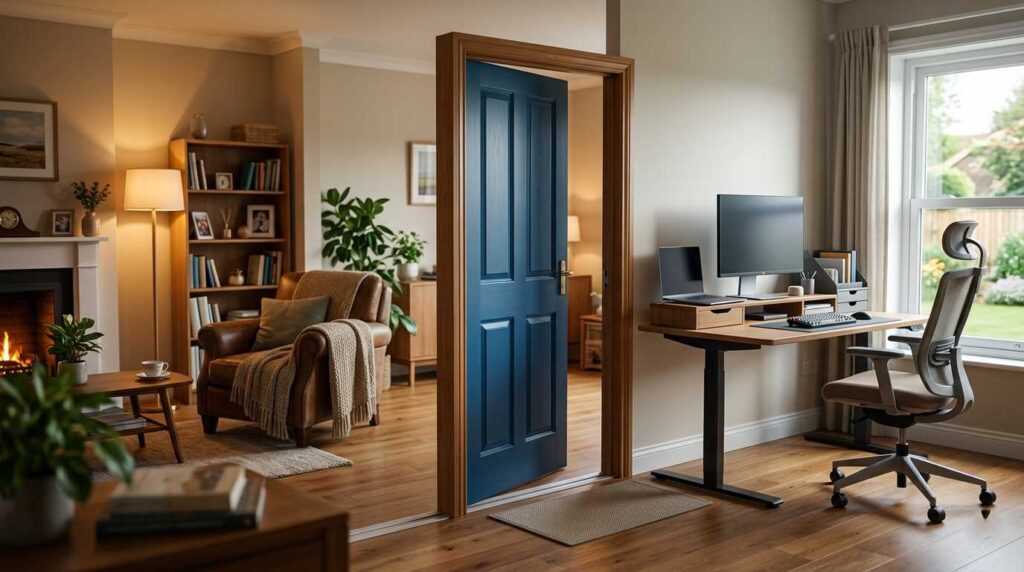
1. The “Work Zone” Boundary A dedicated workspace changes your psychology. Working from your dining table, couch, or bed blurs the boundary between work and rest in ways that damage both. A consistent, dedicated workspace — even a corner of a room with a proper chair and a desk — trains your brain to associate that space with focus. Margaret’s converted sunroom has a door she closes when working. “When that door is closed,” she says, “my brain is at work. When it’s open, I’m home. That door is the most productive thing in my house.”
2. Natural Lighting and Alertness Lighting affects alertness more than most realize. Natural light during morning work hours supports mood and energy in ways artificial lighting cannot match. Position your desk near a window if possible. In the afternoon, warmer lighting supports the natural transition toward rest. For a complete guide to setting up an effective home workspace, see our article on Ergonomic Home Office Setup for Seniors.
3. The Temperature Factor Temperature affects cognitive performance more than you might think. Research shows that cognitive performance peaks between 70 and 77 degrees Fahrenheit. This is a critical detail for a successful work from home schedule for seniors, as older adults often have different temperature preferences than the standard office settings. If you’re consistently cold or too warm, your focus suffers in ways that feel like a motivation problem but are actually physical.
Adjusting Your Senior Work From Home Schedule as Your Work Evolves
The schedule you need in month one of working from home is not the schedule you’ll need in month twelve. As your consulting or freelance practice grows, client volume increases, and your personal rhythms become clearer, your schedule should evolve with you.
Review your schedule quarterly — not daily. Ask three questions at each review:
- Is my deep work block still protecting my most valuable hours?
- Am I ending work at a consistent time, or has scope creep pushed my evenings into work territory?
- Does my schedule reflect what I’m actually doing, or the ideal I planned three months ago?
The third question is usually the most revealing. Most seniors working from home find that their actual schedule drifts significantly from their intended one within a few months — and that the drift is almost always in the direction of more reactive, less focused work. The quarterly review is the mechanism that corrects this before it becomes a deeply embedded habit.
For the broader challenge of managing your time effectively as an independent senior professional, see our guide on Time Management for Seniors Working From Home.
Next Steps: Build the Full Work From Home Foundation
A strong daily schedule is one piece of a sustainable work-from-home practice. Here’s how it connects to everything else:
- Set up a workspace that supports your schedule — read Ergonomic Home Office Setup for Seniors.
- Find the remote work that fits your schedule and skills — browse Remote Jobs for Seniors 55+.
- Use AI tools to work more efficiently within your available hours — see Best AI Tools for Seniors.
- If you’re building a consulting practice, structure your client work around your peak hours — read How to Start Consulting After 50.
- Protect your health alongside your productivity — see Digital Wellness for Senior Freelancers.
- For the complete picture of building an online income after 50, visit our Make Money Online After 50 Master Guide.
Margaret’s consulting practice is now in its third year. She works four days a week, takes Wednesdays off entirely, and earns more per hour than she did as a school principal. She still closes her sunroom door at 8am and still takes off her specific work sweater at 4:30pm.
“The schedule didn’t limit my freedom,” she told me recently. “It created it. I’m more productive in fewer hours than I’ve ever been — and I actually enjoy my evenings now.”
That’s the real promise of a good work-from-home schedule. Not more hours. Better ones.
Frequently Asked Questions: Work From Home Schedule For Seniors
The best schedule is built around your peak energy. Focus on 2–4 hours of “deep work” in the morning, handle communication tasks later, and end each day with a consistent ritual to separate work from personal life.
Quality beats quantity. Most seniors find 4 to 6 focused hours more productive than 8 fragmented ones. Pushing past your cognitive limit creates diminishing returns; work smarter, not longer.
Motivation is about structure, not willpower. Set a firm start time, use a dedicated workspace, and schedule at least one human interaction daily to keep your momentum high.
Yes. A 20-minute power nap between 1 PM and 3 PM can boost afternoon alertness. Keep it short to avoid grogginess—treat it as “productivity maintenance” rather than an indulgence.
Use three simple boundaries: a dedicated physical workspace, firm start and end times, and a daily shutdown ritual (like a walk or closing your laptop) to signal your brain that the workday is over.
Absolutely. Working from home offers the flexibility to manage medication, appointments, and energy levels. It allows you to design a schedule that fits your actual biology rather than a rigid office routine.