
The best national parks for seniors aren’t necessarily the most famous ones. This guide covers accessible trails, honest difficulty ratings, the $80 pass that pays for itself in one visit, and the parks most seniors never think to put on their list — but should.
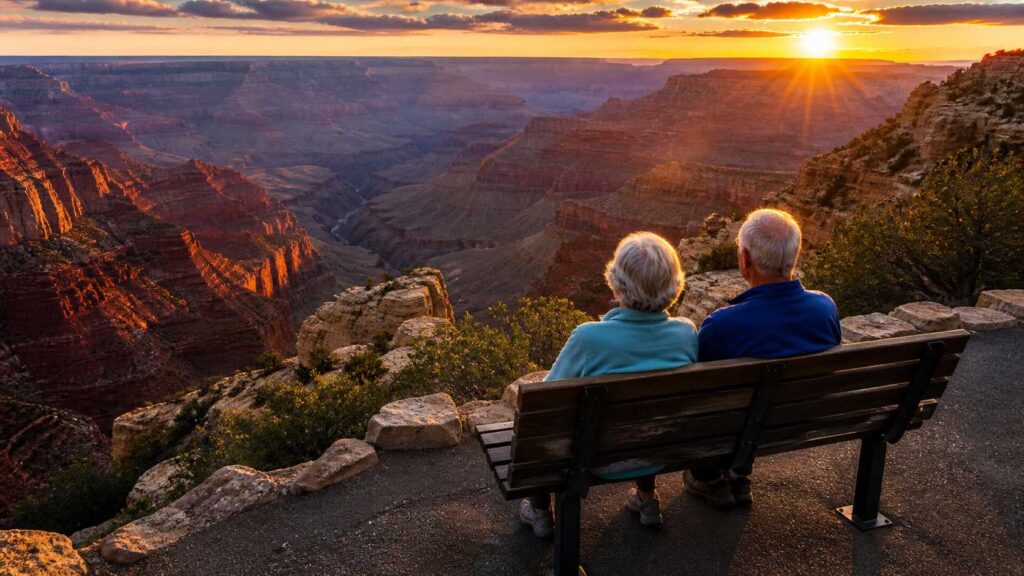
Ruth is 74. She uses a walking stick, takes medication for high blood pressure, and hasn’t done anything she’d call “hiking” in about fifteen years. Last October, she stood at the rim of the Grand Canyon at sunrise and cried — not from exertion, but from beauty. She’d driven to the South Rim with her daughter, parked in the accessible lot, walked 200 meters to Mather Point on a paved path, and witnessed one of the most extraordinary sights on the planet.
That’s the thing about America’s national parks that most seniors don’t fully realize: you don’t have to hike to experience them. Many of the most breathtaking moments these parks offer are accessible within a short walk — sometimes within a short drive — of the parking lot. The parks were designed for everyone, and the best national parks for seniors in particular have put serious investment into accessible infrastructure over the past decade.
This guide covers the parks that deliver the highest ratio of wonder to physical effort, with honest accessibility ratings, the specific trails and spots worth targeting, and everything you need to know about the senior pass that makes visiting almost free.
Start Here: The America the Beautiful Senior Pass
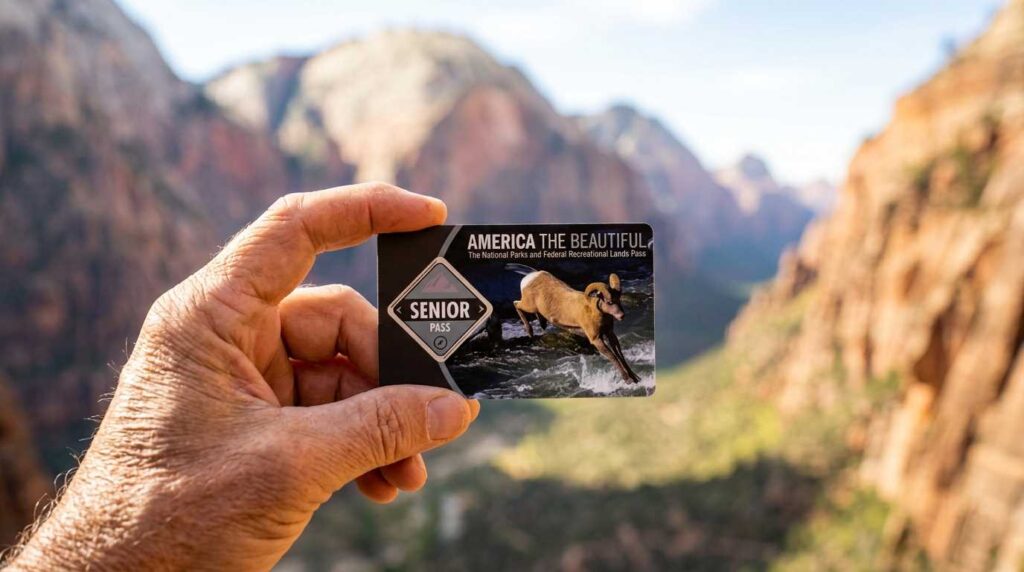
Before we get to the parks themselves, this needs its own section — because it’s genuinely one of the best deals available to American seniors and a surprising number of people over 62 don’t know it exists.
🏔️ America the Beautiful Senior Pass — Everything You Need to Know
| Who qualifies | US citizens or permanent residents age 62 or older |
| Cost | $80 lifetime OR $20/year — lifetime is almost always the better deal |
| What it covers | Free entry to 2,000+ federal recreation sites — all National Parks, National Monuments, National Forests, BLM lands, and more |
| Covers who | The passholder + 3 additional adults in the same vehicle (children under 16 always free) |
| Additional discounts | 50% off camping fees, boat launches, and some amenity fees at federal sites |
| Where to buy | store.usgs.gov/senior-pass (online) or at any park entrance |
| Math check | Grand Canyon entry is $35/vehicle. Two visits = $70. The lifetime pass pays for itself in under 3 visits. |
Buy this before your first park visit. Carry it every trip. It’s one of those rare government programs that delivers obvious, immediate value with no fine print to worry about.
How to Read the Accessibility Ratings in This Guide
Every trail and viewpoint in this guide carries an honest accessibility rating. These are not the sanitized “moderate” labels that park brochures use — they reflect real conditions for real seniors with real bodies.
| Rating | What It Means | Suitable For |
|---|---|---|
| ♿ Fully Accessible | Paved, level surface. Wheelchair accessible. No steps. | All mobility levels including wheelchairs and walkers |
| 🟢 Easy | Paved or packed gravel, minimal elevation change, under 1 mile | Anyone who can walk comfortably for 20–30 minutes |
| 🟡 Moderate | Some uneven surface, 1–3 miles, modest elevation gain (under 300 ft) | Reasonably fit seniors with no significant mobility limitations |
| 🔴 Challenging | Significant elevation, uneven terrain, 3+ miles, or high altitude | Fit seniors who hike regularly — honest about physical demands |
The 12 Best National Parks for Seniors in 2026
1. Grand Canyon National Park — Arizona
The one everyone should see at least once
No photograph has ever done the Grand Canyon justice — the scale only becomes real when you’re standing at the rim. The good news for seniors: the most spectacular views require almost no physical effort. The South Rim’s paved Rim Trail runs for 13 miles along the canyon edge, but you only need a few hundred yards of it to experience the views that have left visitors speechless for generations.
| Best accessible spot | Mather Point — ♿ Fully Accessible — 200m paved walk from parking |
| Best easy trail | Rim Trail (Mather Point to Yavapai Point) — 🟢 Easy — 1.3 miles, paved, flat, extraordinary views |
| Avoid | Going below the rim — Bright Angel Trail descends steeply and ascent in heat is dangerous. Many seniors have required rescue here. |
| Best time to visit | September–November, March–May. Avoid July–August (extreme heat) |
| Senior tip | Free shuttle buses connect all South Rim viewpoints — no driving or parking required once you’re there |
| Entry fee with Senior Pass | Free (normally $35/vehicle) |
Arizona Retirement Guide for Seniors 2026: The Honest Truth About Living There
2. Acadia National Park — Maine
New England’s crown jewel — dramatic coast without the crowds of southern parks
Acadia sits on Mount Desert Island off the Maine coast and offers something rare in American national parks: dramatic ocean scenery combined with a remarkable carriage road system built by John D. Rockefeller Jr. in the 1910s and 20s. These 45 miles of crushed stone carriage roads are closed to cars, completely flat or gently rolling, and wide enough for wheelchairs and walking side-by-side. They’re among the finest accessible trails in the entire National Park System.
| Best accessible spot | Thunder Hole & Sand Beach area — ♿ Accessible overlooks from parking area |
| Best easy trails | Carriage Roads (Jordan Pond area) — 🟢 Easy — flat, crushed gravel, multiple distance options |
| Must-do experience | Jordan Pond House for popovers and tea — a century-old Acadia tradition, beautiful lawn seating |
| Best time to visit | Mid-September through mid-October for fall foliage — genuinely spectacular and fewer crowds |
| Senior tip | Book accommodation in Bar Harbor 6+ months ahead for fall foliage season — it fills completely |
| Entry fee with Senior Pass | Free (normally $35/vehicle) |
3. Everglades National Park — Florida
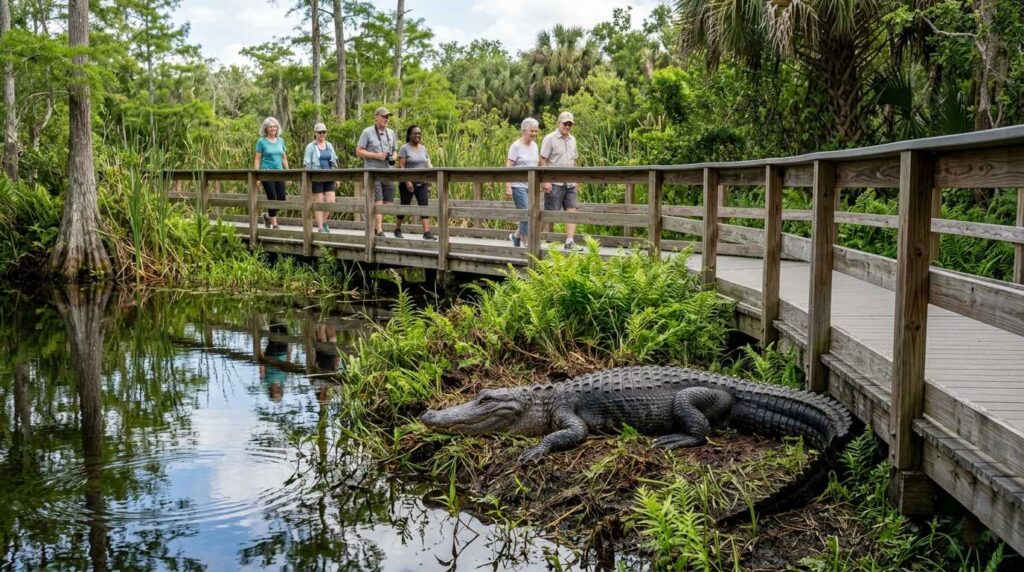
The most accessible wildlife viewing in America — alligators, birds, and total wilderness from a flat paved path
The Everglades Anhinga Trail is, without exaggeration, one of the best wildlife viewing experiences available anywhere in America — and it’s 0.8 miles long, completely flat, and entirely paved. In the dry season (November through April), the freshwater pools along this trail concentrate wildlife so dramatically that you’ll routinely see dozens of alligators, anhingas, herons, spoonbills, and turtles within the first 200 yards. You don’t need to hike. You just need to walk slowly and look.
| Best accessible trail | Anhinga Trail — ♿ Fully Accessible — 0.8 miles, flat paved, extraordinary wildlife |
| Second best | Gumbo Limbo Trail — ♿ Accessible — 0.4 miles, hardpack surface, tropical hammock forest |
| Best time to visit | December–March (dry season). Avoid summer — extreme heat, mosquitoes, flooding |
| Don’t miss | Sunset at Flamingo — remote but extraordinary; book the tram tour if walking is a concern |
| Senior tip | Go at 7–9am on the Anhinga Trail — wildlife is most active, light is beautiful for photos, cooler temperatures |
| Entry fee with Senior Pass | Free (normally $35/vehicle) |
Florida Travel Guide for Seniors 2026: Best Cities, Hidden Gems & Money-Saving Tips
4. Olympic National Park — Washington
Three ecosystems in one park — temperate rainforest, glacier-topped mountains, wild Pacific coastline
Olympic is unusual among major national parks in offering three completely different environments within easy driving distance of each other. The Hoh Rain Forest — with its cathedral-like old-growth trees draped in moss, receiving 12 feet of rain annually — is one of the most otherworldly landscapes in North America. And the Hall of Mosses trail there is 0.8 miles on a relatively flat, packed earth path that most seniors navigate comfortably.
| Best easy trail | Hall of Mosses (Hoh Rain Forest) — 🟢 Easy — 0.8 miles, packed earth, magical old-growth forest |
| Best coastal access | Rialto Beach — 🟢 Easy — short walk on packed gravel to a dramatic wild Pacific beach with sea stacks |
| Best time to visit | July–September for mountain/coast access; rain forest is beautiful year-round (bring rain gear always) |
| Senior tip | Port Angeles is the main gateway town — comfortable, inexpensive, and a good base for day trips to all three ecosystems |
| Entry fee with Senior Pass | Free (normally $30/vehicle) |
5. Shenandoah National Park — Virginia
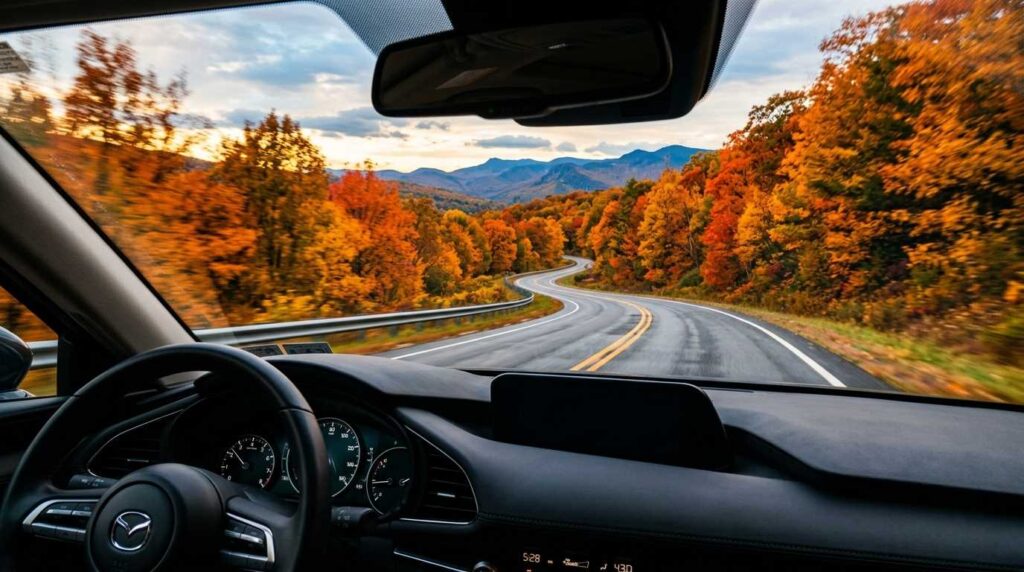
The most accessible national park from the East Coast — Skyline Drive alone is worth the visit
Shenandoah is the national park that many East Coast seniors have driven past dozens of times without stopping — and they’re missing something genuinely wonderful. The 105-mile Skyline Drive winds along the crest of the Blue Ridge Mountains, offering continuous valley views from dozens of overlooks where you never need to leave your car. In fall (mid-October through early November), this drive is one of the most beautiful road trips in America.
| Best drive-up experience | Skyline Drive overlooks — ♿ All overlooks accessible from parking areas — no hiking required |
| Best easy trail | Limberlost Trail — 🟢 Easy — 1.3 miles, accessible surface, old-growth hemlock forest |
| Best time to visit | October 10–25 for peak fall color — plan and book accommodation 3+ months ahead |
| Near major cities | 75 min from Washington D.C., 2 hrs from Richmond — easy day trip from major cities |
| Entry fee with Senior Pass | Free (normally $30/vehicle) |
6. Yellowstone National Park — Wyoming/Montana/Idaho
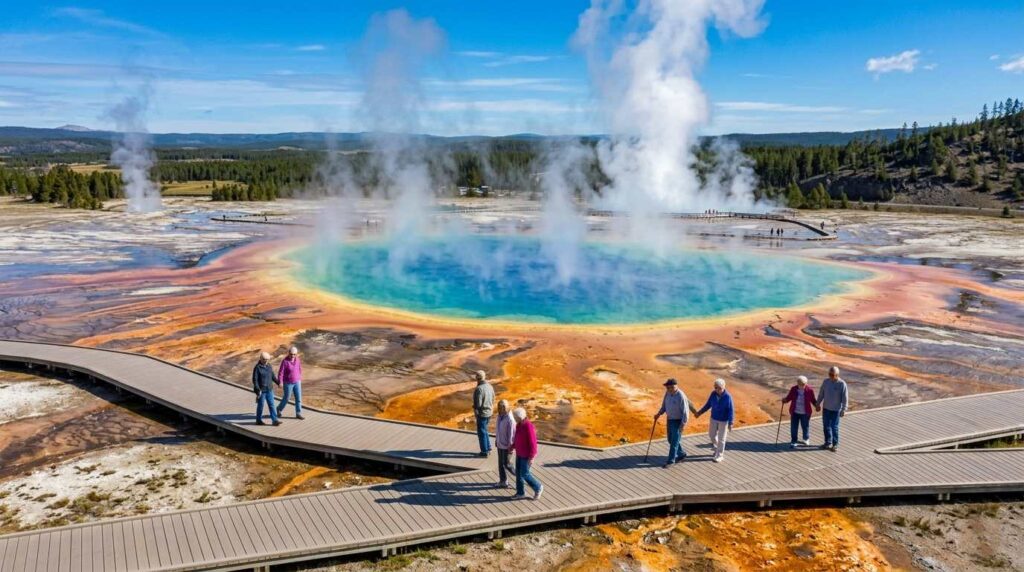
America’s first national park — geothermal wonders and bison herds accessible from the car
Yellowstone is enormous — larger than Rhode Island and Delaware combined — and much of its most extraordinary scenery is accessible within a short, flat walk on boardwalk trails. Old Faithful erupts every 60–110 minutes and can be watched from a paved, accessible viewing area. The Grand Prismatic Spring — the largest hot spring in the United States, brilliant blue and orange — is visible from a short boardwalk. Bison frequently walk alongside the road.
⚠️ Altitude Note: Yellowstone sits at 7,700–8,000 feet elevation. Seniors with heart or lung conditions should arrive a day early to acclimate and expect more fatigue than usual. The thin air is real.
| Best accessible experiences | Old Faithful viewing area ♿, Upper Geyser Basin boardwalk 🟢, Grand Prismatic overlook 🟢 |
| Best time to visit | Early September — crowds thin dramatically after Labor Day, wildlife more visible, roads still open |
| Book accommodation | In-park lodges open reservations in January for the following summer — book immediately. West Yellowstone and Gardiner are good gateway towns if in-park lodging is sold out. |
| Entry fee with Senior Pass | Free (normally $35/vehicle) |
7. Great Smoky Mountains National Park — Tennessee/North Carolina
America’s most-visited national park — free admission, accessible meadows, spectacular fall color
The Smokies are the most visited national park in America — more visitors annually than the Grand Canyon and Yellowstone combined — and notably, they’re also one of the few parks with no entrance fee even without a Senior Pass. The Cades Cove loop road offers 11 miles of wildlife viewing from your car, with deer, wild turkeys, black bears, and historic homesteads visible without leaving the vehicle. For seniors who want the national park experience with minimal physical demands, this is the most consistently rewarding option in the Eastern US.
| Best drive-through experience | Cades Cove Loop — 11-mile car loop, wildlife viewing, historic structures, no hiking required |
| Best easy trail | Laurel Falls Trail — 🟢 Easy — 2.6 miles round trip, paved, leads to beautiful waterfall |
| Best time to visit | Mid-October for peak fall color; early June for wildflowers. Avoid summer weekends — gridlock traffic. |
| Entrance fee | Free always — no charge for any visitor, Senior Pass not required |
8. Arches National Park — Utah
More than 2,000 natural stone arches — the most otherworldly landscape in America
The landscape at Arches looks like it belongs on another planet — red sandstone fins, balanced rocks, and over 2,000 natural arches created by millions of years of erosion. The iconic Delicate Arch is a challenging 3-mile round trip hike with significant elevation — not appropriate for most seniors. But the park road passes dozens of stunning formations accessible from overlooks and short walks, and the Windows Section offers an accessible loop to two massive arches within a half-mile walk on relatively flat terrain.
⚠️ Timed Entry Permit Required: Arches now requires a timed entry reservation (April–October) — book at recreation.gov when they open, typically 3 months in advance. This is separate from the entrance fee.
| Best accessible experience | Windows Section Loop — 🟢 Easy — 1 mile, sandy/packed gravel, two massive arches visible |
| Drive-up views | Balanced Rock overlook — ♿ Paved pullout — one of the most photographed formations, no walking required |
| Best time to visit | March–May or September–October. Avoid June–August (extreme heat, 100°F+) |
| Combine with | Canyonlands National Park (30 min away) and Dead Horse Point State Park — all remarkable, all on the Senior Pass |
| Entry fee with Senior Pass | Free (normally $30/vehicle) |
9. Crater Lake National Park — Oregon
The deepest lake in the US — a blue so intense most people assume it’s been edited in photos
Crater Lake formed in the caldera of Mount Mazama after its eruption 7,700 years ago. The lake is 1,943 feet deep and so clear that its blue color is unlike anything you’ll find naturally elsewhere in the world. The 33-mile Rim Drive circles the entire caldera with dozens of overlook pullouts accessible directly from the car. Most viewpoints require only a short walk from the parking area, and the lake is genuinely one of the most visually stunning natural features in North America.
| Best accessible view | Discovery Point — ♿ Accessible — panoramic lake view from paved overlook |
| Best drive | Rim Drive — 33 miles of overlooks, accessible from car, no hiking required for stunning views |
| Best time to visit | July–September only — rim road closed by snow October through June most years |
| Senior tip | Combine with the Oregon Coast (2-hour drive) for a remarkable 5-7 day Pacific Northwest itinerary |
| Entry fee with Senior Pass | Free (normally $30/vehicle) |
10. Cuyahoga Valley National Park — Ohio
The Midwest’s surprise — a national park between Cleveland and Akron with a historic train and a stunning waterfall
Cuyahoga Valley is the national park that most people in the Midwest drive past without realizing it exists. Wedged between Cleveland and Akron, it offers the Cuyahoga Valley Scenic Railroad — a heritage train that travels through the valley with a stop near Brandywine Falls — and Brandywine Falls itself, one of the most beautiful waterfalls in the Midwest, accessible via a short boardwalk that most seniors handle comfortably.
| Best accessible experience | Brandywine Falls boardwalk — 🟢 Easy — 1.5 miles round trip, boardwalk and paved path, stunning 65-foot falls |
| Unique senior experience | Cuyahoga Valley Scenic Railroad — no hiking, beautiful valley scenery from a restored historic train |
| Best time to visit | October for fall color; May–June for wildflowers and green canopy |
| Entry fee | Free always (no entrance fee for this park) |
Visual Inspiration: Your Next Adventure Starts Here
Reading about these wonders is one thing, but seeing the morning mist settle over a valley or the vibrant colors of a canyon at sunset is where the inspiration truly takes hold. Before we dive into the essential logistics of planning your trip—from securing the right passes to managing altitude—take a moment to immerse yourself in the natural beauty that awaits you in America’s protected wilderness.
Planning Your National Park Trip: Senior-Specific Advice
Book Accommodation Months in Advance
In-park lodges at Yellowstone, Grand Canyon, and Glacier book up within hours of opening — typically in January for the following summer. If you miss that window, gateway towns (the towns just outside park boundaries) are your best alternative. They’re often more comfortable, less expensive, and easier to navigate than in-park lodging anyway.
Altitude Is the Hidden Challenge
Many of America’s most spectacular parks — Yellowstone, Rocky Mountain, Arches, Bryce Canyon — sit at high altitude. Seniors with heart disease, COPD, or anemia are more susceptible to altitude sickness than younger visitors. Symptoms include headache, fatigue, and shortness of breath. The general guidance: spend your first day or two doing light activity, drink extra water, limit alcohol, and don’t push yourself on hikes until you’ve acclimated. If symptoms are severe, descend to lower elevation.
Timed Entry Permits Are the New Reality
Several popular parks — Arches, Rocky Mountain, Glacier — now require timed entry permits on busy days to manage overcrowding. These are typically free and available at recreation.gov, but they sell out quickly. Check your target park’s entry requirements before booking travel — arriving without a required permit means turning around at the gate.
Quick Reference: All 10 Parks at a Glance
| Park | State | Best Accessibility | Best Season | Normal Fee |
|---|---|---|---|---|
| Grand Canyon | AZ | ♿ Mather Point | Sept–Nov, Mar–May | $35 |
| Acadia | ME | 🟢 Carriage Roads | Sept–Oct | $35 |
| Everglades | FL | ♿ Anhinga Trail | Dec–Mar | $35 |
| Olympic | WA | 🟢 Hall of Mosses | Jul–Sept | $30 |
| Shenandoah | VA | ♿ Skyline Drive | Oct (fall color) | $30 |
| Yellowstone | WY | 🟢 Boardwalks | Early Sept | $35 |
| Great Smokies | TN/NC | 🟢 Cades Cove Drive | Oct, Jun | Free |
| Arches | UT | 🟢 Windows Loop | Mar–May, Sept–Oct | $30 |
| Crater Lake | OR | ♿ Rim Drive overlooks | Jul–Sept | $30 |
| Cuyahoga Valley | OH | 🟢 Brandywine Falls | Oct, May–Jun | Free |
Frequently Asked Questions – Best National Parks For Seniors
Absolutely — and this is probably the most underappreciated aspect of the national park system. The National Park Service has invested heavily in accessibility infrastructure over the past 20 years. Most parks now have wheelchair-accessible visitor centers, accessible restrooms at major viewpoints, and at least some paved or boardwalk trails. The NPS Accessibility website has specific accessibility information for every park, including trail surface types, grades, and accessible facilities.
The math is straightforward: most major parks charge $30–$35 per vehicle entry. Visit Grand Canyon twice ($35 × 2 = $70) and the lifetime pass has paid for itself with $10 to spare. If you visit even three parks in your lifetime, the savings are clear. Additionally, the 50% discount on camping fees can save $15–$20 per night, which accelerates the payback significantly for seniors who camp.
The essentials that seniors specifically need beyond the basics: a full day’s worth of any prescription medications (not just the morning dose), a printed or downloaded list of medications in case of emergency, a portable phone charger, electrolyte packets (dehydration at altitude or in heat is more dangerous for seniors), and sturdy shoes with ankle support even for short walks. Cell service is often nonexistent inside parks — download offline maps (Google Maps or AllTrails both work) before you arrive.
Great Smoky Mountains for East Coast seniors — free entry, wildlife-viewing from the car, very accessible, close to major airports. Grand Canyon for West or Midwest seniors — the experience is genuinely bucket-list, the infrastructure is excellent, and the accessible rim views are among the most dramatic on earth. Either is an excellent first national park experience that will almost certainly lead to more.
Yes — and they’re worth considering seriously. Ranger-led programs are free and available at most parks, covering everything from geology to wildlife to history at a comfortable, accessible pace. For more comprehensive guided experiences, companies like Natural Habitat Adventures and Road Scholar specialize in senior-friendly national park tours with small groups, accessible itineraries, and educational components that make the experience significantly richer.
The Parks Were Made for This
When Congress established Yellowstone as the first national park in 1872, the idea was radical: that the most spectacular landscapes in America should belong to everyone, preserved in perpetuity for public use and enjoyment. Not just for the young, the fit, or the wealthy. For everyone.
Ruth standing at the rim of the Grand Canyon at sunrise was exactly what that idea looked like in practice. She didn’t need to hike. She didn’t need to prove anything. She just needed to show up, walk two hundred meters on a paved path, and let something genuinely extraordinary happen to her.
That’s what these parks offer. The $80 pass, the accessible trails, the shuttle buses, the boardwalks through geothermal basins and old-growth forest — all of it exists so that the beauty belongs to you too, whatever your age, whatever your pace.
Go find yours.
Planning more senior travel? Discover these guides: