The short version: The best side hustles for retirees in 2026 are real, they pay real money, and most of them require nothing more than a laptop and skills you already have. This guide cuts through the noise — no hype, no vague advice — and gives you concrete options ranked by how realistic they are to start this week.
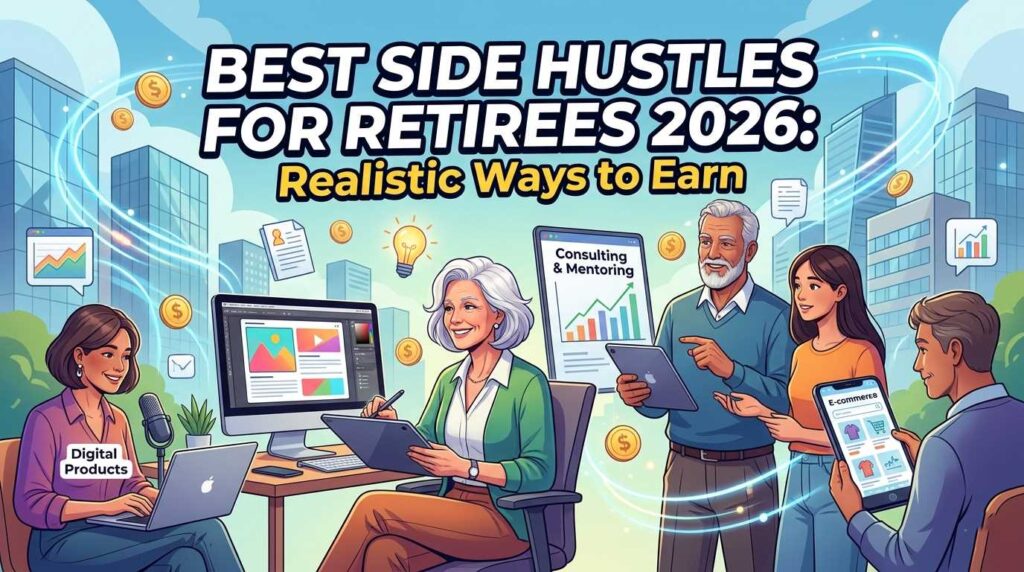
There is a conversation happening in living rooms across America right now. It usually starts with something like: ‘I thought retirement would feel different.’ Perhaps you expected more freedom. In other cases, costs are higher than you planned. Often, it is simply a matter of missing that feeling of being useful—knowing your knowledge matters to someone besides yourself.
If any of that rings true, you are not alone — and the timing of when you are reading this matters. The best side hustles for retirees in 2026 look nothing like the advice you would have received five or ten years ago. Something shifted. Technology that used to require years of training now does most of the heavy lifting for you. The market now actively values the qualities that come with age: reliability, professional judgment, and the ability to finish what you start.
This guide is for Americans over 55 who have never earned money online before. We will cover what actually works, what pays what, what to watch out for, and how to take your first real step — without wasting a single week on ideas that are not built for your situation.
Why Retirement Income Gaps Are Getting Wider in 2026
Before the options, the context — because understanding why this moment is different changes how you approach it.
Social Security replaces roughly 40% of pre-retirement income for the average American, according to the Social Security Administration. Most financial planners suggest you need at least 70 to 80 percent of your former income to maintain your standard of living. That gap — between what Social Security provides and what life actually costs — is what a well-chosen side hustle closes.
And here is the encouraging part: AARP research consistently finds that retirees who stay professionally engaged — even part-time — report higher life satisfaction, sharper cognitive function, and stronger social connection than those who stop working entirely. The money is one benefit. The rest of it turns out to matter just as much.
Honest disclaimer before we go further: There is no side hustle that makes you rich overnight. Anyone who tells you otherwise is selling you something. The options below are vetted, realistic, and grounded in actual 2026 market data. The income ranges reflect what real people are earning — not best-case projections.
The Best Side Hustles for Retirees in 2026: Ranked by Ease of Entry
The following options are ranked from most accessible (fewest barriers to start) to most lucrative (higher pay, but slightly more setup required). Most people do best starting somewhere in the first half of this list.

1. Paid Research Studies and Focus Groups
$50–$250 per session 2–4 hours/week Easiest to start
This is where many retirees begin, and for good reason: there is no sales pitch, no building a client base, and no learning curve. Market researchers and university teams need ordinary Americans — especially those over 55 — to participate in studies, test products, and share opinions in structured interviews.
Platforms like Respondent.io and User Interviews recruit participants based on demographic profiles. Being a homeowner, a retiree, someone with a specific health history, or a professional in a former field makes you a sought-after participant. Sessions typically run 60 to 90 minutes via Zoom and pay $75 to $125 per hour, according to AARP.
This is not a primary income source — sessions are irregular. But it is a legitimate, zero-risk way to earn $200 to $500 per month with almost no effort, and it is a confidence-builder for people who want to test the waters before committing to something more structured.
2. Virtual Assistant Work
$18–$35/hour 10–20 hours/week Very beginner-friendly
A virtual assistant is simply someone who handles tasks that busy professionals and business owners do not have time to manage: scheduling, email management, data entry, travel planning, research, customer follow-up. If you spent any part of your career in administration, office management, or executive support, you have the foundational skills already.
The technology required is minimal — email, Google Calendar, and basic word processing. Most clients communicate via email or a simple project tool. Pay typically starts around $18 to $22 per hour for general VA work and rises to $30 or more when you specialize. A 15-hour workweek at that rate generates $1,000 to $1,500 per month — while leaving five days free for everything else.
The AARP Job Board and FlexJobs both list vetted VA positions. For building your own client base, LinkedIn is your best tool. See our guide on LinkedIn profile optimization for seniors before you start applying.
3. Online Tutoring
$25–$80/hour 5-15 hours/week No teaching degree needed
The value of a tutor comes entirely from what they know — and knowing something deeply enough to teach it is exactly what decades of professional and personal experience provides. Formal licenses are not a requirement here. Neither is specialized training in education. What matters most is having expertise in a subject and the patience to explain it clearly.
Platforms like Wyzant, Tutor.com, and Varsity Tutors handle the matchmaking, scheduling, and payment. General K–12 tutoring in subjects like math, English, and history pays $20 to $35 per hour. If your professional background covers specialized territory — accounting, law, medicine, engineering, finance — you move into a premium bracket: $50 to $80 per hour for test prep and professional skills coaching.
Ten hours per week in that premium bracket generates $2,000 to $3,000 per month. Even five hours per week of general tutoring adds a steady $400 to $600. For a full walkthrough, see our online tutoring guide for seniors.
4. Selling Digital Products
$100–$1,500/month (passive) Upfront setup, then minimal Best long-term passive option
A digital product is a file you create once and sell indefinitely — a PDF guide, a checklist, a template, a simple workbook. There are no shipping costs, no inventory, and nothing to restock. Once it is listed on a platform like Etsy or Gumroad, it earns while you are at dinner, at a grandchild’s soccer game, or asleep.
The best digital products for retirees to create are the ones that solve a problem you already understand deeply. A retirement budget spreadsheet. A Medicare supplement comparison guide. A home modification checklist for aging in place. A weekly meal planner built for the 55+ lifestyle. You are not writing a book — these are practical, 5 to 20 page resources that people pay $7 to $30 each to download.
In 2026, AI tools like ChatGPT make the drafting process genuinely fast. You provide the knowledge and judgment; the tool helps you organize and write it up cleanly. Our full guide to selling digital products with AI for retirees walks through the entire process from first idea to first sale.
5. Freelance Consulting in Your Former Industry
$50–$150/hour 5–20 hours/week, your choice Highest income ceiling
If you spent fifteen or more years in any professional field, someone right now would genuinely pay for an hour of your time. That is consulting — and in 2026, the format has shifted in ways that make it far more accessible for retirees than it used to be.
You no longer need to commute to a client’s office, give formal presentations in a conference room, or commit to months-long engagements. Many businesses in 2026 hire experienced professionals for short, focused projects: a healthcare administrator reviews a small clinic’s billing process; a retired HR director helps a startup build its employee handbook; a former marketing executive advises on a product launch. One to three hours, billed at your rate, delivered via Zoom.
The challenge is positioning yourself correctly. Your LinkedIn profile needs to communicate what problem you solve — not just list your former job titles. Before you reach out to a single potential client, read our corporate to consulting guide and our consulting pricing guide. Undercharging is the single most common mistake new consultants make, and it is one you can easily avoid.
6. AI-Assisted Writing and Editing
$25–$60/hour Flexible Surprisingly accessible in 2026
Here is something the headlines get wrong: AI did not eliminate the need for human writers. It created a new one. Businesses rushed to use AI tools to generate content, and now a large portion of what exists online sounds robotic, repetitive, and untrustworthy. The market’s response has been a sharp increase in demand for real people who can read AI-generated text and make it sound human — warm, clear, and credible.
You do not need to be a professional writer to do this. You need to be a good reader, someone who notices when a sentence sounds awkward or when an explanation is confusing. Combine that instinct with tools like Grammarly and basic AI prompting, and you can offer services including proofreading, light editing, email drafting for small businesses, and content rewriting. Platforms like Upwork and Fiverr have consistent demand for exactly this kind of work.
To understand how to position yourself and use these tools effectively, start with our guide on making money with AI as a senior.
Realistic Income: What to Actually Expect in Your First 90 Days
One of the reasons people give up on side hustles too quickly is that they expect faster results than the timeline actually allows. Below is an honest look at what income looks like in the first 30, 60, and 90 days for each type of work.
| Side Hustle | Day 30 | Day 60 | Day 90 | Sustained Monthly (stable) |
|---|---|---|---|---|
| Paid Research / Focus Groups | $50–$200 | $100–$400 | $150–$500 | $200–$500 |
| Virtual Assistant | $0–$300 | $400–$900 | $800–$1,600 | $1,000–$2,500 |
| Online Tutoring | $100–$400 | $400–$1,000 | $700–$2,000 | $800–$3,000 |
| Digital Products | $0–$50 | $50–$300 | $150–$600 | $300–$1,500 |
| Freelance Consulting | $0–$500 | $500–$2,000 | $1,500–$4,000 | $2,000–$8,000+ |
| AI-Assisted Writing/Editing | $50–$300 | $300–$800 | $600–$1,500 | $700–$2,000 |
The pattern is consistent: month one is slow everywhere. Month two is where things start to click. Month three is when income becomes predictable. The people who give up in week three never find out what month three looks like.
“You can easily earn $500 to $1,000 a month without giving up your travel or doing all the things you want to do in retirement.” — Kathy Kristof, founder of SideHusl.com
Platform Comparison: Where to Find Legitimate Work
Choosing the right platform to start matters as much as choosing the right hustle. Here is how the major options compare for retirees specifically.
FlexJobs
$17–$150/hr
Every listing manually screened. No scam ads. Excellent for VA, writing, bookkeeping, and customer service roles. Small subscription fee worth it for peace of mind. 4.2/5 on Trustpilot from 6,000+ reviews.
AARP Job Board
Varies by role
Specifically designed to connect age-friendly employers with experienced candidates. Lists both part-time remote roles and gig work. Free to use. Powered via Indeed collaboration.
Upwork
$20–$150/hr
Large marketplace for consulting, writing, VA, and design. Takes 10–20% commission. Best for professionals with a clear, specific service to offer. Takes 4–8 weeks to build profile traction.
Respondent.io
$75–$125/session
Paid research platform. Seniors are frequently high-value participants. No skills required. Simply match a study’s demographic criteria. Sessions via Zoom, typically 60–90 minutes.
Wyzant
$25–$80/hr
Top tutoring platform for adults. You set your own rate, choose your subjects, and manage your schedule. Takes 25% until you hit $2,000 in earnings, then drops to 20%. Excellent for specialists.
Etsy
Passive, per sale
Best platform for digital product sales. Large, active buyer base. Charges small listing and transaction fees. Digital downloads require no shipping. Income is passive once products are listed.
Your First Week: A Practical Action Plan
Reading about side hustles is easy. Starting is where most people hesitate. Here is exactly what to do in the next seven days, one step at a time.
Phase 1: Setting the Foundation
- Day 1 — Choose your lane. Go back to the list of six options above. Pick the one that best matches your professional background. Do not try to do two at once. One clear focus beats three half-started efforts every time.
- Day 2 — Update your LinkedIn profile. This is your digital resume and your primary credibility signal. Use our LinkedIn tips for seniors to update your headline, summary, and recent experience. This takes 90 minutes and opens every door.
- Day 3 — Create one account on one platform. FlexJobs, Upwork, Wyzant, Respondent.io — whichever fits your chosen hustle. Do not create five accounts. Do not browse endlessly. Sign up for one and complete your profile fully.
Phase 2: Taking Active Steps
- Day 4 — Write your service description or apply to three listings. If you are on a freelance platform, write a clear, specific description of what you offer. If you are on a job board, apply to three listings that genuinely match your background. Do not apply to everything — quality over quantity.
- Day 5 — Set up a simple AI tool. Go to chat.openai.com and create a free account. Spend 30 minutes asking it to help you draft a professional bio or an email to a potential client. This is all the “AI training” you need to start.
- Day 6 — Check your account and follow up. Log in, respond to any messages, and tweak your profile based on anything you noticed during day four. This takes 20 minutes.
- Day 7 — Tell one person in your network what you are doing. A former colleague, a neighbor, a former boss. Word of mouth still produces the fastest first clients — not because they will necessarily hire you, but because they might know someone who will.
That is the entire first week. You are not trying to earn money this week. You are building the foundation that earns money next month. For a more detailed version of this plan, see our full remote job plan for beginners over 50.
The Scam Problem: What to Watch For Before You Start
This section is not optional reading. Online job scams targeting retirees are widespread, increasingly sophisticated, and worth understanding in detail before you submit a single application anywhere.
The warning signs are consistent across almost every scam:
- The offer arrives via unsolicited text message or social media DM — no legitimate employer contacts you this way.
- The pay rate is dramatically higher than the market — “$800 a day for simple data entry, no experience needed” — is not a job listing. It is bait.
- You are asked to pay something upfront — for training materials, a background check, or starter equipment. Legitimate employers never charge you to start working for them.
- The company cannot be found with a simple Google search, or the website looks hastily built with generic stock photos.
- You are asked to provide your Social Security number, bank account details, or to purchase gift cards during the “onboarding” process. Stop immediately and report it.
The single most reliable protection is starting on platforms that screen their listings: FlexJobs manually reviews every posting before it goes live. The AARP Job Board curates age-friendly employers. These platforms exist specifically because unvetted job boards are unreliable territory. For a comprehensive guide, see our guide to avoiding remote job scams and our cyber safety resource for seniors.
Social Security and Taxes: The Questions Everyone Has

Many retirees hesitate to pursue a side hustle because they are worried about how extra income affects their benefits and their taxes. Here is a plain-language breakdown of both.
Social Security and earning limits: If you have reached your Full Retirement Age — which for most Americans born after 1960 is age 67 — you can earn any amount from a side hustle without any reduction in your Social Security benefits. There is no cap. If you are younger than your Full Retirement Age, the SSA has annual earning limits, and those limits were raised for 2026. Check the current figures directly at ssa.gov for your specific birth year.
Self-employment taxes: When you earn income from a side hustle — rather than a traditional employer — you are considered self-employed. You will receive 1099 forms from clients (not W-2s), and you are responsible for paying self-employment tax, which covers Social Security and Medicare contributions. The rate is 15.3% on net earnings. A safe rule of thumb: set aside 25 to 30% of every payment you receive. The good news is that self-employed individuals can deduct business expenses — your internet bill, a portion of your home office, equipment purchased for the work — which often meaningfully reduces the taxable total. Consulting a CPA for your first year is money well spent.
Frequently Asked Questions
Getting Started with No Experience
Paid research studies and focus groups on platforms like Respondent.io and User Interviews are the most accessible starting point. There is no profile to build, no skills to demonstrate, and no pitching involved — you simply match a demographic profile and participate in structured Zoom sessions. Virtual assistant work is the next step up, requiring only email and basic scheduling skills that most adults already have.
Income Expectations and Technical Needs
Yes — but not in your first month. Tutoring at 10 to 12 hours per week, consulting at 8 to 10 hours, or virtual assistant work at 15 hours per week can each reach $1,000 to $2,000 per month within 60 to 90 days. Paid research alone will not reach that level consistently, but it can contribute $300 to $500 per month alongside another income stream.
No. The options best suited to retirees — consulting, tutoring, virtual assistance, and writing — require professional judgment and communication skills, not technical expertise. AI tools handle most of the digital complexity. If you can send and receive email and join a Zoom call, you have the technical foundation to start.
Benefits, Eligibility, and Flexibility
Medicare is generally not income-dependent, so a moderate side hustle income typically has no effect on your coverage. Medicaid is income-based, however, and additional earned income could affect eligibility in some states. If you rely on Medicaid, speak with a benefits counselor before starting any paid work. Your State Health Insurance Assistance Program (SHIP) provides free, unbiased counseling — find your local program at shiphelp.org.
A side hustle is work you control: you set your hours, choose your clients, and stop whenever you want. There is no manager, no commute, no performance review, and no obligation to show up when you are sick or when a grandchild needs you. That flexibility is the defining feature — and for most retirees, it is the entire point.
The Real Reason This Works in 2026 Specifically
Something worth saying plainly: the cultural narrative about retirement is changing, and it is changing in your favor. The assumption that professional value stops at 65 was always wrong. But in 2026, the market is finally pricing it that way.
Why Human Judgment Outshines AI
Companies are learning — sometimes expensively — that AI can produce volume but cannot provide the judgment, context, and professional credibility that experienced humans bring to client relationships, to crisis situations, and to the long view of how organizations actually function.
At the same time, the technology gap that once made remote and online work intimidating for older adults has largely closed. The tools are simpler, more intuitive, and better designed than they were even three years ago. What once required training now requires an afternoon of curiosity.
Embracing the “Beginner” Mindset
None of that means a side hustle is effortless. Finding your footing usually takes a few weeks of adjustment. Success also demands consistency in the early months when income is still unpredictable. Beyond that, it requires a willingness to be a beginner again — which, if you think about it, is something you have done successfully many times before.
Finding Your Market Fit
The best side hustles for retirees in 2026 are not hidden opportunities available only to tech-savvy people. They are ordinary work arrangements that fit ordinary retirement lifestyles — and right now, the market is ready for exactly what you have to offer.
Start with one option. Give it 90 days. See what month three looks like. For the most detailed step-by-step path from zero to your first paying client, our remote job plan for beginners over 50 covers everything. And if you want to see how the broader landscape of remote work has shifted for seniors, our complete remote jobs guide is a natural next read.
Not sure which side hustle fits your background? Answer a few quick questions and we’ll point you to the right starting place. Find Your Starting Point →
Last reviewed and updated: May 1, 2026 by the SeniorGig Team.