There’s a math problem at the heart of most consulting practices.You have 24 hours in a day. You can only be in one place at a time. Every hour you bill one client is an hour you can’t bill another. No matter how good you are or how much you charge, your income is ultimately capped by the number of hours you’re willing to work.For experienced professionals, group consulting for seniors breaks that math by allowing you to work with multiple clients at once.
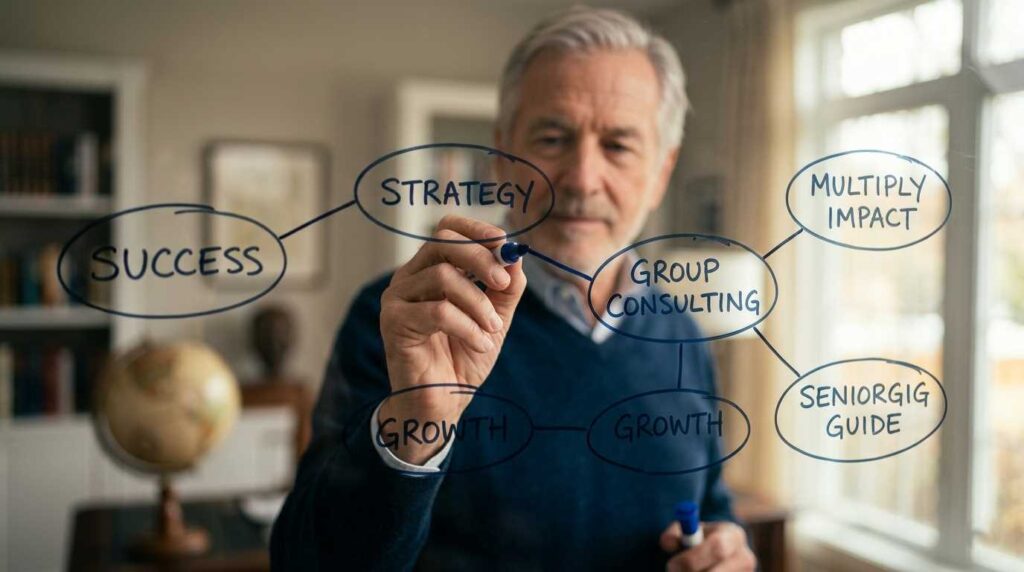
Instead of charging one client $200 for an hour of your time, you charge ten clients $50 each for the same hour. This model generates $500 instead of $200 while requiring the exact same amount of work. Furthermore, your impact expands significantly because you are now helping ten people instead of just one.
That’s the fundamental idea behind group consulting — and it’s one of the most powerful income models available to senior professionals in 2026.
Diane figured this out by accident. She’d been running a one-on-one HR consulting practice for two years after retiring from a 26-year career as a Chief Human Resources Officer. Her schedule was full. She was turning away clients. A colleague suggested she try a group format.
“I was skeptical,” she says. “The assumption was that my clients needed individual attention and that a group format would inevitably feel generic. However, I was wrong on both counts.”
Diane now runs two group consulting programs for HR directors at small and mid-size companies. Twelve participants per group. $400 per person per month. Eight months per program cycle. She earns $4,800 per month from each group — $9,600 total — while working approximately 12 hours per month per group.
“My one-on-one practice maxed out at $8,000 a month and consumed 30 hours a week,” she says. “My group programs earn more and I work a third of the time.”
This guide explains exactly what group consulting is, how it works, who it’s right for, and how to build your first group program from scratch — starting with no experience in group formats.
What Is Group Consulting — And How Is It Different From One-on-One Consulting?
Before anything else, let’s make sure the concept is completely clear — because “group consulting” means different things to different people, and the distinctions matter.
One-on-one consulting is what most people picture when they think of consulting: you work directly with a single client, addressing their specific situation, providing customized advice, and charging for your time individually.
Group consulting brings multiple clients together — typically 6 to 15 people — who share a common challenge, role, or goal. You facilitate the group, provide expertise, guide discussions, and address problems that are relevant to everyone in the room simultaneously.
The key distinction: in one-on-one consulting, your value is custom and individual. In group consulting, your value is shared — and the group itself becomes part of the value, because participants learn from each other as much as from you.
The Three Most Common Group Consulting Formats for Senior Professionals
Mastermind Groups: A facilitated peer group where members bring their current challenges to the group each session, receive structured feedback from both the facilitator (you) and fellow members, and hold each other accountable between sessions. Masterminds work best when all participants are at a similar professional level and face similar challenges. Typical size: 6 to 10 people. Typical format: monthly 90-minute sessions.
Group Coaching or Advisory Programs: A structured curriculum delivered to a cohort of participants over a defined period — typically 3 to 12 months. Each session covers a specific topic or framework. Participants get both the curriculum content and access to your expertise for their specific questions. Typical size: 8 to 15 people. Typical format: bi-weekly 60 to 90-minute sessions.
Peer Advisory Boards: A format where you serve as the facilitator and expert advisor for a small group of non-competing professionals in similar roles — typically CEOs, HR directors, or operations leaders from different companies. Members meet regularly to discuss shared challenges, with your role being to provide structure, expertise, and occasionally direct advisory input. This format is used by organizations like Vistage and YPO at scale, but senior consultants can run their own version independently.
Why Group Consulting Is Especially Well-Suited for Senior Professionals
Group consulting works for consultants at any career stage. But it works particularly well for seniors — for reasons that go beyond the obvious income math.
Your Experience Makes You a Better Group Facilitator
Facilitation — the skill of guiding a group conversation productively, drawing out quieter members, redirecting unproductive tangents, asking questions that unlock insight — is a skill that develops over years of managing teams, running meetings, and navigating complex group dynamics. Most seniors have been developing it for decades without calling it facilitation.
The 34-year-old consultant learning group dynamics from a book is at a genuine disadvantage compared to the 62-year-old who has run hundreds of team meetings, board presentations, and organizational off-sites. This is your territory.
You’ve Seen the Patterns That Groups Need to Hear About
The most valuable thing a group consulting facilitator brings to a session isn’t a framework or a curriculum. It’s pattern recognition — the ability to hear five different participants describe five different situations and say, “These are all variations of the same underlying problem, and here’s what I’ve seen work.” That capacity comes from depth of experience. Seniors have it. Younger consultants are still building it.
The Income Model Fits Senior Lifestyle Preferences
Group consulting naturally produces more income per hour worked — which means you can earn well while working fewer total hours. For seniors who want meaningful professional engagement without full-time demands, the math is genuinely attractive. Diane works roughly 24 hours per month across both groups and earns $9,600. That’s $400 per hour of actual working time.
Is Group Consulting Right for You? Honest Criteria
Group consulting is powerful — but it’s not right for everyone. Here’s an honest assessment of when it works and when it doesn’t.
Group Consulting Works Well When:
- Your clients face similar challenges. If all your clients are HR directors at small companies, or all are first-generation entrepreneurs, or all are healthcare administrators — you have a natural group. The more your clients’ situations resemble each other, the more value the group format produces.
- You enjoy facilitating group dynamics. Some people find one-on-one conversations energizing and group settings draining. Others are the opposite. Group consulting requires genuine comfort with — and ideally enjoyment of — group facilitation. Be honest with yourself about this.
- Your expertise addresses recurring, universal problems. If your consulting addresses challenges that repeat across many clients — building effective teams, managing cash flow, navigating regulatory change, developing leadership skills — group format works. If your work is highly bespoke to each client’s unique circumstances, individual consulting may remain the better model.
- You have or can build a defined audience. Group consulting requires enough interested people to fill the group. If you have an existing professional network, a LinkedIn following, or a Substack newsletter audience, filling a group of 8 to 12 people is achievable. If you’re starting from zero with no audience, individual consulting is a better starting point while you build visibility.
Group Consulting Works Less Well When:
- Your clients’ situations are genuinely unique and highly customized
- Your work involves confidential client information that can’t be shared in a group
- You prefer deep one-on-one relationships over broader group dynamics
- You haven’t yet established enough credibility in your niche to attract a cohort of paying participants
How to Price Your Group Consulting Program — The Economics Explained Simply
Pricing group consulting requires thinking differently than pricing one-on-one work. Here’s a simple framework that makes the numbers clear.
Start With Your One-on-One Rate
If you currently charge — or would charge — $150 per hour for individual consulting, that’s your reference point. A group member receives less of your individual attention than a one-on-one client, but they gain the additional value of peer learning and the group dynamic. A reasonable group rate is typically 30% to 50% of your one-on-one rate per participant.
So if your one-on-one rate is $150/hour: group rate per participant = $50 to $75 per session hour.
Calculate Your Group Revenue
With 10 participants at $60 per session: $600 per session. Two sessions per month: $1,200 per month. Over a 6-month program: $7,200 total. From roughly 12 to 15 hours of actual session and preparation time per month.
Compare that to your one-on-one practice: $150/hour × 15 hours = $2,250 per month for the same time investment. The group model produces more than five times the hourly yield.
The Monthly Retainer Model vs. Per-Session Pricing
Most successful group consulting programs charge a monthly retainer rather than per-session pricing. Monthly retainers produce predictable income, reduce the administrative friction of per-session billing, and psychologically commit participants to the full program rather than treating each session as optional. Typical monthly retainers for senior consultant group programs: $300 to $800 per participant per month depending on session frequency, your niche, and your credibility.
For a complete framework on pricing your consulting services at all levels, see our guide on How to Price Your Consulting Services as a Senior.
Step-by-Step: How to Build Your First Group Consulting Program
This is the practical section. Follow these steps in order and you’ll move from concept to first paying cohort in 60 to 90 days.
Step 1: Define Your Group Member Profile Precisely
The most common mistake in group consulting is defining the group too broadly. “Small business owners” is too broad. “First-generation immigrant entrepreneurs running service businesses with $500K to $2M in revenue” is a group. The more precisely you define who your group is for, the easier it is to find them, the more relevant your content is to all of them, and the more valuable the peer dynamic becomes within the group.
Write a single paragraph describing your ideal group member: their role, their company type, their specific challenge, and where they are in their career or business journey. If you can’t write that paragraph specifically, your group concept needs more refinement before you proceed.
Step 2: Define the Outcome Your Group Will Achieve
People join group consulting programs because they want a specific result — not because they want to attend sessions. Your program needs a clear, specific outcome statement.
Weak outcome: “You’ll develop your leadership skills and learn from peers.”
Strong outcome: “By the end of 6 months, you’ll have a documented succession plan, a restructured compensation framework, and a talent pipeline for your three most critical roles.”
The stronger your outcome statement, the easier it is to sell the program — because potential participants can evaluate whether that outcome is worth the investment.
Step 3: Design Your Program Structure
Decide on four structural elements before approaching any potential participants:
- Duration: How long does the program run? 3 months, 6 months, 12 months? Longer programs build deeper relationships and allow for more substantial transformation. Shorter programs are easier to sell to first-time participants.
- Frequency: How often does the group meet? Weekly is intense and produces fast results but requires high commitment. Monthly is easy to commit to but may feel too sparse. Bi-weekly is the most common format for senior consulting groups.
- Session length: 60 minutes for focused sessions; 90 minutes for sessions with significant group discussion; 2 hours for deep-dive workshops. Most senior consultant groups run 90-minute sessions.
- Group size: 6 people minimum to have enough voices for meaningful group dynamics; 12 people maximum to maintain meaningful individual attention. 8 to 10 is typically the sweet spot.
Step 4: Have Validation Conversations Before Building Anything
Before creating any curriculum, any sales page, or any marketing materials — have conversations with 8 to 10 people who match your ideal participant profile. Tell them you’re considering launching a group program and describe what you’re thinking. Ask:
- Does this challenge resonate with you right now?
- Would a group format be useful, or do you strongly prefer individual work?
- What would need to be true about the program for you to consider joining?
- At $X per month, does that feel reasonable, too high, or surprisingly low?
These conversations will tell you whether demand exists before you invest weeks in building a program. They will also often produce your first participants — people who helped shape the program feel ownership of it and are predisposed to join.
Step 5: Fill Your First Cohort Through Direct Outreach

Your first cohort will not come from advertising. It will come from your professional network and direct outreach. Make a list of 20 to 30 people who match your participant profile and reach out personally — not with a mass email, but with individual messages that explain the program and why you thought of them specifically.
Your LinkedIn network is your most valuable tool here. For how to use LinkedIn outreach effectively without it feeling like sales, see our guide on LinkedIn Outreach for Seniors.
Aim for 8 confirmed participants before your launch date. Don’t wait for 12. A cohort of 8 committed people beats a half-filled cohort of 12 every time.
Step 6: Run Your First Session — Then Improve
Your first group session will not be perfect. That’s expected and acceptable. The goal of the first session is to establish the group’s norms, build initial trust among participants, and demonstrate enough value that everyone leaves wanting to come back next time.
A simple first session structure that works:
- Welcome and introductions — each participant shares their name, role, and one specific challenge they’re hoping the group will help with (15 minutes)
- Group norms — establish confidentiality, respectful challenge, attendance expectations (10 minutes)
- First content or discussion topic — something immediately relevant to everyone (45 minutes)
- Homework and close — one action each participant commits to before the next session (10 minutes)
After the session, send a follow-up email summarizing key takeaways and commitments. This professional documentation signals that this is a serious program — not a casual conversation.
The Technology Senior Consultants Need to Run Group Programs Online
If you’ve never run an online group program before, the technology can feel intimidating. It isn’t. Here’s exactly what you need — nothing more:
Video Conferencing: Zoom
Zoom is the standard platform for professional group consulting. The free tier limits meetings to 40 minutes — not enough for group sessions. Zoom Pro costs $15.99 per month and removes the time limit. That’s your primary investment. Every participant joins from their own computer, no installation required on their end beyond downloading the free Zoom app.
Key Zoom features for group consulting: breakout rooms (for small group discussions within the larger group), the whiteboard (for visual brainstorming), recording (with participant permission, for members who miss a session), and polling (for quick group surveys during sessions).
Scheduling: Calendly
Use Calendly to schedule sessions and send automated reminders. The free tier is sufficient for group program scheduling. Participants receive calendar invites automatically when sessions are scheduled, and reminder emails reduce no-shows significantly.
Communication Between Sessions: A Private Group Space
Group consulting programs produce more value when participants can connect between sessions. A private Slack workspace (free for basic use), a private LinkedIn group, or a WhatsApp group all serve this purpose. Choose whichever your participants are most comfortable with — simplicity of adoption matters more than platform sophistication.
Documents and Resources: Google Drive
Create a shared Google Drive folder for each cohort. Store session recordings, resource documents, frameworks, and any materials you develop. Participants access it through any Google account — no special software required.
For AI tools that can help you prepare session materials, create frameworks, and manage your group program more efficiently, see our guide on Best AI Tools for Seniors.
How Group Consulting Fits Into Your Broader Consulting Practice
Group consulting works best not as a replacement for one-on-one consulting but as a complement to it. Here’s how many successful senior consultants structure their practice to include both:
The tiered model: Your group program is your entry-level offering — a lower-cost way for clients to access your expertise and experience the quality of your thinking. Participants who want more individualized attention upgrade to one-on-one engagements. This structure means your group program constantly feeds your higher-value individual practice.
The parallel model: You run group programs for clients whose needs fit the format and maintain a small number of one-on-one clients for more complex, customized work. Income comes from both streams simultaneously.
The transition model: You start one-on-one as you build your reputation and client base, then gradually introduce group programs as your credibility and network grow enough to fill cohorts. This is what Diane did — and it’s the most common path for seniors new to consulting.
For the complete framework of building a consulting practice from scratch, see our guide on How to Start Consulting After 50. For how to position your group program as a premium offer, read our High-Ticket Consulting for Seniors guide.
Realistic Income Expectations From Group Consulting for Seniors
Honesty first: income from group consulting varies enormously based on your niche, your existing reputation, your pricing, and how many groups you run simultaneously. Here’s what realistic numbers look like across different scenarios:
| Scenario | Group Size | Monthly Price | Monthly Revenue | Time/Month |
|---|---|---|---|---|
| Conservative start (1 group) | 8 people | $350/person | $2,800 | ~15 hrs |
| Established practice (1 group) | 12 people | $500/person | $6,000 | ~20 hrs |
| Two groups running | 10 people each | $450/person | $9,000 | ~35 hrs |
| Premium niche program | 8 people | $800/person | $6,400 | ~15 hrs |
The premium niche scenario — smaller group, higher price — is where experienced senior consultants with specific credibility often land after their first or second cohort. A group of 8 CFOs paying $800/month each for a CFO peer advisory group run by a former Fortune 500 CFO is entirely realistic and represents the kind of value proposition that justifies premium pricing.
For how this income interacts with Social Security, see our guide on Earning Income While on Social Security.
Next Steps: Build Your Group Consulting Practice
- Choose your consulting niche before designing your group program — read How to Choose Your Consulting Niche as a Senior.
- Protect your group program with proper agreements — see our Consulting Contract Template for Seniors.
- Set up the professional infrastructure your group practice needs — read our guide on How to Set Up a Consulting Website for Seniors.
- For the complete picture of online income options after 50, visit our Make Money Online After 50 Master Guide.
Diane is launching her third group program next quarter. A new format — an intensive 3-month cohort for HR directors navigating their first merger or acquisition. Twelve participants. $650 per month each. $7,800 per month from a format she had never tried two years ago.
“The group format changed how I think about my expertise,” she says. “One-on-one, you’re solving one person’s problem. In a group, you’re solving a problem for an entire community of people simultaneously. That’s a completely different kind of impact — and honestly, a more satisfying one.”
Your expertise doesn’t have to be dispensed one person at a time. Group consulting lets you multiply your impact, your income, and your reach — without multiplying your hours.
Frequently Asked Questions: Group Consulting for Seniors
Group consulting involves advising 6–12 clients simultaneously rather than one-on-one. The main difference is economic: you earn more per hour by serving multiple paying participants at once. Additionally, participants benefit from peer learning, which often creates deeper insights than solo sessions.
Six participants is a functional minimum for good group dynamics. The “sweet spot” is 8–10 people, providing diverse perspectives while maintaining personal attention. Aim for a maximum of 12 members to ensure the quality of the experience.
Look to your existing professional network and LinkedIn connections rather than paid ads. Start by listing 20–30 ideal candidates and reaching out personally. Most seniors fill their first cohort within 4–8 weeks through these direct validation conversations.
A typical starting range is $300–$600 per participant monthly for bi-weekly sessions. Premium niches, such as C-suite advisory, can command $700–$1,500. Begin conservatively and increase your rates as you gather success stories.
Yes, online programs are highly effective and eliminate travel costs or geographic limits. Tools like Zoom make it easy to facilitate professional sessions from anywhere. Well-managed virtual groups often develop bonds as strong as in-person meetings.
Consulting is self-employment income and counts toward annual earnings limits. In 2026, those below full retirement age may see temporary benefit reductions if they earn over $22,320. Once you reach full retirement age, earnings no longer impact your benefits.
A Note From the SeniorGig Team
Transitioning from a traditional career to a flexible, high-impact consulting model is one of the most rewarding moves you can make after 50. At SeniorGig Guide, we believe your decades of experience are far too valuable to be shared only one person at a time.
Group consulting isn’t just about the “income math”—it’s about creating a community where your wisdom helps multiple professionals grow simultaneously. If you’re feeling hesitant about the tech or the structure, start small. Reach out to your network, have those first few conversations, and you’ll likely find that people are eager for the guidance only someone with your background can provide.