

This North Carolina retirement guide for seniors covers the real story — why it’s the fastest-growing retirement state in America, which cities actually deliver, what’s gotten expensive, and the things most retirement guides conveniently leave out.
Something unusual happened in North Carolina over the past decade. It was always a pleasant state — good climate, beautiful mountains, reasonable coast, decent cities. But it quietly became the fastest-growing retirement destination in the United States, attracting more net migration of seniors than any other state including Florida in recent years.
The reasons are real, and this guide covers all of them honestly. But we’re also going to cover the things the state’s chamber of commerce doesn’t put in the brochure — because the seniors who move to North Carolina and love it are the ones who understood both sides of the picture before they arrived.
Why North Carolina? The Honest Case
North Carolina offers something rare: genuine geographic variety within a single state. You can retire in the Blue Ridge Mountains near Asheville at 2,000 feet elevation with cool summers and spectacular fall foliage. You can retire in the Research Triangle (Raleigh-Durham-Chapel Hill) with world-class healthcare, university-town energy, and a thriving economy. You can retire on the Outer Banks or near Wilmington with Atlantic beaches and mild coastal climate. Or you can retire in Charlotte with urban amenities, a major airport, and suburban affordability.
Very few states let you choose between mountains, coast, and major metros — all within a few hours of each other. That geographic variety, combined with a generally favorable tax environment and healthcare infrastructure anchored by Duke, UNC, and Wake Forest medical systems, is the genuine core of North Carolina’s appeal.
💰 North Carolina Tax Summary for Retirees 2026
| State income tax | 4.75% flat rate (dropping to 3.99% by 2026 under current law) |
| Social Security income | Fully exempt from state income tax |
| Pension income | Up to $4,000 exempt for private pensions; government pensions may be fully exempt |
| 401(k)/IRA withdrawals | Taxed at flat rate after standard deductions |
| Property tax | Moderate; senior homestead exclusion available for qualifying residents 65+ |
| Sales tax | 4.75% state + local (typically 6.75–7.5% combined) |
| Estate/inheritance tax | None |
The comparison to Tennessee is worth making directly: Tennessee has no income tax at all, while North Carolina taxes retirement income above deductions at 4.75% (declining). For a detailed breakdown of exemptions and filing requirements, you can visit the official North Carolina Department of Revenue website. For a couple with $80,000 in retirement income, North Carolina’s tax bill might be $2,000–$3,000 per year versus zero in Tennessee. Whether that difference matters to your decision depends on your income level and how much you value the specific things North Carolina offers that Tennessee doesn’t — primarily better beach access and the Research Triangle’s medical and educational infrastructure.
The Best North Carolina Cities for Senior Retirement
Asheville — Arts, Mountains & the Most Talked-About Retirement Town in the South
Asheville is the retirement destination that every magazine and every list puts at the top, and the reputation is largely earned. The arts scene is genuine and vibrant — more galleries, live music venues, and working artists per capita than cities three times its size. The Blue Ridge Parkway runs along the ridgeline above town. The food culture has developed into something nationally recognized. The four seasons are real and beautiful, with summer highs in the mid-70s that are genuinely extraordinary compared to the rest of the South.
⚠️ What the articles don’t say: Asheville is expensive now. Dramatically more expensive than it was five years ago. Median home prices have crossed $400,000 and many desirable neighborhoods are pushing $600,000+. The city has a housing shortage, a homeless population that surprises new arrivals, and an infrastructure that hasn’t kept pace with rapid growth. If you’re on a moderate budget, the Asheville area — not the city itself but the surrounding communities of Weaverville, Swannanoa, Black Mountain, and Hendersonville — delivers most of the same appeal at significantly lower cost.

| Best for | Arts, culture, mountain lifestyle, cool summers |
| Avg. home price | City: $420K–$650K | Hendersonville: $320K–$440K | Black Mountain: $340K–$480K |
| Healthcare | Mission Hospital (HCA), but Mission has faced quality concerns — complex cases often go to Charlotte or Duke |
| Climate | Highs in the mid-70s in summer, genuine fall color, cold winters with occasional snow |
| Best alternative | Hendersonville — 30 min south, similar appeal, 20–30% lower housing costs, less traffic |
Raleigh / Durham / Chapel Hill — Best Healthcare, Universities & Intellectual Energy
The Research Triangle is the retirement choice for seniors who prioritize access to world-class healthcare and university-level intellectual engagement above all else. The region’s medical excellence is consistently reflected in the U.S. News & World Report hospital rankings, where North Carolina facilities often place among the nation’s best.
Duke University Medical Center, UNC Health, and WakeMed all operate here, and the concentration of medical expertise is genuinely exceptional — among the best in the country for complex care, specialized treatment, and cutting-edge clinical trials. The presence of Duke, UNC, NC State, and several other universities creates a lecture series, arts, and cultural calendar that rivals cities three times the size.

The Triangle has gotten noticeably more expensive over the past five years as tech and pharmaceutical companies have relocated here. It’s no longer the bargain it once was, but it’s still meaningfully more affordable than similar quality-of-life metros in the Northeast or California. Cary, Chapel Hill, and Morrisville are the suburbs where most retiring seniors land — close to the medical facilities, calmer pace than the cities themselves.
| Best for | Complex medical needs, intellectual lifestyle, university culture |
| Avg. home price | Cary/Chapel Hill: $450K–$600K | Morrisville: $380K–$500K |
| Top healthcare | Duke University Medical Center (top 10 nationally), UNC Hospitals, WakeMed |
| Senior programs | Duke’s OLLI, UNC’s Carolina Center for Public Service — exceptional senior learning options |
| Senior tip | Pittsboro (30 min from Chapel Hill) offers a charming small-town alternative at lower cost with Triangle access |
Wilmington — Best Coastal Living at a Fraction of Florida’s Price

Wilmington sits at the Cape Fear River’s mouth, 15 minutes from the Atlantic beaches of Wrightsville Beach and Carolina Beach. It has a genuinely lovely historic downtown, a UNCW campus that contributes cultural energy, warm Atlantic waters for swimming from May through October, and a much more relaxed pace than the Florida coastal resorts that cost twice as much.
Hurricane risk is real — Wilmington and the NC coast have taken direct hits in recent years. Property insurance has risen, though not to the crisis levels seen in South Florida. For seniors who want coastal North Carolina living, this is the tradeoff that requires honest assessment. The question isn’t whether hurricanes happen — they do — but whether the lifestyle value justifies the insurance cost and the occasional disruption.
| Best for | Beach lifestyle, coastal scenery, historic downtown walkability |
| Avg. home price | $340K–$480K; beachfront significantly higher |
| Healthcare | Novant Health New Hanover Regional — solid regional hospital; Duke 2 hrs for complex care |
| Hurricane risk | Moderate-high — research flood zone for any specific property before purchasing |
| Senior tip | Leland (across the river) offers significantly lower housing costs with easy Wilmington access |
Charlotte — Urban Amenities, Major Airport & Suburban Affordability
Charlotte is North Carolina’s largest city and the financial capital of the Southeast — home to major banks, a booming economy, and a city infrastructure that’s grown rapidly. For seniors who want a major city with a nonstop flight to anywhere, grandchildren access, professional sports, and urban amenities, Charlotte’s suburbs (Huntersville, Ballantyne, Waxhaw, Mooresville) offer that package at prices that remain reasonable compared to similar markets elsewhere.
📺 Watch: The 4 Best Areas to Retire in Charlotte Metro
Thinking about retiring in North Carolina’s largest hub? In this video, local real estate expert Jay White breaks down the most popular retirement spots in the Charlotte metro area, including South Charlotte, Lake Norman, Fort Mill, and Matthews. Discover why South Charlotte is a healthcare powerhouse and how Lake Norman offers a unique waterfront lifestyle for active seniors.
| Best for | Urban lifestyle, major airport access, family proximity |
| Avg. home price (suburbs) | Huntersville: $380K–$530K | Mooresville: $350K–$480K | Waxhaw: $400K–$560K |
| Healthcare | Atrium Health (strong regional system), Novant Health Charlotte |
| Lake Norman | 30 min north of Charlotte — lake lifestyle communities popular with retirees (Mooresville, Cornelius) |
What Nobody Tells You: The Honest Tradeoffs
Every retirement guide covers the positives. Here’s what gets left out.
Asheville’s Healthcare Situation Has Changed
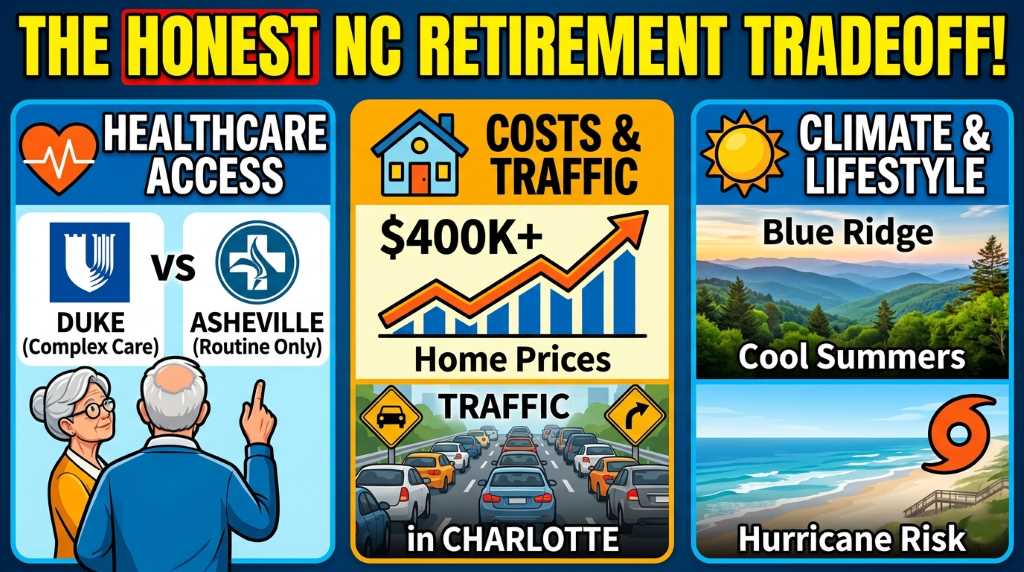
Mission Hospital — Asheville’s main hospital — was acquired by HCA Healthcare in 2019, and the quality concerns that followed have been well-documented in local and national reporting. Staff reductions, nurse strikes, and investigations by the state attorney general have all made news. For routine care and emergencies, Mission remains functional. For complex cardiology, oncology, or neurology, many Asheville-area residents now drive 2 hours to Charlotte or 3 hours to Duke. This matters significantly for seniors with ongoing complex medical needs who are considering the Asheville area specifically for retirement.
The “Affordable” Label Is Getting Stale
North Carolina was genuinely affordable a decade ago. Parts of it still are. But the most desirable retirement destinations in the state — Asheville, Chapel Hill, coastal areas, and Charlotte suburbs — have seen dramatic price appreciation driven by remote work migration and general in-migration from more expensive states. The people who moved to Asheville in 2015 got a deal. The people moving in 2026 are paying significantly more than that deal. Research current prices in specific neighborhoods rather than relying on state-level averages.
Traffic Has Gotten Noticeably Worse
Raleigh-Durham and Charlotte have both experienced significant traffic deterioration as population has grown faster than road infrastructure. Asheville’s mountain geography limits road expansion and creates bottlenecks. For seniors who are car-dependent (which most of NC is, outside of select walkable neighborhoods), this is a quality-of-life consideration worth accounting for.
Monthly Cost Comparison: North Carolina in 2026
| Expense | Hendersonville / Tri-Area | Research Triangle | Wilmington |
|---|---|---|---|
| Housing (own) | $1,000–$1,600 | $1,400–$2,200 | $1,200–$1,900 |
| Utilities | $150–$220 | $160–$240 | $170–$250 |
| Groceries | $350–$500 | $400–$580 | $380–$520 |
| Transportation | $250–$380 | $300–$480 | $280–$420 |
| Healthcare | $200–$380 | $200–$380 | $200–$380 |
| Dining & entertainment | $300–$500 | $400–$700 | $350–$600 |
| Monthly Total (couple) | $2,250–$3,580 | $2,860–$4,580 | $2,580–$4,070 |
Frequently Asked Questions – North Carolina Retirement Guide Seniors
Different priorities, different answer. Asheville wins on natural beauty, arts culture, cooler climate, and outdoor access. The Research Triangle wins on healthcare quality (Duke is in a different league than Mission Hospital), intellectual environment, urban amenities, and practical infrastructure. For seniors with significant medical needs, the healthcare quality gap strongly favors the Triangle. For seniors whose priorities are lifestyle and environment over medical infrastructure, Asheville’s appeal is real and well-earned.
Yes — significant ones. Del Webb has communities in the Triangle area. Fearrington Village near Chapel Hill is one of the most well-regarded planned retirement communities in the Southeast, with a walkable village center, arts programming, and distinctive character. The Four Seasons community in Pittsboro and several larger active adult developments in the Charlotte suburbs round out the options. The density isn’t Arizona-level, but the quality of the communities that do exist is high.
Yes — as of 2021, military retirement pay is fully exempt from North Carolina state income tax. This is a significant benefit for veterans and military retirees considering NC, and it makes the state considerably more competitive on the tax front for this demographic specifically. Combined with the no-tax treatment of Social Security, military retirees in North Carolina face a very favorable state tax environment overall.
October is genuinely spectacular in western NC — peak fall foliage on the Blue Ridge Parkway is one of the most beautiful natural displays in the eastern United States. But October is also tourist season, which means you’re seeing the area at its most crowded and most expensive. A more useful scouting visit might be late January or February — you see the winter (which is when most people decide the climate isn’t for them), the tourist infrastructure is quiet, and locals have time to talk. Visit in both seasons if you’re seriously considering the mountain areas.
NC Medicaid covers nursing facility care and some home-based services for qualifying residents who meet income and asset requirements. North Carolina expanded Medicaid in 2023, which has extended coverage to more residents, including some in the senior population who previously fell into coverage gaps. The eligibility criteria and look-back period rules are state-specific and complex — if long-term care planning is central to your retirement financial planning, consult an elder law attorney familiar with North Carolina’s specific rules before making residency decisions.
North Carolina Rewards the Research
The seniors who love North Carolina are the ones who did their homework — who understood before they arrived that Asheville is expensive now and Mission Hospital has real limitations, that the Triangle has traffic problems but also has Duke, that Wilmington has hurricane risk but also has genuinely beautiful coastal living for a fraction of Florida’s price.
The state offers something genuinely rare: a choice between multiple compelling retirement environments within a few hours of each other, anchored by world-class healthcare in the Triangle, natural beauty in the mountains, and coastal access in the east. The tax situation is favorable without being perfect. The cost of living is moderate without being cheap. The quality of life, in the right part of the state for your specific priorities, is excellent.
The key phrase in that last sentence is “the right part for your specific priorities.” North Carolina doesn’t work for everyone in the same way. It works very well for seniors who know what they want, research it carefully, and choose accordingly. That’s what this guide is designed to help you do.
Compare more retirement destinations: