
Vietnam is extraordinary — one of the most culturally rich, scenically dramatic, and culinarily extraordinary countries on earth. It’s also the Southeast Asian retirement destination with the most significant visa challenge for Americans. This guide gives you the real 2026 picture: what makes Vietnam genuinely compelling, what the visa situation actually looks like, and how the growing community of American expats makes it work.
If you are planning to retire in Vietnam, you are embarking on a journey to one of the most culturally rich countries. This retire in Vietnam guide for Americans 2026 covers everything you need to navigate the visa environment, costs, and expat life. When you decide to retire in Vietnam, you gain access to a unique lifestyle that many Americans find deeply rewarding. It’s the energy. The motorbikes. The street food vendors who’ve been making the same pho or banh mi from the same cart for forty years. The Vietnamese people — energetic, entrepreneurial, warm toward Americans in a way that defies the obvious historical complication — who make daily life there feel genuinely alive.
Vietnam is also the most visa-complex destination in this guide series. Unlike Thailand (straightforward retirement visa), Colombia (accessible pensionado), or Portugal (clear D7 pathway), Vietnam has no dedicated retirement visa and requires careful management of a limited-stay framework that most long-term residents navigate through a combination of visa renewals, e-visas, and strategic planning. This is solvable — tens of thousands of American expats live in Vietnam — but it requires honest understanding before you commit.
📋 Contents
- → Why Vietnam: What Makes It Genuinely Extraordinary
- → The Visa Reality: How Americans Live Long-Term in Vietnam
- → Real 2026 Costs: City by City
- → Best Cities: Hanoi vs. Hoi An vs. Da Nang vs. Ho Chi Minh City
- → Healthcare: Good News in Major Cities, Limited Elsewhere
- → Practical Realities: Language, Culture, Daily Life
- → Vietnam vs. Thailand: Honest Comparison
- → Frequently Asked Questions
Why You Should Retire in Vietnam in 2026
| Advantage | What It Means in Practice |
|---|---|
| Lowest cost in Southeast Asia | A comfortable couple’s life in Hoi An or Da Nang: $1,200–$2,000/month. Equivalent in Thailand: $1,800–$2,800. Vietnam consistently beats every other comparable destination on cost. |
| Food culture | Widely considered one of the world’s 5 greatest food cultures. Pho, banh mi, bun bo Hue, cao lau, banh xeo — regional diversity extraordinary. Street meals $1–3. Restaurant excellence at $8–15. |
| Geographic diversity | 1,650km coastline, mountain highlands, ancient towns, river deltas, limestone karsts — more landscape variety per square kilometer than almost any country |
| American warmth | Despite — or perhaps because of — the war’s history, Vietnamese people have a documented warmth toward Americans that consistently surprises first-time visitors. The “doi moi” (renovation) generation grew up with economic partnership, not historical grievance. |
| Vibrant, modern energy | Vietnam is one of Asia’s fastest-growing economies. The cities feel alive, entrepreneurial, forward-moving. For seniors who find other retirement destinations too quiet, Vietnam has a pulse. |
| Expat infrastructure | Da Nang and Hoi An have well-developed English-speaking expat communities, Western restaurants, expat-oriented services, and healthcare accessible to foreigners. |
The Visa Reality: How Americans Live Long-Term in Vietnam
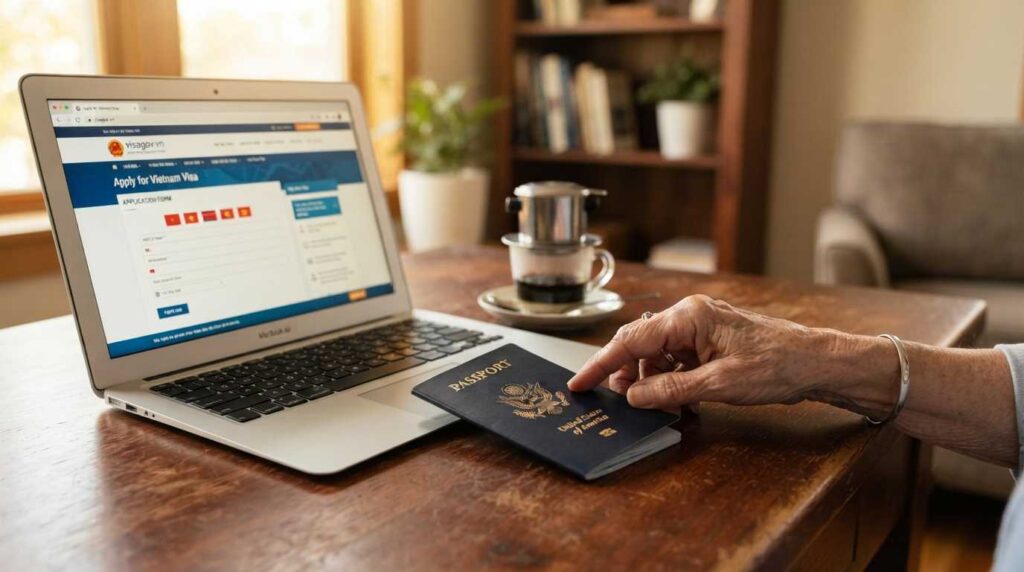
Vietnam has no dedicated retirement visa — this is the most important practical fact about retiring there. What it does have is a framework of visa options that, managed properly, allows for long-term residence.
🛂 Vietnam Visa Options for Americans in 2026
| Visa Type | Duration | Requirements | Notes |
|---|---|---|---|
| E-visa | 90 days single or multiple entry | Apply online at evisa.xuatnhapcanh.gov.vn; $25 fee | Renewable once; maximum 180 days on e-visa path before needing to exit and re-enter |
| DT visa (investor) | 1–5 years | Business investment in Vietnam | Requires legitimate business activity; used by some expats with local businesses |
| TT visa (family/spouse) | Up to 2 years | Married to Vietnamese citizen | Most stable path; requires marriage |
| NG3 (NGO/expert) | Up to 2 years | Working for recognized organization or as invited expert | Available for volunteers with accredited NGOs |
| E-visa + periodic exit | Continuous through renewal | Leave Vietnam briefly, re-enter on new e-visa | Most common strategy; legal but technically a gray area for permanent residence intent |
💡 How Most American Expats Do It: The practical reality for most American retirees in Vietnam is the e-visa renewal cycle — obtaining a 90-day multiple-entry e-visa, living in Vietnam, making a brief exit to a nearby country (Cambodia, Thailand, Laos, even just a day trip to Cambodia via bus) and returning on a new e-visa. This is legal and widely practiced. Vietnam is working on a longer-term visa framework, and regulations change. An immigration specialist based in Vietnam (easily found through expat community forums) can advise on the current optimal approach for your situation.
Real 2026 Costs: City by City
| Expense | Hoi An | Da Nang | Hanoi | Ho Chi Minh City |
|---|---|---|---|---|
| Rent (2BR modern) | $300–$600 | $400–$800 | $500–$1,000 | $600–$1,200 |
| Food (mix local + Western) | $250–$450 | $280–$500 | $300–$550 | $350–$650 |
| Transport | $60–$120 | $80–$160 | $100–$200 | $120–$250 |
| Healthcare (private insurance) | $120–$250 | $130–$280 | $150–$300 | $150–$300 |
| Utilities + internet | $60–$110 | $70–$130 | $80–$150 | $90–$170 |
| Entertainment + wellness | $100–$250 | $120–$300 | $150–$350 | $200–$500 |
| Monthly Total (couple) | $890–$1,780 | $1,080–$2,170 | $1,280–$2,550 | $1,510–$3,070 |

💡 The Vietnam Cost Reality: Vietnam is genuinely the lowest-cost comfortable retirement destination in this guide series. A couple living well in Hoi An — good apartment, mix of local and Western food, occasional restaurant splurges, wellness activities — can do so for $1,200–$1,500/month. This is roughly half the cost of an equivalent lifestyle in Thailand and a third of comparable comfort in Southern Europe. The trade-off is the visa complexity and more limited healthcare infrastructure outside major cities.
Best Cities for American Retirees
🏮 Hoi An — The Most Beautiful Small Town in Southeast Asia

Hoi An’s Ancient Town — a UNESCO World Heritage Site of preserved 15th–19th century trading port architecture, lantern-lit streets, and tailors who can make a bespoke suit in 24 hours — is genuinely one of the most beautiful places on earth. The surrounding area offers beaches (An Bang, Cua Dai), rice paddies, bicycle-friendly roads, and an expat community large enough to provide infrastructure and social life without being overwhelming. Costs are the lowest of any comfortable Vietnamese expat hub. The drawback: Hoi An is small, and some expats find its limited entertainment and professional options confining after extended stays.
🌊 Da Nang — Best Infrastructure + Beach + City Combination
Da Nang is Vietnam’s third-largest city and has been extensively modernized — excellent roads, reliable infrastructure, good international hospitals, a long clean beach (My Khe), and proximity to both Hoi An (30 min south) and Hue (1.5 hours north). It’s the most livable city in Vietnam for expats who want urban infrastructure without Ho Chi Minh City’s intensity. The expat community is well-established. For most American retirees choosing Vietnam, Da Nang is the practical best choice — urban enough to have everything needed, small enough to feel human-scaled.
🏯 Hanoi — For Those Who Want Old Vietnam
Hanoi is Vietnam’s capital and its most historically layered city — the Old Quarter’s 36 guild streets, the Ho Chi Minh Mausoleum, Hoan Kiem Lake, French colonial architecture, street food that’s different from the south (bun cha, pho Hanoi, banh cuon). It’s also cooler than the south — genuinely cold in December-February — which suits some seniors and alienates others. The expat community is active but smaller than Saigon’s. Traffic and pollution are significant. For seniors specifically drawn to deep Vietnamese cultural character and history, Hanoi is extraordinary.
🏙️ Ho Chi Minh City (Saigon) — For Urban Energy Lovers
HCMC is Vietnam at its most intense — 10 million people, 8 million motorbikes, extraordinary food, the best hospitals in Vietnam, a massive expat community, world-class restaurants, rooftop bars, and a pace that never stops. For seniors who are urban by nature and find smaller cities boring, Saigon delivers. The District 2 (Thao Dien) and District 7 areas have well-developed expat infrastructure with Western supermarkets, international schools, and good English-language services. The cost is higher than Hoi An but still dramatically lower than any comparable city in the US or Europe.
Healthcare: Good in Major Cities, Limited Elsewhere
Vietnam’s private healthcare has improved dramatically over the past decade. In Ho Chi Minh City and Hanoi, international hospitals — FV Hospital, Vinmec, Hoan My — provide genuinely good care with English-speaking staff at a fraction of US prices. In Da Nang, Da Nang Hospital for Women and Children and Hoan My Da Nang handle most expat healthcare needs well. Specialist consultation: $30–$60. Full health checkup: $80–$150.

The honest limitation: for serious conditions requiring advanced specialist care — complex cardiac surgery, cancer treatment, neurosurgery — evacuation to Bangkok or Singapore (Bumrungrad, Gleneagles) remains the expat standard. Vietnam’s best hospitals are excellent for general care; their specialist capacity doesn’t yet match Bangkok’s top-tier facilities. Seniors with significant health complexity should factor the Bangkok evacuation option into their healthcare planning — and ensure their insurance includes medical evacuation coverage.
🚨 Medicare Note: US Medicare has no coverage in Vietnam. International health insurance with medical evacuation coverage is essential. Cigna Global, Allianz Care, and AXA all offer Vietnam-based expat plans. Budget $150–$350/month for comprehensive coverage including evacuation for a couple in their 60s.
Practical Realities: Language, Culture, Daily Life
Language
Vietnamese is a tonal language — six tones — that’s genuinely difficult for English speakers. In expat areas of Da Nang, Hoi An, and Saigon’s District 2, English is functional for daily life. Outside these zones, communication requires translation apps (Google Translate’s camera function handles Vietnamese well) or basic Vietnamese. Unlike Thailand, Vietnamese uses the Latin alphabet (romanized by a Portuguese missionary in the 17th century) — you can read words phonetically even without understanding meaning, which makes navigation and ordering food significantly easier than in Thailand or China.
The American History Question
Many American seniors approach Vietnam with anxiety about how they’ll be received given the war’s history. The reality, consistently reported by American expats: Vietnamese people — particularly the majority who were born after 1975 — treat Americans with genuine warmth and curiosity. The war is a historical event, not a present wound, in most Vietnamese interactions. American veterans who have returned to Vietnam for the first time often describe the experience as unexpectedly healing. The anxiety about reception is almost universally reported as unfounded after arrival.
The Traffic Reality
Vietnamese traffic — particularly in Hanoi and Ho Chi Minh City — is famously chaotic by Western standards. Millions of motorbikes operate according to a fluid logic that takes time to decode. Crossing the street in Saigon is an art form that takes weeks to master. Most expats either hire drivers, use ride-hailing apps (Grab is the dominant platform — equivalent to Uber, works excellently throughout Vietnam), or adapt to the motorbike culture. Renting or buying a motorbike is common among expats in Hoi An and smaller cities. In Da Nang, bicycles work well. Driving a car requires a Vietnamese license and is not recommended for most expats.
Before packing your bags to retire in Vietnam, it is vital to weigh both the beautiful rewards and the daily adjustments you will face. While the high quality of life and friendly communities are massive advantages, navigating the local traffic culture or tracking visa updates requires a realistic approach.
To help you visualize what day-to-day life actually looks like for an expat, we highly recommend watching this insightful breakdown by fellow travelers. They share an honest perspective on housing costs, safety, and the real lifestyle trade-offs:
Vietnam vs. Thailand: The Honest Comparison
| Factor | Vietnam | Thailand | Winner |
|---|---|---|---|
| Cost of living | $1,200–$2,000/mo couple | $1,500–$2,800/mo couple | Vietnam |
| Visa accessibility | No retirement visa; e-visa cycling | Clear Non-OA retirement visa at 50+ | Thailand decisively |
| Healthcare | Good in major cities; Bangkok evacuation for serious cases | World-class in Bangkok; excellent in Chiang Mai | Thailand |
| Food culture | ⭐⭐⭐⭐⭐ Extraordinary | ⭐⭐⭐⭐⭐ Extraordinary | Tie — both world-class, different styles |
| Scenery | More dramatic — karsts, coast, highlands | Excellent — islands, mountains, temples | Vietnam slight edge |
| English in expat areas | Good in Da Nang/Hoi An | Good in Chiang Mai/Bangkok | Comparable |
| Cultural depth | ⭐⭐⭐⭐⭐ Extraordinary | ⭐⭐⭐⭐⭐ Extraordinary | Tie |
| Political stability | Very stable — one-party state | Periodic instability; coups possible | Vietnam |
| Overall ease of retirement | Harder due to visa complexity | Easier — clear framework | Thailand |
Bottom line: If ease of long-term legal residence is your primary concern, Thailand wins clearly. If maximum cost efficiency and Vietnam’s specific cultural character draw you, Vietnam is worth the additional visa management complexity. Many experienced Southeast Asia expats do both — spending extended periods in each country, using the geographic proximity to manage visa requirements while enjoying the best of both.
Frequently Asked Questions
Is Vietnam safe for American seniors?
Vietnam is very safe for foreign residents. Violent crime targeting foreigners is extremely rare. The primary concerns are traffic accidents (significant — Vietnam has high road fatality rates; avoid motorbikes, use Grab), petty theft in tourist-dense areas (bag snatching from motorbikes is a known issue in Saigon; use inside pockets), and food safety for those with sensitive stomachs while adjusting to local cuisine. Most American expats report feeling very safe in daily life. The single-party political system is stable — there are no protest movements or political violence risks relevant to expats.
Can foreigners own property in Vietnam?
Since 2015, foreigners can own apartments (condominiums) in Vietnam on 50-year leasehold terms, renewable. Foreigners cannot own land. The 50-year leasehold on apartments is secure and legally established, but it’s a meaningful limitation compared to freehold ownership in Colombia or condominium ownership in Thailand. Most long-term expats rent rather than buy — Vietnam’s rental market is excellent, with well-managed expat-targeted apartments widely available in Da Nang, Hoi An, and Saigon. Given the visa uncertainty, renting is usually the more prudent choice until/unless longer-term legal residency frameworks develop.
How far is Vietnam from the US?
Ho Chi Minh City and Hanoi are approximately 20–23 hours from the US West Coast and 22–26 hours from the East Coast via connections through Tokyo, Seoul, Hong Kong, or Taipei. There are no direct flights from the US to Vietnam currently, though Vietnamese airlines have discussed establishing these routes. Round-trip economy fares range from $700–$1,300 in shoulder season. Vietnam is among the most geographically distant retirement destinations from the US — the flight distance is a real consideration for seniors who need or want to return to the US frequently.
What do Vietnam expats say they wish they’d known?
The consistent themes: (1) The visa situation is manageable but requires ongoing attention — treat it as an administrative reality of Vietnam life, not a solvable-once problem. (2) The heat and humidity in south and central Vietnam are intense from April to September — factor in air conditioning as a non-negotiable budget item. (3) The food is even better than expected — and the street food is safe in established locations. (4) Vietnamese people’s warmth toward Americans is one of the most consistently cited sources of daily happiness. (5) The expat community in Da Nang and Hoi An is welcoming and well-organized — connect with it early through Facebook groups (Expats in Da Nang, Expats in Hoi An) before you arrive.
Is Vietnam right for me if I have significant health issues?
For seniors with mild to moderate health needs, Vietnam’s major city private hospitals handle routine care well and at excellent prices. For seniors with complex ongoing specialist care needs — active cancer treatment, advanced cardiac conditions, complex orthopedic issues — Vietnam’s limitations become more significant. The practical approach: get a thorough health assessment before planning a Vietnam retirement, understand what your care needs are likely to be, and honestly assess whether Da Nang or Saigon’s hospital infrastructure can meet those needs, with Bangkok as the evacuation backup. For healthy seniors or those with manageable chronic conditions that are stable, Vietnam’s healthcare situation is entirely workable.
The Country That Earns Its Own Discovery
Vietnam is not the easiest Southeast Asian retirement destination — the visa situation requires more management than Thailand, the healthcare infrastructure has more limitations than Bangkok, and the distance from the US is as great as anywhere on this list.
What Vietnam offers in return is harder to quantify but deeply real: a country that is still in the process of becoming, where ancient and modern coexist in a way that’s genuinely startling, where the food is extraordinary even by the standards of a region with no bad cuisine, where the scenery ranges from dramatic to transcendent, and where the cost of living is low enough that a modest retirement income can fund a genuinely rich life.
The seniors who love Vietnam most tend to be those who went in genuinely curious — about the history, the culture, the language, the people — rather than those who primarily wanted cheap living. Vietnam rewards curiosity generously. It just asks that you bring some.
For more insights on global living, you can check International Living for expert reviews.
Explore more Asian and international retirement options: