
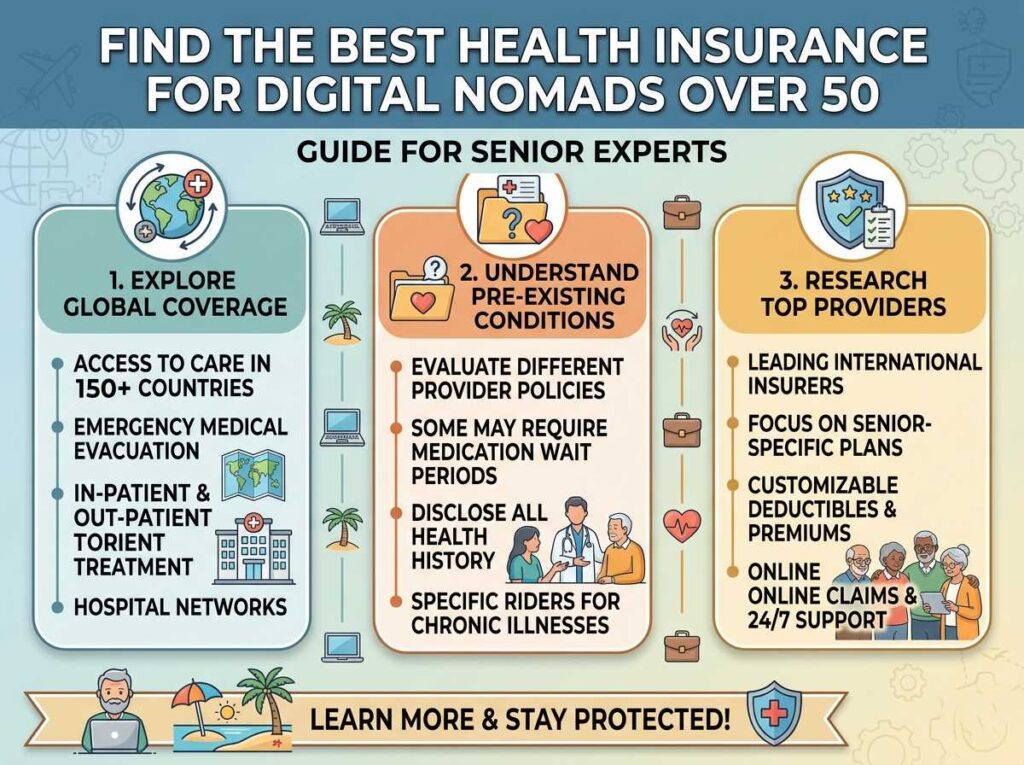
Health insurance for digital nomads over 50 is the one logistical problem that stops more American seniors from living abroad than any other. Not the language barrier, cultural adjustment, time zones. The insurance question — specifically, the gap left by Medicare the moment you cross an international border — is what keeps the dream of slow travel and location-independent living on the “someday” list for seniors who would otherwise go.
This guide closes that gap completely by providing a clear roadmap for health insurance for digital nomads over 50. By the end, you’ll know exactly which plans cover seniors traveling or living abroad, what they cost, how pre-existing conditions are handled, what visa requirements demand, and how to choose the right coverage for your specific situation.
The Medicare Gap: Why American Seniors Over 50 Cannot Rely on What They Have
Watch: A comprehensive breakdown of how Medicare works for travelers in 2026.
This is the foundation of everything that follows, so let’s be clear about it upfront.
Medicare — Parts A, B, C, and D — provides essentially zero coverage outside the United States. As outlined by the official U.S. Medicare website, the exceptions are so narrow that for practical purposes, the rule is absolute: leave the country, lose your Medicare coverage
.The exceptions are so narrow (medical emergencies within 60 miles of the Canadian or Mexican border under specific circumstances) that for practical purposes, the rule is absolute: leave the country, lose your Medicare coverage.
What this means for a senior spending three months in Lisbon or six months traveling through Southeast Asia:
- A routine specialist visit that costs $25 after Medicare at home costs $80–$150 out of pocket abroad — which is actually affordable in most destinations
- A hospitalization that Medicare would cover at near-zero cost at home could cost $5,000–$50,000 out of pocket abroad without private insurance
- An emergency medical evacuation back to the United States — which may be medically necessary for complex care — costs $50,000–$150,000 without coverage
The solution is not complicated: international private medical insurance (IPMI) fills the Medicare gap with comprehensive coverage that follows you wherever you go. The challenge is choosing the right plan from a market that has grown significantly as senior digital nomadism has expanded.
⚠️ Medicare Supplement (Medigap) policies: Some Medigap plans (C, D, F, G, M, N) provide limited foreign travel emergency coverage — typically 80% of costs after a $250 deductible, up to a $50,000 lifetime limit. This is meaningful for short trips but inadequate for extended international living. If you have a Medigap plan, check whether it includes foreign travel emergency coverage and treat it as supplemental, not primary, international protection.
Types of International Health Insurance for Seniors Over 50
Not all international health insurance is the same. Understanding the three main categories helps you match coverage to your actual situation:
🌍 International Private Medical Insurance (IPMI)
International health insurance for digital nomads is the most comprehensive option — designed for people living abroad long-term rather than visiting. IPMI plans provide the same coverage as a domestic health insurance plan: routine care, specialist visits, hospitalizations, surgeries, mental health, dental (with add-on), and vision. Coverage works in multiple countries simultaneously, making it ideal for seniors who move between destinations.
Best for: Seniors spending 6+ months per year outside the US, digital nomads moving between destinations, seniors considering permanent relocation abroad.
✈️ Travel Medical Insurance
Designed for defined trips rather than ongoing international living. Covers emergency medical care and evacuation for a specific travel period — typically up to 6 months. Significantly less expensive than IPMI but also less comprehensive: it typically does not cover pre-existing conditions, routine care, or non-emergency situations.
Best for: Seniors taking a defined trip of 1–6 months with no chronic conditions requiring ongoing management, as a supplement to existing Medigap foreign travel coverage.
🏥 Expat Health Insurance
A category between IPMI and travel insurance — designed for people living in a specific country long-term rather than moving between countries. Often less expensive than full IPMI because it’s geographically limited. If you’re settling in one destination (Portugal, Panama, Thailand) rather than moving around, expat insurance for that specific country may be more cost-effective than a global IPMI plan.
Top Health Insurance Providers for Senior Digital Nomads in 2026
The market for international senior health insurance has expanded significantly. These are the providers most consistently recommended by American senior expats and nomads in 2026:
| Provider | Best For | Est. Monthly (Age 60) | Upper Age Limit |
|---|---|---|---|
| Cigna Global | Comprehensive IPMI, large hospital network | $320–$550 | No limit |
| Allianz Care | Premium global network, executive care | $350–$600 | No limit |
| GeoBlue | Americans abroad, Blue Cross network access | $280–$480 | 84 |
| SafetyWing Nomad Health | Budget-friendly, monthly subscription | $160–$280 | 69 |
| Genki World | Europe-based seniors, flexible coverage | €115–€180 | 69 |
| BUPA International | UK and European destinations, strong network | $300–$520 | No limit |
💡 The honest recommendation for most American seniors over 60: Cigna Global or GeoBlue for comprehensive IPMI coverage. SafetyWing is an excellent budget option for healthy seniors under 69 doing their first extended trip. For seniors over 70, Cigna Global and Allianz are the primary options with no upper age limits.
Pre-Existing Conditions: The Question Every Senior Over 50 Has
Most American seniors over 60 have at least one managed health condition — hypertension, diabetes, thyroid issues, a past surgery, controlled cholesterol. The assumption that this makes international health insurance unavailable or unaffordably expensive is one of the most persistent misconceptions in senior travel planning.
It’s largely wrong. Here’s what actually happens:
The Two Underwriting Approaches
Full Medical Underwriting (FMU): You disclose your complete medical history. The insurer reviews it and may: cover everything including your pre-existing conditions (at a higher premium), cover your condition with a “loading” (extra charge), or exclude your specific condition while covering everything else. FMU typically produces better outcomes for seniors because it clarifies exactly what’s covered rather than leaving ambiguity.
Moratorium Underwriting: No medical questionnaire required at application. Instead, any condition you’ve been treated for or had symptoms of in the past 2–5 years is automatically excluded — until you’ve been symptom-free and treatment-free for a defined period (usually 2 consecutive years) while on the policy. Simpler to apply for but creates uncertainty about what’s actually covered.
For most seniors with managed chronic conditions: Full Medical Underwriting is the better choice. The transparency it provides — knowing exactly what your policy covers and what it doesn’t — is worth the slightly more involved application process. A premium loading of $80–$150/month to cover a managed condition is far preferable to discovering a condition is excluded after a hospitalization.
What Typically Cannot Be Insured
Some conditions are routinely excluded by all providers regardless of underwriting approach. These generally include: active cancer treatment, end-stage organ failure, conditions requiring organ transplants, and severe psychiatric conditions requiring inpatient treatment. If you’re managing any of these, extensive research with a specialist insurance broker before making travel plans is essential.
The “Worldwide Excluding USA” Decision: A Major Cost Lever

This is the single most impactful cost decision in international health insurance for American seniors — and it’s one that most seniors don’t fully understand until they see the pricing difference.
International health insurance plans offer two geographic coverage options:
- Worldwide Including USA: Covers you everywhere, including the United States. Because US healthcare costs are the highest in the world by a significant margin, including this coverage nearly doubles the premium for most plans.
- Worldwide Excluding USA: Covers you everywhere except the United States. Dramatically lower premiums — often 40–50% less than the inclusive version.
| Scenario | Recommended Option | Rationale |
|---|---|---|
| Living abroad 10+ months/year, visiting US 1–2 months | Worldwide Excl. USA + short-term US travel policy for home visits | Saves $150–$250/month; US visits covered separately at low cost |
| Splitting time 50/50 US and abroad | Worldwide Including USA | Too much US time to justify exclusion |
| First 3-month trial trip abroad | Travel medical insurance for the trip only | Lower cost for defined trip; evaluate IPMI after trial |
What Your International Health Insurance Must Cover for Visa Applications
If you’re applying for a long-term visa in popular senior nomad destinations, your health insurance must meet specific requirements. This is not optional — inadequate insurance results in visa denial.
European Schengen Area and Portugal D7 Visa
For Schengen tourist visits and Portugal’s D7 Passive Income Visa (the most popular long-term visa for American retirees in Europe), insurance must provide:
- Minimum €30,000 in emergency medical coverage
- Full hospitalization coverage — emergency-only policies are frequently rejected
- Medical repatriation coverage (evacuation back to your home country)
- Coverage valid throughout the Schengen zone for the full duration of your stay
Panama Pensionado Visa
Panama’s retirement visa program does not mandate specific insurance, but private health insurance is practically essential given that Medicare doesn’t cover Panama and the Pensionado’s healthcare discounts apply to out-of-pocket costs at Panama’s excellent private hospitals. See our complete Panama City for American Seniors guide for the full healthcare picture there.
Thailand LTR Visa (Long-Term Resident)
Thailand’s retirement-focused LTR visa requires proof of health insurance with minimum THB 40,000 (~$1,100) coverage for outpatient and THB 400,000 (~$11,000) for inpatient care annually. Most IPMI plans significantly exceed these minimums.
How Much Should Senior Digital Nomads Budget for Health Insurance?
| Situation | Recommended Plan Type | Monthly Budget |
|---|---|---|
| First 3-month trip, healthy, under 65 | Travel medical insurance | $80–$150 |
| Active nomad, 55–65, managed conditions | IPMI (SafetyWing or Genki) | $180–$320 |
| Active nomad or expat, 65–75 | IPMI (Cigna Global or GeoBlue) | $320–$550 |
| Senior nomad 75+, complex health history | Premium IPMI (Cigna or Allianz, full underwriting) | $500–$800+ |
Think of international health insurance as a fixed business cost — the same category as your phone plan or software subscriptions. For seniors earning consulting or remote income abroad, it’s a fully legitimate business expense with potential tax deductibility. See our Tax Tips for Senior Freelancers guide for how to handle this.
Practical Tips: Getting the Most From Your International Health Coverage
Before You Leave
- Get a comprehensive pre-departure health check. Address any issues that might require follow-up care abroad. Refill prescriptions for a 90-day supply where possible.
- Verify your medications are legal at your destination. Japan, the UAE, and several other countries have strict import rules on certain medications. Check with each country’s embassy or health ministry before departure.
- Create a secure digital medical file. Store your medical history, medication list, insurance card, and emergency contacts in a secure, cloud-accessible format. Your tablet or phone can access this from anywhere.
- Confirm your insurer’s direct billing hospitals. Most IPMI providers maintain networks of hospitals where they bill directly — you don’t pay out of pocket and wait for reimbursement. Know which hospitals in your destination city are on your insurer’s direct billing list.
While Abroad
- Use your insurer’s 24/7 assistance line before any significant care. Most IPMI plans require pre-authorization for planned hospitalizations. Calling first ensures you’re directed to an appropriate facility and that billing is handled correctly.
- Keep all receipts for any out-of-pocket medical expenses. Even small pharmacy purchases may be reimbursable and contribute toward annual deductibles.
- Use telemedicine for routine consultations. Most 2026 IPMI plans include telemedicine services allowing video consultations with physicians who speak English and understand international patient needs. For minor concerns, this is faster and more convenient than finding a local clinic.
Protecting Your Health Beyond Insurance: Daily Habits That Matter
The best international health insurance is your backstop — your daily habits are your primary defense. Several practices specifically matter for senior nomads:
- Ergonomics: Long flights and unfamiliar work setups create real physical risk. A portable laptop stand, travel keyboard, and neck pillow add minimal weight to your bag and prevent the cumulative strain that leads to real health issues over months. See our Ergonomic Home Office Setup for Seniors guide.
- Morning movement: A consistent morning exercise routine maintains the joint mobility and cardiovascular conditioning that makes travel physically sustainable. See our Morning Exercises for Seniors guide.
- Nutrition consistency: International eating is one of the great pleasures of travel — but erratic meals undermine the energy and cognitive function that professional nomads depend on. Our High-Protein Breakfast for Seniors guide covers the morning foundation that sustains productive days abroad.
- Health tracking: Wearable devices that monitor heart rate, sleep quality, and activity levels help you catch patterns that warrant attention before they become medical issues. See our Best Smart Rings for Seniors guide for options that travel well.
The Complete Digital Nomad Picture
Health insurance is the critical foundation — but it’s one piece of a larger preparation for senior digital nomadism. Once your coverage is sorted, the full picture of how to make this lifestyle work financially, professionally, and personally is covered in our complete Digital Nomad Lifestyle for Seniors guide — destinations, banking, remote income, visa strategies, and the honest assessment of whether this life is right for you.
For the remote income streams that fund the nomadic lifestyle, see our Make Money Online After 50 Master Guide. For how Social Security income interacts with earning abroad, see our Earning Income While on Social Security guide.
The Medicare gap is real. The solution is straightforward. The world beyond that gap is extraordinary.
Get a quote from two or three providers this week — Cigna Global, GeoBlue, and SafetyWing are all worth comparing for your specific age, health profile, and travel plans. The coverage that costs $250–$400/month is what makes the rest of the plan possible.
Frequently Asked Questions – Health Insurance For Digital Nomads
Generally no. Medicare provides virtually no coverage outside the United States. Some Medigap supplement plans offer limited foreign travel emergency coverage (typically up to $50,000 lifetime limit), but this is inadequate for extended international living. Private international health insurance is essential for American seniors spending significant time outside the US.
Yes. Most major IPMI providers — including Cigna Global and Allianz with no upper age limits — cover seniors with managed pre-existing conditions through Full Medical Underwriting. The condition may result in a premium loading (extra cost) or specific exclusion, but being uninsurable is rarely the outcome for seniors with typical managed conditions like hypertension, diabetes, or controlled cholesterol.
A comprehensive IPMI plan for a healthy 65-year-old American on a “Worldwide Excluding USA” basis typically costs $320–$480/month in 2026. Adding US coverage increases this to $500–$750/month. Pre-existing conditions, the specific plan’s coverage level, and chosen deductible all affect final pricing. Getting personalized quotes from two or three providers is the only way to know your exact cost.
For seniors pursuing Portugal’s D7 Passive Income Visa, Cigna Global and GeoBlue are the most commonly recommended options — both meet Schengen visa requirements, have strong European hospital networks, and provide English-language customer service. SafetyWing’s Nomad Health plan is a more affordable alternative for healthy seniors under 69 who don’t require the full breadth of IPMI coverage.
Final Thoughts: Don’t Let the “What-Ifs” Stop Your Journey
The transition from a traditional U.S. lifestyle to a location-independent one is exhilarating, but for those of us over 50, the “what-ifs” regarding health can feel heavier than they did in our 30s. It is easy to let the complexity of international medical systems keep you anchored to a zip code you’ve outgrown.
However, as we have explored in this 2026 guide to health insurance for digital nomads, the “Medicare Gap” is not a wall—it is simply a bridge you need to build. Whether you choose a high-deductible plan to cover catastrophic events or a comprehensive IPMI that rivals the best U.S. executive plans, the goal is the same: Certainty.
Your Next Steps:
- Audit Your Health: Map out your recurring prescriptions and any ongoing specialist needs.
- Run the Numbers: Use the $250–$400/month estimate as your baseline and get three competing quotes.
- Check the Visa Boxes: If you are eyeing Portugal, Spain, or Panama, ensure your policy explicitly mentions “no co-payments” to satisfy immigration officers.
Modern retirement—or the “Senior Gig” lifestyle—isn’t about taking fewer risks; it’s about managing them better. With the right coverage in your digital wallet, the world doesn’t just look smaller; it looks safer.
Last reviewed and updated: April 26, 2026 by the SeniorGig Team.