
Senior strength training over 60 is the single most important form of exercise — more than walking, yoga, or cardio.. Sarcopenia (muscle loss) begins at 30 and accelerates after 60, reducing strength, balance, metabolic rate, and independence at an accelerating pace. This guide explains why lifting matters more than ever after 60, how to start safely, and provides a complete 12-week beginner program.
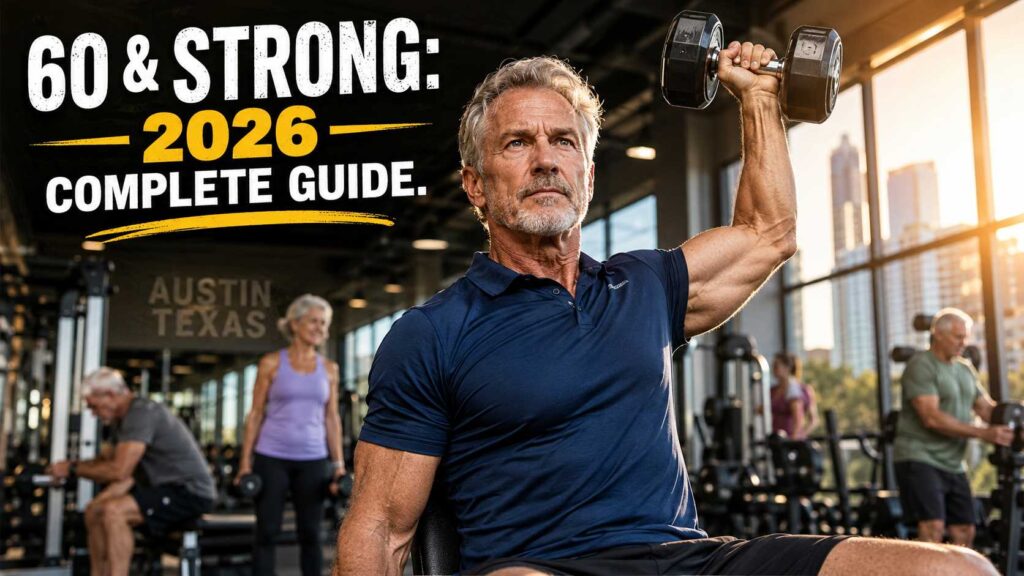
Here is the number most people don’t know: without deliberate resistance training, adults lose 3–5% of muscle mass per decade after 30, and this rate accelerates significantly after 60. By age 80, the average American has lost 30–40% of their peak muscle mass. This loss — sarcopenia — is not just about how you look or how strong you feel. It’s the primary driver of age-related falls (falls are the leading cause of injury death in seniors), mobility decline, metabolic slowdown, loss of independence, and a significant contributor to the frailty that defines poor quality of life in late age.
The most important finding in aging research over the past two decades: sarcopenia is not inevitable. Muscle loss can be slowed, stopped, and even reversed at any age with appropriate resistance training. The research is unambiguous on this point — 70, 75, and 80-year-olds who begin strength training programs gain meaningful muscle and strength within weeks. The body’s ability to respond to resistance training does not disappear with age. Implementing senior strength training over 60 ensures that you maintain this ability. It just becomes more important to apply it.
📋 Contents
- → Why Strength Training Is #1 for Seniors (The Science)
- → 5 Myths About Lifting After 60 That Keep Seniors Out of the Gym
- → Before You Start: Safety, Assessment, Equipment
- → The Key Principles for Senior Strength Training
- → The 12-Week Beginner Program (No Gym Required)
- → Nutrition: The Protein Factor Most Seniors Miss
- → How to Progress: What Happens After 12 Weeks
- → Frequently Asked Questions
Why Strength Training Is #1 for Seniors (The Science)
| Benefit | Magnitude of Effect | Why It Matters After 60 |
|---|---|---|
| Falls prevention | 30–40% reduction in fall risk with regular strength training | Falls are the #1 cause of injury death in adults over 65 — stronger legs and better balance are the primary prevention |
| Bone density | 1–3% increase per year; slows or reverses osteoporosis progression | Hip fractures after 70 carry a 20–30% 1-year mortality rate; bone density is the primary determinant |
| Metabolic rate | Each pound of muscle burns ~6 calories/day at rest vs. 2 for fat | Sarcopenia slows metabolism, contributing to weight gain; muscle maintenance prevents this |
| Blood sugar control | Comparable to medication in type 2 diabetes management | Muscle is the primary site of glucose disposal; more muscle = better insulin sensitivity |
| Cognitive function | Resistance training shows benefits for executive function and memory | Strength training increases BDNF and IGF-1, which promote brain health |
| Functional independence | Directly maintains ability to perform daily activities | Carrying groceries, rising from chairs, climbing stairs — all depend on lower body strength that can be maintained |
| Depression and mood | Effect sizes comparable to antidepressants in some studies | Resistance training improves mood through multiple neurochemical pathways |

5 Myths About Lifting After 60 That Keep Seniors Out of the Gym
Myth 1: “I’ll injure myself”
Reality: Properly designed strength training has injury rates lower than most recreational activities including walking and gardening. The most common cause of gym injuries in seniors is doing too much too soon — a problem that proper programming (starting light, progressing gradually) eliminates. Untreated sarcopenia and weak bones are far more dangerous than properly supervised resistance training. The risk calculation overwhelmingly favors training.
Myth 2: “It’s too late — I’ve already lost too much muscle”
Reality: A landmark study published in the Journal of Applied Physiology showed that nursing home residents aged 86–96 who participated in a 10-week strength training program increased muscle strength by 174% and muscle size by 9%. The capacity for muscular adaptation does not disappear with age. Starting at 70 or 75 is better than starting at 80 — but starting at 80 is better than not starting at all.
Myth 3: “Lifting is for bodybuilders, not people my age”
Reality: Resistance training for seniors has nothing to do with bodybuilding. The goal is functional strength — the ability to get up from a chair, carry bags, climb stairs, and live independently. A program using body weight, resistance bands, or light dumbbells achieves all the health benefits without ever touching a barbell. The image of weight training as a young person’s gym activity is both outdated and counterproductive.
Myth 4: “Walking is enough” for senior strength training over 60 requirements.
Reality: Walking is excellent for cardiovascular health, mood, and brain function — and should absolutely continue. But walking does not provide sufficient mechanical load to stimulate muscle protein synthesis or slow sarcopenia meaningfully. The body adapts to walking relatively quickly; it doesn’t produce the resistance loading required to maintain or build muscle mass. Walking plus strength training is the optimal combination; walking alone, while beneficial, leaves the most important age-related physical decline unaddressed.
Myth 5: “I have arthritis / a bad knee / an old injury — I can’t lift”
Reality: Most musculoskeletal conditions are not contraindications to strength training — they are conditions that strength training can help. Resistance training around arthritic joints (not through painful range of motion, but around it) strengthens the supporting musculature and reduces joint load. Knee osteoarthritis specifically is treated more effectively with quadriceps strengthening than with most other interventions. The caveat: start with appropriate guidance (physical therapist, certified personal trainer with senior experience) and work within pain-free range of motion.

Before You Start: Safety, Assessment, Equipment
Medical Clearance
Most healthy seniors can begin a moderate strength training program without special medical clearance. The American College of Sports Medicine recommends that seniors with known cardiovascular disease, uncontrolled blood pressure, severe osteoporosis, or recent joint surgery get physician clearance before beginning. When in doubt, a brief conversation with your doctor about starting senior strength training over 60 is worthwhile — not as a barrier to starting, but to identify any specific modifications needed.
Equipment Needed for the Beginner Program
| Equipment | Cost | Used For | Optional Substitute |
|---|---|---|---|
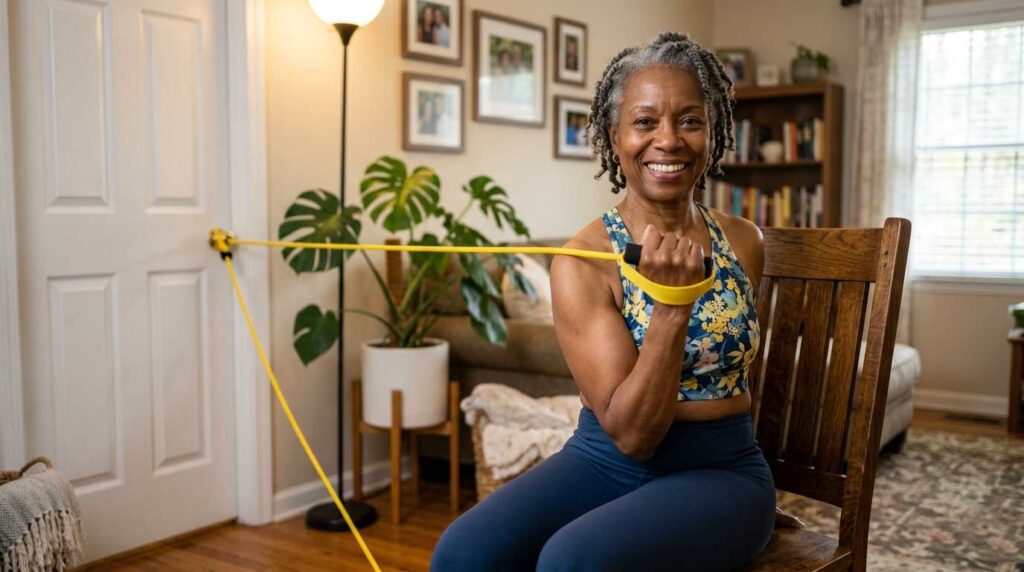
| Resistance bands (set of 3 levels) | $15–$30 | Upper body pulling, rows, bicep curls | Dumbbells or cable machines at gym |
| Pair of light dumbbells (5–15 lbs) | $20–$40 | Shoulder press, lunges with weight | Water bottles, soup cans for very light work |
| Sturdy chair | Already have it | Seated exercises, chair squats | Any stable surface |
| Non-slip exercise mat | $15–$25 | Floor exercises | Carpet for floor work |
| Stable step or low box (optional) | $20–$40 | Step-ups | Bottom stair of staircase |
Total equipment investment: $50–$100 gets everything needed for the full 12-week program. A gym membership is entirely optional — this program can be done at home. If you prefer a gym environment, any facility with dumbbells, resistance machines, and cable stations works.
Key Principles for Senior Strength Training
1. Progressive Overload — The Non-Negotiable Principle
Muscles only adapt to challenges that exceed their current capacity. If you do the same workout at the same weight forever, you maintain what you have but don’t progress. Progress requires gradually increasing either the resistance, the repetitions, or the difficulty of the movement over time. This doesn’t mean adding weight every week — it means consistently, gradually challenging the muscle beyond its current comfort zone.
2. Compound Movements First
Compound movements — exercises that work multiple muscle groups simultaneously — provide the most functional benefit and time efficiency. Squats work quads, hamstrings, glutes, and core simultaneously. Rows work biceps, rear delts, and all the muscles of the upper back. These movements replicate real-life activities (standing from a chair, picking things up, pushing open a door) and should be the foundation of any senior program.
3. Recovery Is Part of the Program
After 60, muscles recover more slowly than they did at 30. This means rest days between strength sessions are not optional — they are when the adaptation actually occurs. A 2-days-per-week program with full rest days between sessions is appropriate for beginners. Working up to 3 days per week (non-consecutive) is optimal for most seniors. Training 5–7 days per week is counterproductive — it prevents recovery and increases injury risk.
4. Controlled Movement Speed
Lift with controlled speed — not jerky or explosive. A typical cadence: 2 seconds to lift, 1–2 second pause, 3 seconds to lower. The lowering (eccentric) phase is where much of the muscle-building stimulus occurs and is often rushed. Slow, controlled movement is both safer and more effective for seniors than the faster, explosive movements that may have been appropriate at younger ages.
The 12-Week Beginner Program (No Gym Required)
This senior strength training over 60 program is designed for seniors who are new to strength training or returning after a long break. It uses body weight and resistance bands primarily, with optional dumbbells. Work out 2 days per week (e.g., Monday and Thursday) with rest days in between.
Phase 1: Foundation (Weeks 1–4)
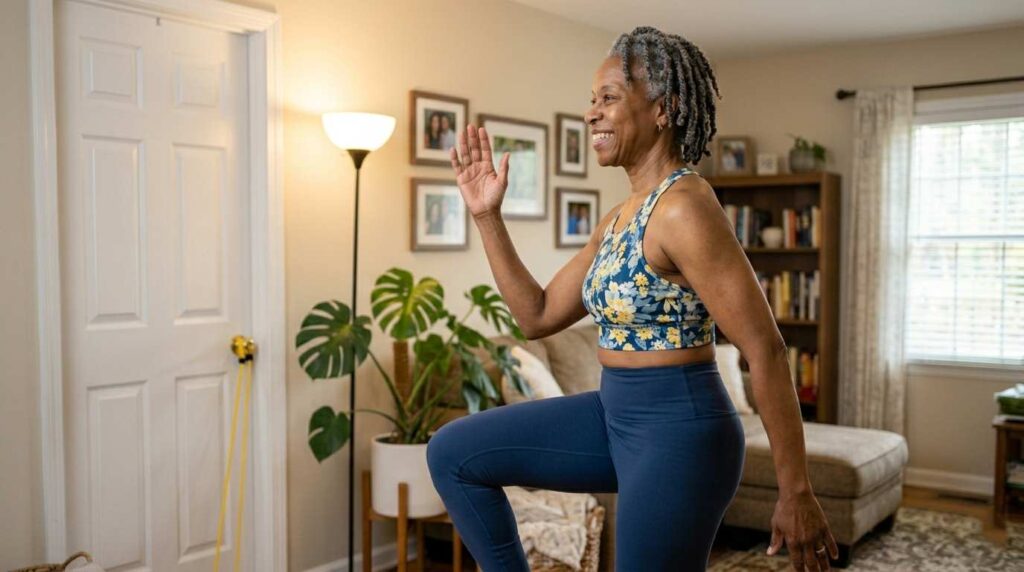
Goal: Learn movement patterns, build base strength, establish habit. Use body weight only. Stop 2–3 reps before failure.
| Exercise | Sets × Reps | What It Works | Notes |
|---|---|---|---|
| Chair Squat (sit to stand) | 2 × 8–10 | Quads, glutes, hamstrings | Sit fully, then stand. Use arms only if needed. |
| Wall Push-Up | 2 × 8–10 | Chest, shoulders, triceps | Hands on wall at shoulder height. Body straight. |
| Resistance Band Row | 2 × 10–12 | Upper back, biceps | Band around door handle. Pull elbows back. |
| Glute Bridge | 2 × 10–12 | Glutes, hamstrings, lower back | On floor, knees bent, lift hips to ceiling. Hold 2 sec. |
| Standing Calf Raise | 2 × 12–15 | Calves (fall prevention) | Hold chair for balance. Rise on toes slowly. |
| Seated Band Shoulder Press | 2 × 8–10 | Shoulders, upper arms | Band under feet, seated. Press up overhead. |
Watching someone perform these movements is often more effective than just reading about them. If you are beginning your senior strength training over 60 journey, observing proper form in real-time is crucial to avoid injury and maximize your gains. Check out this guide on how to approach these exercises correctly:
Phase 2: Building (Weeks 5–8)
Goal: Add resistance, increase sets, introduce more challenging variations.
| Exercise | Sets × Reps | Progression from Phase 1 |
|---|---|---|
| Squat with resistance band above knees | 3 × 10–12 | Band adds hip resistance; deeper squat if comfortable |
| Incline push-up (hands on counter or low table) | 3 × 8–10 | Lower than wall = harder; full range of motion |
| Bent-over dumbbell row | 3 × 10–12 | 5–10 lb dumbbell; one arm supported on chair |
| Single-leg glute bridge | 2 × 8 each leg | One foot on floor; other leg extended. Harder version. |
| Step-up | 3 × 8–10 each leg | Bottom stair or low step; hold railing if needed |
| Dumbbell shoulder press (seated) | 3 × 8–10 | 5–10 lb dumbbells; controlled movement |
| Resistance band bicep curl | 2 × 12 | New exercise added in Phase 2 |
Phase 3: Strengthening (Weeks 9–12)
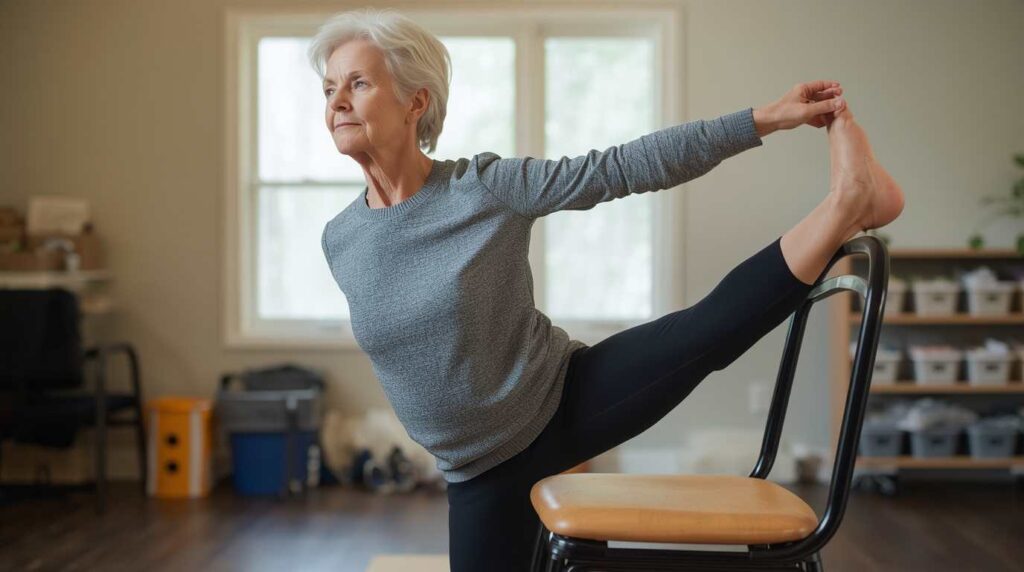
Goal: Increase weights, introduce balance challenges, work toward 3 sessions/week.
| Exercise | Sets × Reps | Progression |
|---|---|---|
| Dumbbell goblet squat | 3 × 10–12 | Hold 10–15 lb dumbbell at chest; deeper, more loaded |
| Push-up from floor (or elevated surface) | 3 × 5–10 | Knee push-ups acceptable; full push-ups if possible |
| Dumbbell Romanian deadlift | 3 × 10 | 10–15 lb dumbbells; hip hinge, back straight |
| Dumbbell row (heavier) | 3 × 10–12 | Increase weight from Phase 2 |
| Single-leg calf raise (unassisted if possible) | 3 × 12 each | Greater balance challenge; single leg |
| Reverse lunge | 3 × 8 each leg | Step back; gentler on knees than forward lunge |
| Dumbbell shoulder press (heavier) | 3 × 8–10 | Increase weight from Phase 2 |
💡 Warm-Up Before Every Session: 5–10 minutes of light movement — marching in place, arm circles, leg swings, gentle walking. Never skip the warm-up. Cold muscles are more injury-prone, and joint mobility improves significantly with even brief warm-up movement.
Nutrition: The Protein Factor Most Seniors Miss

Most seniors severely underestimate their protein needs. While the standard RDA is low, for muscle preservation, you should aim for 1.2–1.6g of protein per kilogram of body weight. Remember that nutrition is a holistic game; while protein builds your muscles, combining it with an anti-inflammatory diet for seniors is the secret to quicker recovery and sustained energy. Integrating nutrient-dense, easily digestible meals—like a warm, healing best anti-inflammatory soup—not only supports your joints but also ensures you have the systemic health needed to keep training consistently.
| Food | Serving Size | Protein Content |
|---|---|---|
| Chicken breast (cooked) | 4 oz | 35g |
| Greek yogurt | 1 cup | 17–20g |
| Canned tuna | 3 oz can | 20g |
| Eggs | 3 large | 18g |
| Cottage cheese | ½ cup | 14g |
| Black beans | ½ cup cooked | 8g |
| Salmon (cooked) | 4 oz | 29g |
| Whey or plant protein powder | 1 scoop | 20–25g |
Timing matters: Research suggests distributing protein intake across 3–4 meals rather than concentrating it in one meal is more effective for muscle protein synthesis — particularly for seniors, whose anabolic response to protein is somewhat reduced and benefits from more frequent stimulation. Including 25–35g of protein at each main meal, and especially within 1–2 hours after a strength training session, maximizes the training benefit.
After 12 Weeks: What to Expect and Where to Go Next
After 12 weeks of consistent training, most seniors report:
- Measurable strength increases — 20–50% improvement in strength on trained movements is common and expected within 12 weeks
- Improved balance and confidence in movement
- Easier performance of daily activities (stairs, carrying groceries, rising from chairs)
- Better sleep quality (strength training consistently improves sleep in older adults)
- Mood improvement — often reported as one of the most noticeable early changes
Where to go from week 13: Continue progressive overload. Increase weights when you can complete 12 reps with good form and it feels manageable. Consider working with a certified personal trainer (look for NASM, ACE, or NSCA certifications with senior experience) for your next program design. Many seniors also benefit from adding one group fitness class — water aerobics, yoga, or circuit training — to the 2–3 strength sessions for variety and social benefit.
Frequently Asked Questions About Senior Strength Training Over 60
Start lighter than you think you need to. The first 2–3 weeks should feel almost too easy — that’s intentional. Your goal in the first weeks is to learn movement patterns and let your connective tissue (tendons and ligaments, which adapt more slowly than muscles) adjust to the loading. A simple guideline: choose a weight where you can complete all reps with good form and the last 2–3 reps feel challenging but not impossible. If you can easily complete all reps, increase weight. If your form breaks down before completing the set, decrease weight.
Delayed onset muscle soreness (DOMS) — the stiffness and soreness that peaks 24–48 hours after a new workout — is normal and expected, especially in the first 2–4 weeks. It’s caused by microscopic muscle fiber damage that heals stronger than before. It’s not an injury signal; it’s an adaptation signal. Mild to moderate soreness is fine. Sharp pain during exercise, pain that’s one-sided (affecting only one knee or shoulder but not the other), or soreness that doesn’t improve within 3–4 days — these warrant stopping and consulting a doctor or physical therapist.
Yes — with appropriate modifications. Strength training is actually one of the primary recommended interventions for osteoporosis because mechanical loading stimulates bone-forming cells. The modifications for osteoporosis: avoid exercises with significant spinal flexion (sit-ups, crunches, bent-over rows with heavy rounding), avoid high-impact activities, and avoid exercises with high fall risk. Hip fracture risk is higher with osteoporosis, so fall prevention through lower body strengthening and balance work is specifically important. The National Osteoporosis Foundation has specific exercise guidelines; your physician or a physical therapist can provide personalized program recommendations.
For seniors new to strength training, 3–6 sessions with a qualified trainer to learn technique is genuinely valuable. Poor form is the primary cause of gym injuries, and habits established early tend to persist. Look for trainers with NASM-CPT, ACE-CPT, or NSCA-CSCS certification AND specific senior or older adult specialization. Many YMCAs have senior fitness programs with trained instructors. If a gym is financially or geographically inaccessible, the program above with YouTube tutorials for technique (search each exercise name + “proper form”) provides adequate guidance for the beginner phases.
Neurological improvements (better motor patterns, coordination, strength) begin in the first 2–4 weeks before significant muscle mass changes occur. Most seniors notice strength improvements within 4 weeks. Visible changes in muscle tone and meaningful strength increases are typically apparent at 8–12 weeks with consistent training. The functional changes — easier time with stairs, getting up from chairs, carrying things — are often noticed by family members before you notice them yourself. Real results from a 12-week program are significant and measurable. Sustaining those results requires sustained practice — there is no point at which you’ve “done enough” and can stop.
The Body You Build Is the One That Carries Your Future
There is a version of your 70s and 80s where you are strong, balanced, mobile, and independent — where you can carry your own groceries, play with grandchildren on the floor, travel without physical limitation, and live in your own home on your own terms. And there is a version where muscle loss, frailty, falls, and dependence narrow your world progressively.
The distance between those two versions is not primarily genetic. It is primarily behavioral. And the behavior that makes the largest difference — more than diet, more than brain training, more than any supplement — is senior strength training over 60 done consistently over years.
Start with the 12-week program above. Pick two days this week. Do Phase 1. The exercises are simple. The equipment is minimal. The time commitment is 30–40 minutes twice a week. The return on that investment — measured in years of independent, capable life — is extraordinary.
More senior health and wellness guides:
⚠️ Medical Disclaimer
The content provided in this article is for informational and educational purposes only and is not intended as a substitute for professional medical advice, diagnosis, or treatment. Always seek the advice of your physician or other qualified health provider with any questions you may have regarding a medical condition. Never disregard professional medical advice or delay in seeking it because of something you have read on this website.