
Testimonials for senior consultants, coaches, and freelancers are the single most persuasive element in any professional’s marketing — more convincing than a polished website, more compelling than a detailed services page, more credible than any description you write about yourself. When a real person who has worked with you describes a specific result they achieved, that statement does something no self-promotion can: it transfers your credibility from your own mouth into someone else’s.
The problem most seniors face isn’t a shortage of satisfied clients or happy customers. It’s that nobody taught them how to systematically collect, structure, and use testimonials as an active business development tool. Wonderful things people have said sit in old emails, in memory, in private conversations — completely invisible to the next potential client trying to decide whether to hire you.
This guide fixes that. By the end, you’ll have a specific system for gathering powerful testimonials, a clear method for making them compelling, and a practical strategy for deploying them at exactly the right moments in your client acquisition process.
Why Testimonials Work So Powerfully for Senior Professionals
While social proof is universal, testimonials for senior consultants work with particular force because they address the specific way potential clients evaluate high-level experience.
When a company or individual considers hiring a senior consultant, coach, or freelancer, they carry two competing thoughts simultaneously. The first is enthusiasm: this person has exactly the experience we need. The second is uncertainty: but will they actually deliver for us specifically? Do they understand our situation? Have they done this for someone like us?
Testimonials resolve that uncertainty directly. Not with your assertions about your capabilities — with someone else’s testimony about their specific experience. A testimonial that says “I hired Margaret for exactly this kind of challenge and here’s what happened” answers the potential client’s real question in a way no brochure can.
For seniors specifically, testimonials also address an unstated concern some potential clients carry about hiring older professionals: will they be current? Adaptive? Engaged? A testimonial from a recent client that describes specific, modern results puts this concern to rest instantly — far more effectively than anything you could say in your own defense.
The Anatomy of a Testimonial That Actually Wins Clients
Understanding what makes testimonials for senior consultants powerful — versus what makes them forgettable — determines both how you ask for feedback and how you guide your clients to write them.
The Weak Testimonial vs. The Powerful One
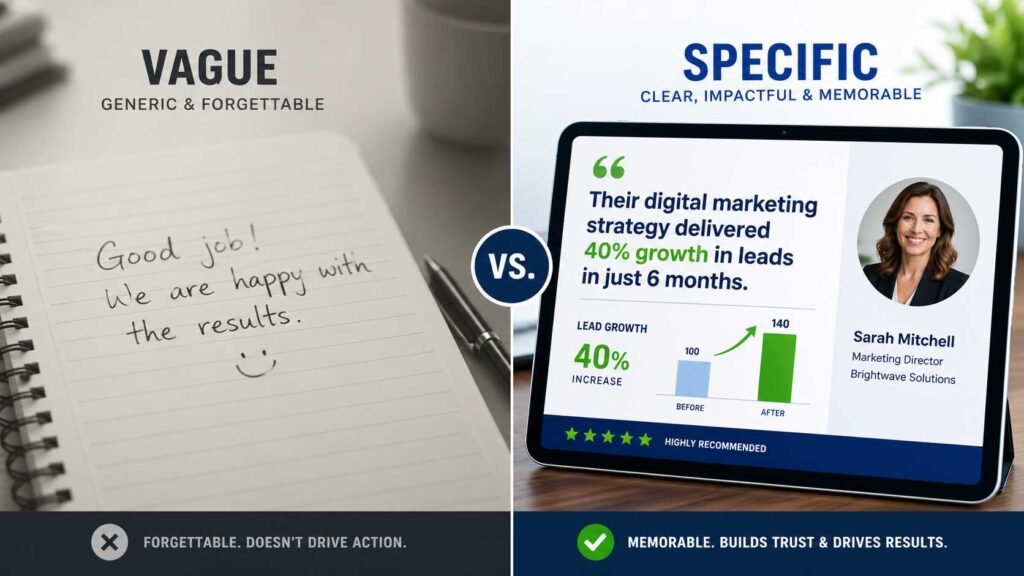
⚠️ Weak Testimonial
“Margaret is a wonderful consultant. She’s very professional, easy to work with, and clearly knows her field. I would recommend her to anyone.”
Why it fails: Vague, generic, no specific situation, no measurable outcome. Could describe anyone. Raises no confidence in the reader.
✅ Powerful Testimonial
“We brought Margaret in during a workforce reduction that was threatening to fracture our team culture. Within six weeks she had redesigned our communication approach and personally facilitated three town halls that honestly saved our culture. Twelve months later, our employee satisfaction scores are higher than before the reduction. I’d hire her again without hesitation.”
Why it works: Specific situation, specific timeline, specific actions, measurable outcome, credible recommender.
The Five Elements of a Powerful Testimonial
| Element | What It Does | Example |
|---|---|---|
| The Situation | Shows context — reader sees themselves in the story | “We were struggling to retain our top performers…” |
| The Specific Action | Shows what you actually did — not vague praise | “She redesigned our onboarding process completely…” |
| The Measurable Result | Proves impact with numbers wherever possible | “Turnover dropped 40% in the following year…” |
| The Emotional Truth | Creates trust through genuine human voice | “Honestly, I was skeptical at first, but…” |
| The Clear Recommendation | Closes the loop — tells the reader what to do | “I would recommend her without hesitation to any…” |
When to Ask for a Testimonial: The Exact Right Moment
Timing determines whether you get a powerful testimonial or a polite decline. Most professionals ask too late — months after a project ends, when the client’s enthusiasm has cooled and the details have blurred.
The optimal moments to ask for a testimonial:
✅ Best moment #1: Immediately after a visible win. A client emails you excited about a result — the project launched, the metrics improved, the problem was solved. Reply to their excited email: “I’m so glad to hear this — would you be willing to capture what you just shared in a brief LinkedIn recommendation or written testimonial? Your perspective would mean a great deal.”
✅ Best moment #2: At project completion, during your wrap-up call. Build a testimonial request into your standard project close: “Before we wrap up — I’d really appreciate if you’d be willing to share a brief written testimonial about your experience working with me. I’m happy to send you a few questions to make it easier.”
✅ Best moment #3: When a client refers someone to you. A client who refers you is already demonstrating satisfaction. Their referral is implicit testimony. Converting that into explicit written testimony is natural: “Thank you so much for sending Sarah my way — that means the world. Would you be willing to put a few of those thoughts in writing? Even a few sentences would be incredibly helpful.”
⚠️ When NOT to ask: In the middle of a project when outcomes are unclear. When a client seems less than fully satisfied. More than six months after project completion without any recent contact. Cold outreach to someone you haven’t worked with recently — reconnect first, ask later.
How to Ask for a Testimonial: Message Templates That Work
The way you ask determines the quality of what you receive. A vague ask produces a vague testimonial. A guided ask — one that gives your client a framework and specific focuses — produces the specific, compelling testimonial that actually wins new clients.
- Template 1: The Direct Ask (Best for Recent Clients)
“Hi James — I’ve been reflecting on the work we did together on the supply chain restructuring project, and I wanted to reach out.
I’m building my consulting practice and testimonials from clients I’ve genuinely helped make an enormous difference. Would you be willing to write a brief testimonial — even three to four sentences — about your experience working with me?
If it helps, you might focus on: the specific challenge we were addressing, what the working experience was like, and any measurable outcomes you observed. But please write it in whatever way feels honest and natural to you.
No pressure at all if the timing isn’t right — I completely understand. But I’d be genuinely grateful if you’re willing.” - Template 2: The Question-Guided Ask (Best for Clients Who Seem Uncertain)
“Hi Carol — I’d love to ask a small favor. I’m updating my professional materials and a testimonial from you would be incredibly meaningful.
To make it easier, here are three questions you could answer in a few sentences each — or feel free to just write whatever comes to mind:
What was the situation or challenge when you first reached out to me?
What did working together actually look like, and what did I help you accomplish?
Would you recommend me to others — and if so, who would benefit most from working with me?
Even a paragraph is enormously helpful. Thank you so much for considering it.” - Template 3: The Draft Offer (Best for Very Busy Clients)
“Hi Robert — I know you’re incredibly busy, so I wanted to offer an option that might make this easier. If you’re willing to write a brief testimonial about our work together, I’d be happy to draft something based on what I know of our project — you’d just review it, edit anything that doesn’t feel right, and approve it. Many people find it much easier to edit than to write from scratch.
Just say the word and I’ll send something over. And of course, if you’d prefer to write your own, that’s wonderful too.”
How to Write a Draft Testimonial for a Client to Approve
Offering to draft a testimonial for a client’s review is common professional practice and often produces the best results — because you can write it with the specific focus and language that will most persuade your next potential client.
When drafting for someone else’s review, follow these rules:
- Write entirely in their voice. Use first person from their perspective. Reference only things they would actually know from working with you.
- Include the specific situation and outcome. This is your opportunity to ensure the testimonial addresses the exact concerns your potential clients typically have.
- Keep it honest. Don’t exaggerate outcomes or invent details. The client must feel comfortable putting their name on it exactly as written.
- Offer genuine editorial freedom. “Please change anything that doesn’t feel right” isn’t just courtesy — it’s essential. A testimonial the client has genuinely approved is authentic; one they felt pressured to accept is not.
Claude or ChatGPT can help you draft testimonials in another person’s voice efficiently — describe the working relationship, the project, and the outcomes, and ask the AI to draft a testimonial from the client’s perspective. Edit it to match the client’s actual communication style before sending. See our Best AI Tools for Seniors guide for how to use AI for professional writing tasks like this.
Where to Display Testimonials: Maximum Visibility Strategy
Collecting powerful testimonials is half the work. The other half is placing them where potential clients will actually see them at the moments when trust matters most.
🌐 Your Personal Website
Your website is where testimonials do the most work. Optimal placement:
- Homepage: One or two of your strongest testimonials above the fold — visible before a visitor scrolls. These should address the most common concern your potential clients have.
- Services page: A testimonial directly adjacent to each service description. When someone reads about your consulting packages, the testimonial immediately below provides social proof at the exact moment of consideration.
- Dedicated testimonials page: A full page with all your testimonials, organized by type of client or project. Some potential clients will specifically look for this.
- Contact page: A strong testimonial near your contact form reduces the hesitation that people feel right before reaching out.
For building the website that hosts these testimonials effectively, see our Personal Website for Seniors guide.
💼 LinkedIn Recommendations
LinkedIn recommendations are publicly visible testimonials that appear directly on your profile. Any employer, client, or potential partner who researches you on LinkedIn will see them. A senior professional with eight to twelve specific, recent LinkedIn recommendations effectively has a self-service testimonial portfolio visible to everyone who looks them up. For the complete strategy, see our LinkedIn Recommendations for Seniors guide.
📄 Proposals and Pitch Documents
Include two to three relevant testimonials in every consulting proposal or pitch document you send. Place them after your methodology section and before your pricing. At the moment when a potential client is evaluating whether to commit financially, third-party validation is maximally persuasive.
For building strong consulting proposals, see our guide on Using ChatGPT to Write Consulting Proposals.
🏪 Etsy and Freelance Platform Profiles
On Etsy, client reviews are your testimonials — they’re built into the platform and automatically displayed. The fastest way to build your Etsy review base is to follow up with every customer 7–10 days after delivery: a brief, warm message thanking them and gently inviting a review if they’re happy with their purchase. For building your Etsy presence, see our Etsy Shop for Seniors guide.
📧 Email Signature and Marketing Emails
A single powerful testimonial quote — one memorable sentence from a strong testimonial — in your email signature provides constant low-level social proof to everyone you correspond with. For any marketing emails or newsletters, opening with a client success story before pitching your services consistently outperforms opening with a direct pitch.
Video Testimonials: The Most Persuasive Format in 2026
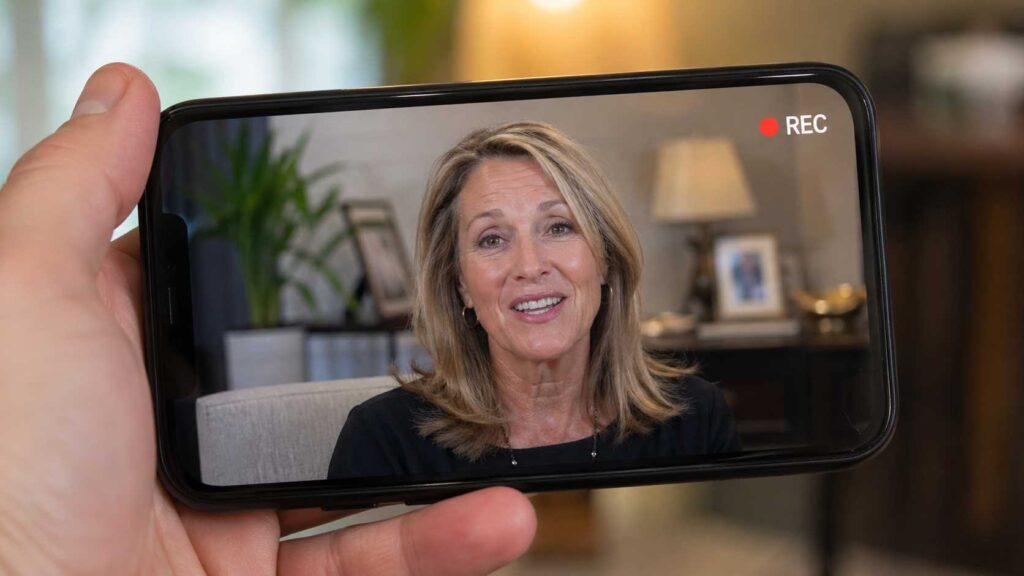
A written testimonial is powerful. A video testimonial — even a 60-second smartphone recording of a satisfied client speaking genuinely about their experience — is dramatically more persuasive. The human voice, the visible emotion, the specific words chosen in the moment carry a credibility that text simply cannot replicate.
Asking for a video testimonial sounds intimidating. In practice, many clients are more comfortable speaking than writing — particularly professionals who are used to presenting or communicating verbally.
How to ask: “Would you be willing to record a quick 60-second video sharing your thoughts on our work together? Even just a selfie-style video on your phone would be incredibly valuable. I’d just ask you to briefly describe the situation, what we did together, and what the outcome was.”
Most clients who agree to a written testimonial will also agree to a video version if asked — the initial agreement to provide feedback makes the second ask much easier. Video testimonials displayed on your website homepage or consulting inquiry page significantly increase the percentage of visitors who reach out.
Building a Testimonial System That Runs Automatically
The seniors who have the strongest testimonial portfolios don’t collect testimonials sporadically when they remember to ask. They have a simple system that makes testimonial collection a natural part of every client relationship:
📋 The 5-Step Testimonial System
- At project kickoff: Mention testimonials naturally — “If we do great work together, I’ll ask if you’d be willing to share your experience.” Sets expectations without pressure.
- At first positive milestone: Note it in your records — “Client expressed satisfaction with [specific outcome] on [date].” This is your testimonial opportunity trigger.
- At project completion: Send your guided testimonial request within 48 hours. Include the question framework. Offer to draft if they’re busy.
- On receipt: Acknowledge warmly and immediately. Ask permission to use it on your website, LinkedIn, and proposals. Most clients will say yes — but always ask explicitly.
- In your master file: Maintain a running document of all testimonials with the client’s name, title, company, and date. Organize by the type of challenge addressed so you can quickly find the right testimonial for each proposal.
Testimonials as Part of Your Complete Senior Professional Strategy
Testimonials connect directly to and amplify every other professional activity:
- Strong testimonials improve consulting proposal conversion — see How to Start Consulting After 50
- LinkedIn recommendations are testimonials in their most public form — see LinkedIn Recommendations for Seniors
- Speaking engagements generate audience testimonials and referrals — see Speaking Engagements for Seniors
- Mentorship program testimonials build coaching credibility — see Mentorship Programs for Seniors
- For the full income picture after 50, see our Make Money Online After 50 Master Guide
Your career left a trail of people whose professional lives you improved. Some of them still think about the work you did together. Some of them would speak highly of you in a heartbeat — if someone only asked.
The testimonial system in this guide is that ask, systematized. It turns scattered goodwill into visible, permanent, persuasive proof that what you do works.
Identify three people right now who would speak highly of your work. Send the first message today. Your next client is one good testimonial away from saying yes.
Frequently Asked Questions
Yes — drafting a testimonial for a client’s review and approval is common professional practice. The ethical requirement is that the client genuinely reviews, edits if needed, and approves it as their authentic view. A draft that the client approves without changes because it accurately reflects their experience is legitimate. A testimonial the client felt pressured to approve is not.
Three to five strong, specific testimonials are sufficient to establish credibility for most senior professionals. Quality matters far more than quantity — five detailed testimonials addressing specific situations and outcomes are more persuasive than fifteen generic ones. Build toward ten to fifteen over time, then curate actively: display your strongest five to eight and archive older or weaker ones.
Start by asking for LinkedIn recommendations from former colleagues and supervisors who can speak to your professional capabilities — these function as testimonials and are visible immediately. Then do one or two initial engagements at a reduced rate specifically to generate testimonials and case studies. One strong testimonial from a satisfied early client opens the door to full-rate work with future clients.
Yes, with some care. Older testimonials from credible sources remain valuable — particularly if the recommender has a strong current professional profile. Supplement older testimonials with newer ones from any recent work, volunteer engagement, or consulting to show current professional relevance. A mix of career history validation and recent engagement builds the most complete credibility picture.