
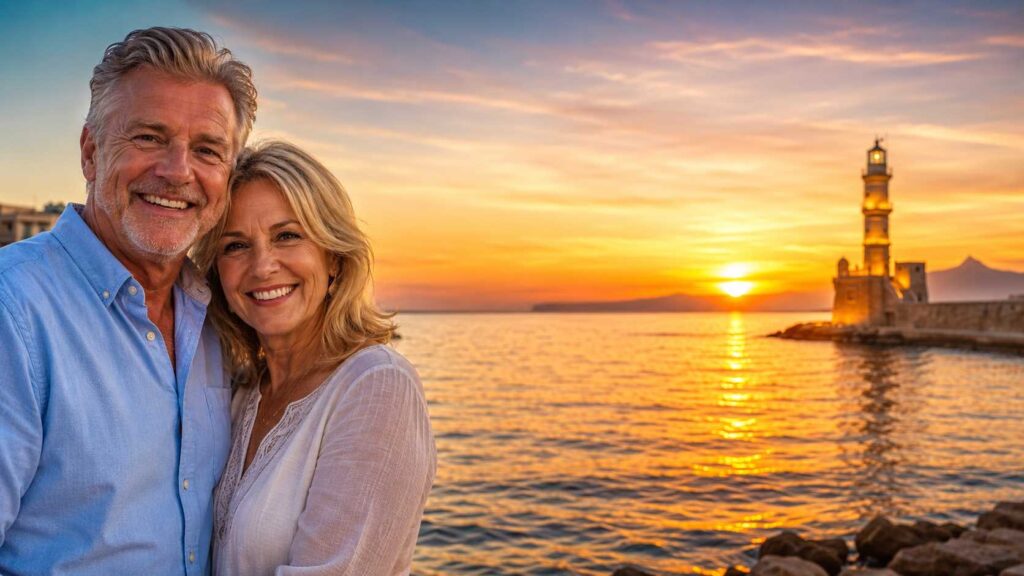
Crete is Greece’s largest island — and by a significant margin, its most complete one. It has the beaches, yes. But it also has a university hospital, direct international flights, mountain villages older than ancient Rome, and a cuisine that makes the mainland look like it’s still learning. This guide is for seniors who want to do it right.
Most Americans discover Crete one of two ways: they book a beach week on a travel agent’s recommendation, land in Heraklion, transfer to a resort, spend seven days by a pool, and leave thinking they’ve seen Crete. Or they stumble into Chania’s old harbor at dusk — the Venetian lighthouse catching the last amber light, the air smelling of jasmine and the sea — and immediately start rearranging their itinerary to stay longer. If you are looking for a more authentic experience, this Crete travel guide for seniors is designed to help you plan your journey effectively. By using this Crete travel guide for seniors, you can focus on the destinations that offer the best balance of comfort and culture.
Crete rewards depth. It is large enough (the fifth-largest island in the Mediterranean, 260 km from east to west) that you can spend weeks and still find new corners. For seniors, it also happens to offer some of the most favorable conditions in Greece: a gentler pace than Athens, excellent infrastructure, extraordinary food and wine, world-class beaches that are accessible without strenuous effort, and a warmth of local character — the Cretan personality is famously generous, proud, and hospitable — that makes you feel like a guest rather than a tourist.
📋 Contents
- → Chania vs. Heraklion: Which City Is Right for You?
- → Best Time to Visit Crete for Seniors
- → Getting Around Crete: Transportation Explained Simply
- → Chania: Senior-Friendly Sights, Beaches & Experiences
- → Heraklion & Knossos: What Seniors Need to Know
- → Best Beaches in Crete for Seniors (Accessibility Guide)
- → Cretan Food & Wine: Why It’s Different
- → Where to Stay in Crete for Seniors
- → Real Costs in Crete 2026
- → Frequently Asked Questions
Chania vs. Heraklion: Which City Is Right for You?
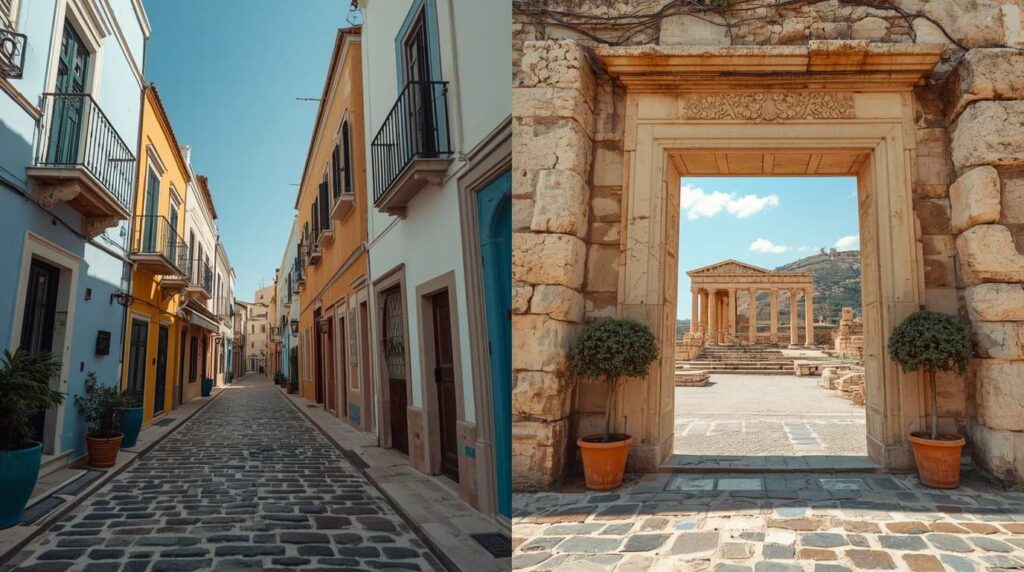
Choosing between these two cities is the most important decision highlighted in our Crete travel guide for seniors. The two cities are 150 km apart, have distinct characters, and serve different travel styles. Most visitors land at one or the other (both have international airports) and base there — trying to stay in both on a short trip adds transit time and disrupts the settled rhythm that makes Crete enjoyable. As you follow this Crete travel guide for seniors, remember that selecting the right base determines the overall pace of your vacation.
| Factor | Chania (West Crete) | Heraklion (Central/East Crete) |
|---|---|---|
| Atmosphere | Romantic, historic, slow-paced old town with Venetian harbor | Larger, more urban, commercial — but authentic and underrated |
| Best for | Strolling, dining, beaches west of town, Samaria day trip | Knossos Palace, Archaeological Museum, day trips east |
| Senior walkability | Old town is compact and mostly flat near the harbor | Larger city; use taxi/bus for most attractions |
| Hotel options | Excellent boutique hotels in old town; beach resorts nearby | More midrange chain hotels; some excellent boutique options |
| Airport | Chania International (CHQ) — international flights direct | Heraklion International (HER) — larger, more connections |
| Overall senior verdict | ✅ Slightly preferred — more charming daily environment | ✅ Essential if Knossos is a priority |
💡 The Best Strategy for Two Weeks: Base in Chania for 7–8 nights (exploring west Crete, the old town, and coastal villages), then move to Heraklion for 4–5 nights for Knossos and the east. The drive between cities on the northern coastal highway is easy (2 hours), the scenery is beautiful, and it gives you two different Cretan experiences without constantly repacking.
Best Time to Visit Crete for Seniors
Crete has the longest warm season of any Greek island — which is wonderful for most of the year and overwhelming in peak summer. Unlike Athens, which has compensating indoor attractions, Crete’s main appeal (beaches, coastal walking, outdoor archaeology) is outdoor-dependent. The heat matters more here.
| Season | Temperatures | Sea Temperature | Senior Verdict |
|---|---|---|---|
| April – May | 18–26°C (64–79°F) | 17–21°C — swimable for some | ✅ Excellent. Wildflowers, green landscapes, few crowds, best hiking conditions |
| June | 24–30°C (75–86°F) | 22–24°C — perfect swimming | ✅ Very good. Before peak crowds; warm evenings |
| July – August | 28–38°C (82–100°F) | 25–27°C | ⚠️ Hot and crowded. Manageable with shade, morning sightseeing, afternoon beach/rest rhythm |
| September – October | 22–30°C (72–86°F) | 23–25°C — still warm | ✅ Best overall. Summer crowds gone, sea still warm, light extraordinary |
| November – March | 10–18°C (50–64°F) | 16–19°C | 🔵 Quiet and authentic. Most beaches closed; some resorts shut; beautiful walking weather |
Getting Around Crete: Transportation Explained Simply
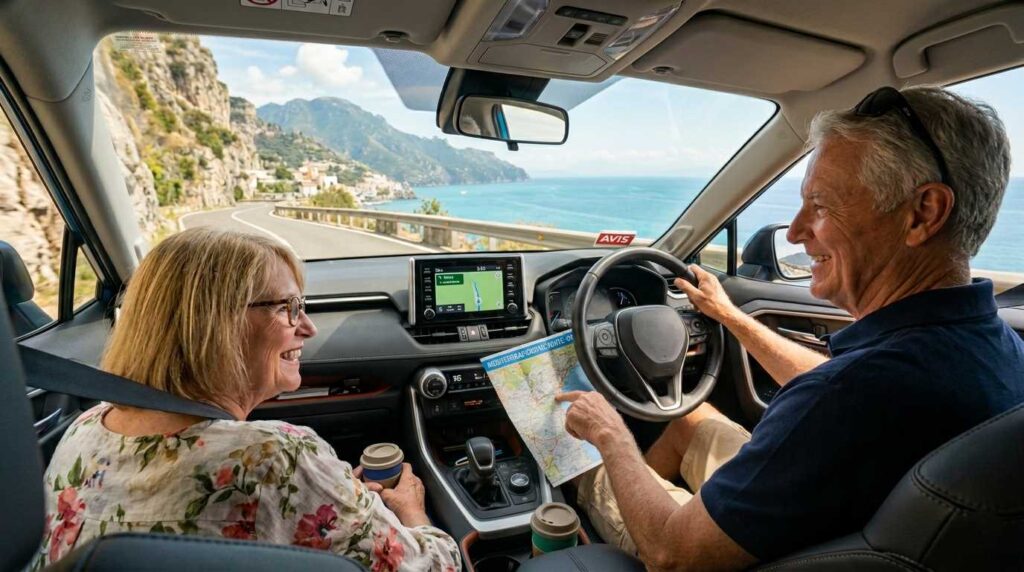
🚗 Rental Car (The Freedom Option)
As recommended in this Crete travel guide for seniors, for those who are comfortable driving, a rental car is the single best way to experience the island. The northern coastal highway (E75) connecting Chania and Heraklion is well-maintained and easy to drive. The roads into the mountains and south coast require more care — narrower lanes, steep grades, occasional livestock — but they access the most beautiful parts of the island. Rental cars in Crete in 2026 run €35–€65/day for a small automatic (specify automatic — many European rentals default to manual). Book ahead for September and any summer period. International driving license is not strictly required for Americans but is recommended. Greek drivers are spirited but not dangerous if you’re prepared for them.
🚌 KTEL Bus (Affordable Intercity Travel)
The KTEL bus network connects Chania and Heraklion (departs roughly every 30 minutes, takes 2 hours, costs €13–€15 one-way), and branches connect to most major towns. For seniors not wanting to drive, KTEL is a legitimate option for the main route. Buses are modern, air-conditioned, and punctual. The Chania KTEL terminal is on the east side of the city (a short taxi from the old town); Heraklion’s terminal is near the port. The catch: local buses to villages and beaches are less frequent and not always senior-friendly for luggage.
🚕 Taxis (For Shorter Distances)
Taxis within Chania’s old town and to nearby beaches are metered, plentiful, and affordable. A taxi from Chania old town to the beach at Agia Marina (popular, sandy, accessible) costs €12–€18 one-way. Your hotel will call taxis on request. Apps like Beat and Bolt are available in Chania but less reliable than in Athens — phone calls or hotel arrangements work better. For day trips to sites like Elafonisi or Balos, organized coach tours from Chania are often the best combination of simplicity and value.
⚠️ Scooters and ATVs: You’ll see them everywhere in Crete — rentable on every tourist street. Skip them if you’re over 60 and haven’t ridden one regularly. The combination of unfamiliar vehicles, rough roads, and local driving styles produces a high rate of accidents among tourists. The roads outside tourist areas are often unpaved or poorly maintained. Enjoy them as scenery, not transportation.
Chania: Senior-Friendly Sights, Beaches & Experiences
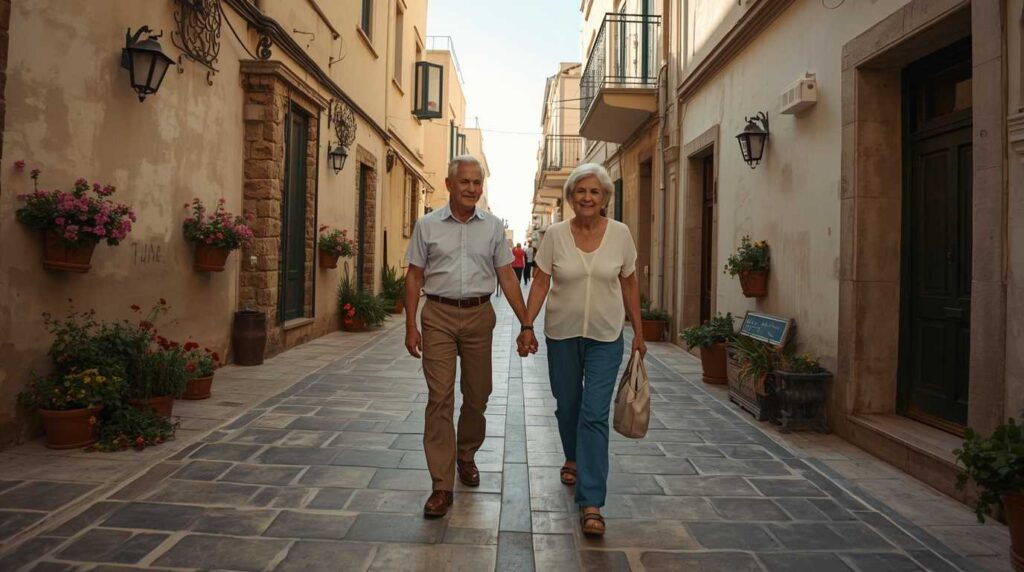
Chania (pronounced hahn-YAH) is consistently ranked among the most beautiful cities in Europe — a claim that, for once, bears out in reality. The old Venetian harbor with its lighthouse, the Ottoman-era mosques, the Jewish quarter’s remaining synagogue, the covered market, the neighborhood of Splantzia with its quiet squares and plane trees — Chania rewards slow walking more than almost any city in the Mediterranean.
🏛️ The Venetian Harbor & Lighthouse
The harbor is the center of daily life in Chania, and walking its length — from the Firka Fortress at the west end to the seafront restaurants at the east — is the essential Chania experience. Distance is about 800 meters, flat, paved, and manageable for virtually any mobile senior. Do it at sunrise (the light is extraordinary and crowds are absent) and again at sunset (when the whole town comes out for the evening volta). The Egyptian Lighthouse at the harbor mouth — named for the Egyptian rule during which it was rebuilt in the 18th century — is Crete’s most photographed landmark. The Maritime Museum of Crete, adjacent to the Firka Fortress, is excellent and takes about an hour. Admission: €4.
🕍 The Old Town & Jewish Quarter
Chania’s old town is a layered archaeological dig in the form of a living city: Minoan, Greek, Roman, Byzantine, Venetian, and Ottoman eras all visible in successive layers of architecture. The Jewish quarter (Evraiki) preserves the Etz Hayyim Synagogue — one of the oldest in Europe, recently restored — and its surrounding streets retain a particular quietness and intimacy. The covered market (Agora), built in 1913, is the best indoor market in Crete: an X-shaped covered building full of cheese vendors, olive oil producers, herb sellers, and butchers. It’s a sensory immersion and a good place to assemble a picnic or buy gifts. Open Monday–Saturday, mornings only.
🌿 Archaeological Museum of Chania
Housed in the former Venetian church of San Francesco, this museum holds Minoan, Hellenistic, and Roman finds from western Crete. It’s a manageable size (two hours, not overwhelming) and fully air-conditioned — valuable on any afternoon after a morning outdoors. Admission: €4. Located just off the harbor in the heart of the old town. For seniors particularly interested in Minoan civilization, it’s an essential stop that provides context for the Knossos visit if you’re continuing to Heraklion.
🏔️ Samaria Gorge (Day Trip) — For the Reasonably Active
The Samaria Gorge is one of Europe’s most famous hiking trails — 16 km through a dramatic natural canyon, ending at the Libyan Sea where a boat returns you to the south coast. It’s popular, organized, and manageable for active seniors in good health, but requires a genuine 4–6 hour walk on uneven terrain. Ages 60–70 with good joints complete it regularly; many don’t and that’s completely fine. The alternative: take the organized bus to the top of the gorge (Omalos Plateau), walk to the viewpoint, and return — the scenery is worth the trip without the full descent. Or book one of the organized boat trips to the beach at the gorge’s end (Agia Roumeli) and swim there without walking the gorge at all. All three options are bookable from Chania.
Heraklion & Knossos: What Seniors Need to Know
Heraklion is a working city of 140,000 people and carries none of Chania’s postcard quality. But it’s home to two experiences that belong on any serious traveler’s Greece itinerary: the Palace of Knossos and the Heraklion Archaeological Museum. Together, these represent the fullest accessible picture of Minoan civilization — a Bronze Age culture that flourished 3,500 years ago and produced art, architecture, and social structures that rival anything in the ancient Mediterranean.
🏰 The Palace of Knossos
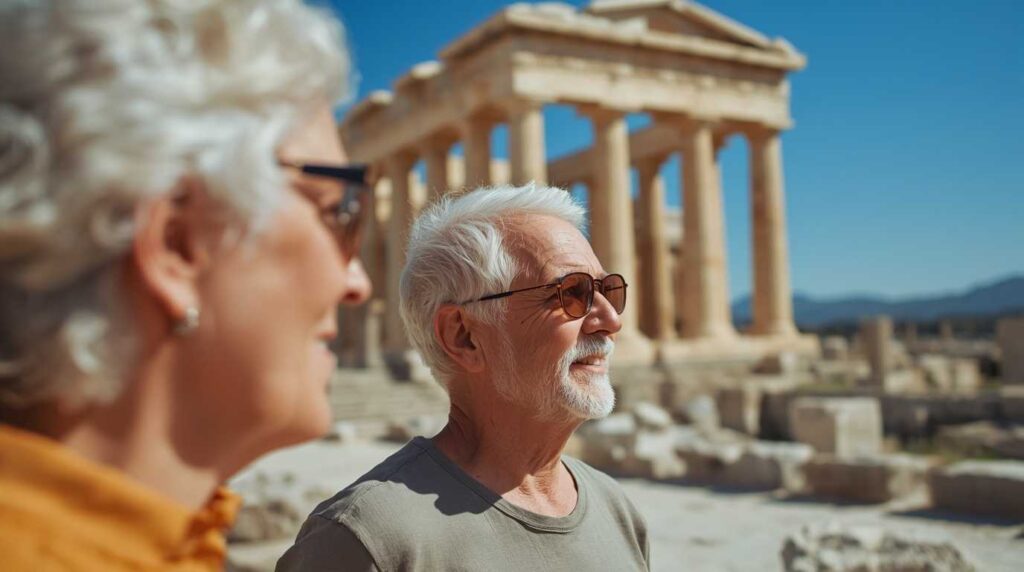
Knossos is 5 km from Heraklion city center — accessible by taxi (€12 from the harbor) or Bus Line 2 from Eleftherias Square (€1.80, frequent service). The site itself is large — plan on 2–3 hours — and partially reconstructed in controversial early-20th century concrete, which makes it both visually striking and historically debated. The famous Minoan frescoes (the Bull-Leaper, the Ladies in Blue) are reconstructions; the originals are in the Archaeological Museum in Heraklion. Wear good shoes; the site involves uneven ancient stone and gravel paths but is mostly flat. Admission: €15 (combined ticket with the Archaeological Museum: €20, excellent value). Book online at etickets.tap.gr to skip queues. A licensed guide hired at the entrance (€15–€20 for a 1.5-hour tour) transforms the experience enormously — ask your hotel to recommend one or hire from the official guide association.
🏺 Heraklion Archaeological Museum
This museum holds the world’s greatest collection of Minoan art and artifacts — including the actual frescoes, the enigmatic Phaistos Disc (still not fully deciphered), the famous Snake Goddess figurines, and exquisitely detailed gold jewelry. The building is modern and fully accessible with elevators between floors. Air-conditioned, benches throughout the galleries, and a good café. Budget three hours. Admission included in the Knossos combo ticket. Located on 25th August Street, a 10-minute walk from the harbor. The combined Knossos + Museum itinerary is best done over two mornings rather than one — it’s a lot to absorb in a single day, and rushing it shortchanges one of the most extraordinary cultural experiences in Europe.
Best Beaches in Crete for Seniors: An Accessibility Guide
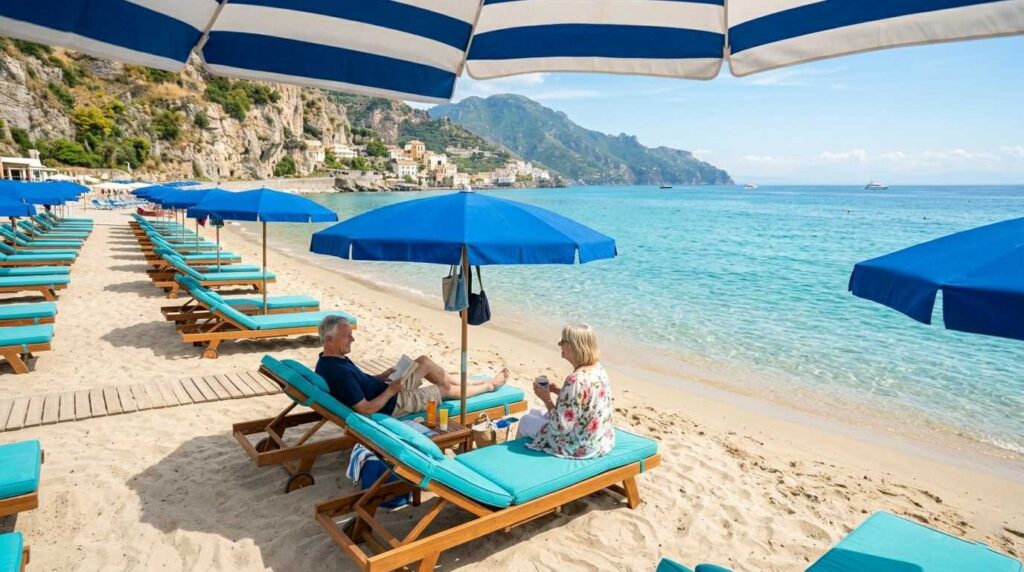
Not all of Crete’s famous beaches are equally accessible for seniors. The most photographed — Balos, Elafonisi — involve boat trips or difficult roads. The most accessible are sandy, organized (sunbeds, showers, cafés) and reachable by bus or taxi. Here’s an honest breakdown:
| Beach | Location | Accessibility | Senior Notes |
|---|---|---|---|
| Agia Marina | 12km west of Chania | ✅ Very accessible — taxi or bus | Wide sandy beach; organized sunbeds; cafés; gentle entry to water; excellent for the average senior visit |
| Platanias | 11km west of Chania | ✅ Very accessible | Long sandy beach; lively village; many restaurant options; multiple bus connections daily |
| Falassarna | 60km west of Chania | 🔵 Car or organized tour needed | Stunning wide sandy beach; worth the drive; sunsets are exceptional; some steep path sections to beach entry |
| Elafonisi | 75km southwest of Chania | 🔵 Car or organized tour (2hr drive) | Famous pink-tinged sand lagoon; shallow water perfect for seniors; shallow entry; can be very crowded July-August |
| Balos Lagoon | Northwest peninsula | ⚠️ Boat trip recommended | The most beautiful lagoon in Crete; boat from Kissamos port (1.5 hrs); beach landing has some rocky walking — flat-soled shoes essential |
| Stavros | 15km north of Chania | ✅ Very accessible | Calm, sheltered bay; featured in the film Zorba the Greek; quiet and lovely; no current or waves |
🌊 Beach Water Quality Note: Crete’s beaches consistently receive Blue Flag certification for water quality — one of the highest rates in Europe. The water is genuinely clear, clean, and free of jellyfish through most of the season (late August sometimes brings visitors — check locally before swimming). Organized beaches (those with sunbed rentals) always have lifeguards during operating hours, which is reassuring for seniors swimming alone.
Cretan Food & Wine: Why It’s Different (and Why It Matters for Your Health)
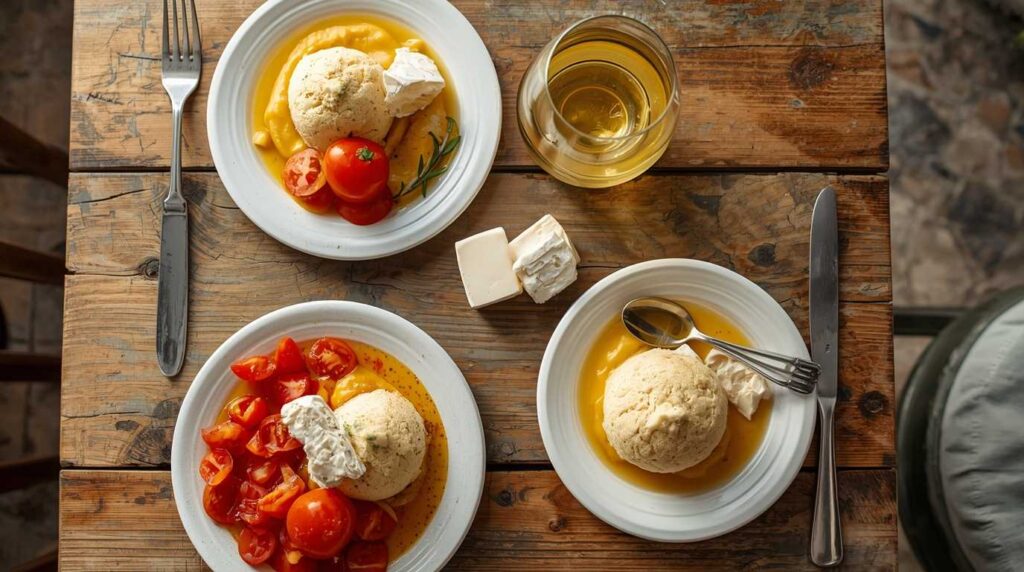
Cretan cuisine isn’t just “Greek food.” It is a distinct regional tradition that has been studied by nutritionists as one of the healthiest diets on earth — the original Mediterranean diet was largely documented from Crete, where cardiovascular disease rates in the 1950s were among the lowest recorded anywhere. Whether or not you care about nutrition science, you’ll care about the taste: Cretan olive oil is widely considered the finest in Greece, the local sheep and goat cheeses have no equivalent elsewhere, and the wild herbs (thyme, sage, savory) gathered from the hillsides add dimensions to simple dishes that defy replication.
What to Order in Crete (and Where)
Dakos: The signature Cretan appetizer — a dried barley rusk soaked slightly in olive oil, topped with crushed tomato, mizithra cheese, and olives. Served everywhere; order it everywhere. €4–€7.
Kalitsounia: Small pastries filled with fresh herbs or soft cheese; eaten as breakfast or a snack. Found in every bakery for €1.50–€2.50 each.
Lamb and goat: Cretan meat traditions center on slow-roasted lamb and goat — kleftiko (wrapped in parchment, cooked for hours), stifado (stew with wine and spices), and the simple charcoal-grilled cuts that are a Sunday tradition. Any traditional taverna serves these well; avoid places where the menu is entirely in tourist English and features photos.
Cretan wine: Crete produces wines from indigenous grape varieties — Vidiano (white, mineral, excellent), Kotsifali (red, soft), and Vilana — that are gaining international recognition. A carafe of house wine at a good taverna runs €8–€15. Local wine shops in Chania’s old town will let you taste before buying.
Where to eat: In Chania, avoid the harbourfront restaurants (beautiful setting, mediocre food, tourist prices). Walk two blocks inland into Splantzia neighborhood — the quality improves dramatically and prices drop by 30%. In Heraklion, the area around Lion Fountain (Morosini Fountain) in the city center has several excellent choices. In any Cretan village, the one kafeneio is almost always a taverna too — ask if they’re cooking and order whatever the kitchen is making that day.
Where to Stay in Crete for Seniors
Crete’s accommodation ranges from large resort complexes to intimate old-town guesthouses. For seniors, the most important factors are: elevator access (essential in old town buildings that date to the Venetian era — many have steep internal stairs), proximity to the harbor for evening walks, air conditioning, and whether breakfast gives you a proper start to the day.
In Chania: Old Town vs. Beach Hotels
Staying in the old town puts you in the heart of the experience — morning walks to the harbor before the crowds, dinner at places you walk past on the way back. The converted Venetian mansions are atmospheric, though rooms vary. Specify that you need an elevator when booking — many old buildings don’t have one. Mid-range old town hotels run €80–€150/night with breakfast in 2026. If you prefer a beach hotel with a pool and easier mobility, Agia Marina and Platanias (both 10–15km west of Chania) have excellent resort-style properties at similar prices; a taxi to Chania old town for dinner is €15–€20. For the best of both, consider renting an apartment in the newer part of the old town (south of the harbor) where buildings are modern but walking distance to everything is 10 minutes.
In Heraklion: City Center vs. Beach Suburbs
For a 3–4 night Heraklion base, the city center near Lion Fountain or the harbor is ideal — walking distance to the Archaeological Museum and easy taxi access to Knossos. Modern hotels here run €75–€140/night. The beach suburb of Ammoudara (8km west of center) has larger resort properties if you want beach access combined with the Heraklion base — regular buses connect it to the city.
Real Costs in Crete 2026
| Expense | Budget | Mid-Range | Comfortable |
|---|---|---|---|
| Hotel / Guesthouse (per night, couple) | €55–€80 | €85–€150 | €155–€280+ |
| Meals (per day, couple) | €30–€50 | €55–€90 | €90–€160 |
| Transport (taxi + occasional car rental days) | €10–€20/day | €20–€40/day | €35–€65/day |
| Site admission (2 sites/day average) | €10–€20/person | €20–€35/person | €30–€60/person (guided) |
| Boat trip to Balos or similar | €25–€35/person | €35–€50/person | €50–€80 (private) |
| Beach sunbeds + umbrella (pair) | €10–€15/day | €15–€25/day | €25–€50/day |
| Daily Total (couple, all in) | €110–€175 | €185–€310 | €330–€580 |
Crete is modestly more affordable than Athens for day-to-day living, and significantly cheaper than Mykonos or Santorini for equivalent quality. A 10-day couple’s trip to Crete (excluding international flights) at mid-range comfort runs approximately €2,200–€3,500 total. For planning your broader European senior travel budget, explore our guide to budget-friendly European destinations and our full Smart Travel for Seniors resource library.
Frequently Asked Questions — Your Essential Crete Travel Guide for Seniors
A minimum of seven days gives you enough time to experience Chania properly, make it to two or three beaches, and include either Knossos or a mountain day trip. Ten to fourteen days is the ideal — long enough to settle into a rhythm, discover a village you love, return to the same café twice, and feel you’ve actually been somewhere rather than passed through. Crete rewards pacing. Seniors who try to compress it into four days come back planning their next trip.
Crete is among the safest destinations in Europe. Violent crime is extremely rare. The Cretan culture of hospitality — philoxenia — extends to genuine practical helpfulness: if you look lost, someone will almost certainly stop to help you. Solo senior travelers, including solo women, consistently rate Crete as one of their most comfortable European experiences. Take normal precautions (secure valuables at organized beaches, be aware of traffic), but there’s no special concern for the island. The main health consideration is heat — carry water, wear a hat, rest midday in summer.
Most Americans flying from the US will connect through a European hub (Athens, London, Frankfurt, Amsterdam). Heraklion (HER) has more international connections and is the larger airport. Chania (CHQ) has direct seasonal flights from several European cities and is closer to the old town. If you’re planning to spend most of your time in Chania and western Crete, fly into CHQ. If Heraklion and eastern Crete are your priority — or if your routing is better through Athens connection — fly into HER. There’s no wrong answer; from either airport, a taxi to your hotel takes 15–30 minutes.
Heraklion has a university hospital (PAGNI — University General Hospital of Heraklion) that is the best medical facility in Crete and handles complex cases well. Chania’s general hospital is solid for standard care. Private clinics in both cities have English-speaking staff and are often faster for non-emergency care. Rural areas and smaller villages have health centers (kentro ygeias) for urgent care, with transfer to Heraklion for anything serious. Keep travel health insurance active (US Medicare does not cover Greece) and carry your medical history and medication list in writing. For seniors with complex medical needs, both Chania and Heraklion are appropriate bases; very remote areas of the island are not.
They offer fundamentally different experiences, and ideally you’d do both — Athens first (2–3 nights) to acclimate, then Crete for a longer stay. Athens gives you the concentrated history and the Acropolis. Crete gives you the Mediterranean lifestyle, beaches, Minoan archaeology, and the particular character of an island that has been the crossroads of civilizations for four millennia. If you can only choose one for a first trip: Athens is irreplaceable for history lovers; Crete is the better choice for those who want a full vacation experience that includes beach, food, culture, and a sense of place. For those considering spending extended time in Greece, our Retire in Greece Guide for Americans covers what long-term Crete living looks like.
An Island That Has Always Known How to Welcome Strangers
There’s a Cretan word — leventia — that has no direct English translation. It describes a kind of noble generosity of spirit, an effortless pride and warmth that doesn’t need to announce itself. You feel it when a Cretan farmer waves you down to offer raki from a bottle in his truck. When the taverna owner sends an extra plate of cheese because you mentioned you liked the first one. When the old woman in the village square gestures at the chair next to her, not speaking a word of English, simply making clear that you’re welcome to sit.
For American seniors who have traveled Europe widely and sometimes found it beautiful but cool, Crete is often the revelation: a place that is genuinely pleased to see you, not as a revenue source, but as a guest in the old sense of the word.
Explore more Greece senior travel guides: