
Greece has been drawing artists, philosophers, and dreamers for millennia. In 2026, it’s drawing American retirees with a compelling combination: a flat 7% tax on foreign income, EU infrastructure, Mediterranean lifestyle, and costs that — outside Athens and the famous islands — remain genuinely affordable. This guide covers the complete picture, including what most articles miss.

Greece is the European retirement destination that most Americans haven’t seriously considered — and that oversight may be costing them. While Portugal and Spain dominate the conversation, Greece offers something neither can currently match: a 7% flat tax on foreign retirement income identical to Southern Italy’s, combined with lower overall living costs than Spain, and a quality of life that’s difficult to describe without sounding like a travel brochure.
The complications are real too. The bureaucracy is legendarily Byzantine. Athens is simultaneously one of Europe’s most culturally rich and logistically chaotic cities. Island life is incomparably beautiful and logistically dependent on ferries and small airports. And Greek bureaucracy — like Italian bureaucracy — has a particular character that either becomes charming or maddening depending on your disposition.
This guide answers every significant question American seniors actually ask before making this move.
📋 Contents
- → Why Greece? The Case That Most Articles Miss
- → Visa Options: Non-Dom, Golden Visa & Digital Nomad
- → Greece’s 7% Flat Tax: The Complete Picture
- → Real Costs in 2026: Athens vs. Islands vs. Mainland
- → Where to Live: Islands vs. Athens vs. Mainland Cities
- → Healthcare: The Public-Private Picture
- → Practical Realities: Language, Bureaucracy, Daily Life
- → Frequently Asked Questions

Why Greece? A Retire in Greece Guide for Americans in 2026
Most retirement articles mention Greece’s beauty and food. If you are looking for a practical retire in greece guide for americans in 2026, here is what most sources underemphasize:
| Factor | Greece’s Specific Advantage |
|---|---|
| 7% flat tax on foreign income | Same as Southern Italy, but available throughout Greece (not just rural regions) with fewer restrictions |
| English penetration | Extremely high for a non-Anglophone country — consistently ranked top 10 in Europe for English proficiency according to the global EF English Proficiency Index; nearly universal among younger Greeks |
| Lower cost than you think | Outside Athens tourist areas and famous islands, Greece is significantly cheaper than Spain or Portugal — many mainland towns cost less than Southeast Asia equivalents |
| Mediterranean health advantages | Genuine Mediterranean diet in daily life, warm climate, walkable towns, outdoor activity — legitimate longevity associations |
| Accessibility from the US | Direct flights from New York to Athens; connections available from most major US cities |
| Community warmth | Greeks have a genuine and deeply cultural hospitality (philoxenia — literally “love of strangers”) that most expats describe as one of their most pleasant surprises |
Visa Options for American Retirees in Greece
Greece offers multiple visa pathways for expats. To make this retire in greece guide for americans in 2026 as useful as possible, let’s break down the three primary options. — but understanding all three options helps you choose correctly.
Option 1: Non-Dom / Type D Income Transfer Visa (Best for Most Retirees)
| Income requirement | €2,000/month for primary applicant (~$2,200) + €200 per dependent |
| Income source | Any passive income transferred to Greece from abroad: pension, Social Security, investment income, rental income |
| Tax benefit | Qualifies for 7% flat tax on all foreign-sourced income (see dedicated section below) |
| Where to apply | Greek consulate in the US before arrival (you can check the official Greek Ministry of Foreign Affairswebsite for regional consulate locations); then register locally in Greece within 30 days |
| Duration | 2 years initially; renewable |
| Residency requirement | Must spend at least 6 months per year in Greece |
| Path to citizenship | 7 years of legal residency (EU citizenship) |
Option 2: Golden Visa (Investment Route)
Greece’s Golden Visa grants residency through real estate investment. The threshold was significantly raised in 2023: €800,000 in Athens, Thessaloniki, Mykonos, and Santorini; €400,000 elsewhere. This route is primarily for seniors who want to invest in property anyway and can meet the elevated thresholds. It does not automatically include the 7% tax benefit — that requires the Non-Dom tax registration separately. Note that Greece’s Golden Visa is currently under review by EU authorities and requirements may change.
Option 3: Digital Nomad Visa (For Remote-Working Retirees)
Greece’s Digital Nomad Visa allows remote workers employed by companies outside Greece to live in Greece for up to 12 months (renewable once). Income requirement: €3,500/month. If you continue part-time consulting or remote work in retirement, this may be appropriate — but it has different tax implications than the Non-Dom route. Consult with a Greek tax attorney before choosing between these options.
Greece’s 7% Flat Tax: The Complete Picture
Greece introduced a 7% flat tax on foreign-sourced income for retirees who transfer their tax residency to Greece and meet specific requirements. Unlike Italy’s 7% regime (which is restricted to rural Southern municipalities), Greece’s applies more broadly — making it accessible to residents of Athens, islands, and major mainland cities.
Requirements to Qualify
- Must have been a tax resident of a country with a double-taxation treaty with Greece for at least 5 of the last 6 tax years
- Must transfer tax residency to Greece
- Must invest a minimum of €500 in Greece (very low bar — even opening a Greek bank account qualifies for some interpretations)
- Must apply for the special regime within the first year of becoming a Greek tax resident
💰 Tax Comparison: Greece 7% vs. Standard US Taxation
A retired couple with $90,000/year in retirement income (pension + SS + investment income):
| Living in high-tax US state (California, NY) — state tax alone | $8,000–$12,000/year state tax |
| Greek 7% flat tax on $90,000 (using Foreign Tax Credit vs. US taxes) | ~$6,300/year to Greece; significant FTC offset against US liability |
| Living in US no-income-tax state — state tax | $0 state tax |
Important: The US-Greece tax treaty and Foreign Tax Credit interaction is complex. Some income types are taxed differently. The 7% regime is not automatically a tax saving for all American retirees — it depends on your income composition, existing US tax liability, and how the treaty applies to each income source. A dual-qualified US/Greek tax attorney is essential before relying on these calculations.
Real Costs in 2026: Athens vs. Islands vs. Mainland
| Expense | Greek Mainland (Thessaloniki, Patras, Nafplio) | Athens | Popular Islands (Crete, Corfu, Rhodes) | Famous Islands (Santorini, Mykonos) |
|---|---|---|---|---|
| Rent (2BR) | €450–€800 | €700–€1,400 | €500–€1,000 | €1,500–€3,500+ |
| Groceries | €250–€380 | €320–€480 | €280–€420 | €400–€650 |
| Dining out | €150–€350 | €250–€550 | €200–€450 | €500–€1,200 |
| Healthcare (private) | €100–€200 | €150–€280 | €120–€220 | €200–€400 |
| Utilities + internet | €100–€180 | €130–€230 | €110–€200 | €180–€350 |
| Monthly Total (couple) | €1,050–€1,910 ($1,155–$2,100) | €1,550–€2,940 ($1,705–$3,234) | €1,210–€2,290 ($1,331–$2,519) | €2,780–$6,100+ (luxury tier) |
💡 The Insider Distinction: Santorini and Mykonos are global luxury tourism destinations — their prices reflect that, not typical Greek costs. Crete (Greece’s largest island), Corfu, Rhodes, and the Peloponnese coast offer Mediterranean island beauty at a fraction of the headline island prices. Most experienced expats live on Crete or the Ionian islands rather than the Instagram-famous Cyclades.
Where to Live: A 2026 Retire in Greece Guide for Americans
Crete — The Best Overall Island for Retirees
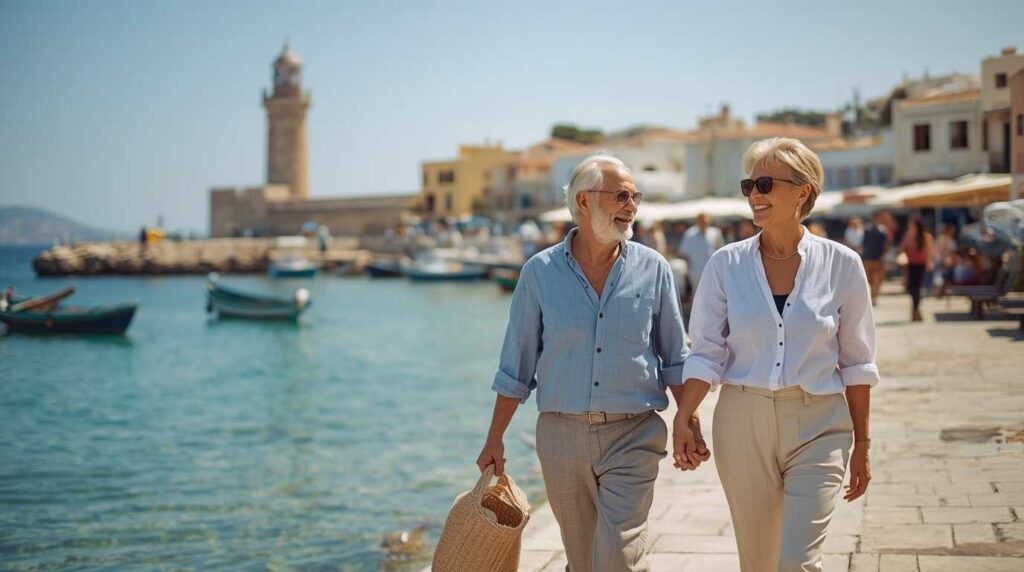
Crete is Greece’s largest island and offers something no smaller island can: the full range of infrastructure, healthcare, and lifestyle options in a compact, manageable setting. Heraklion (the capital) has a university hospital, international airport with direct European flights, and a functioning city with culture and amenities. Chania in the west is considered one of the most beautiful small cities in Europe — Venetian harbor, old town maze of streets, excellent food scene, growing expat community. Rethymno sits between them with its own Ottoman-era old town and quieter pace. Costs are lower than Athens and dramatically lower than the Cyclades.
To help you decide if this island is the perfect fit for your lifestyle, we’ve detailed the best neighborhoods, healthcare access, and cost-of-living data in our comprehensive Crete Travel Guide for Seniors.
Athens — For Urban Seniors Who Want Everything

Athens is genuinely underrated as a livable city for retirees. Beyond the tourist version — the Acropolis, Plaka — Athens has extraordinary neighborhood-level appeal: the Koukaki district below the Acropolis, the gentrified Monastiraki and Psyrri areas, the upscale northern suburbs (Kifissia, Glyfada) with beach access. World-class museums, excellent healthcare (the best in Greece), an international airport with direct New York connections, and a cultural life that rivals any European capital. If you are planning an exploratory trip first, check out our comprehensive Athens travel guide for seniors to learn about accessible sights, transit options, and real costs. Housing costs significantly more than the mainland or islands but remains competitive with comparable European cities.
Peloponnese — Hidden Gem for the Truly Adventurous
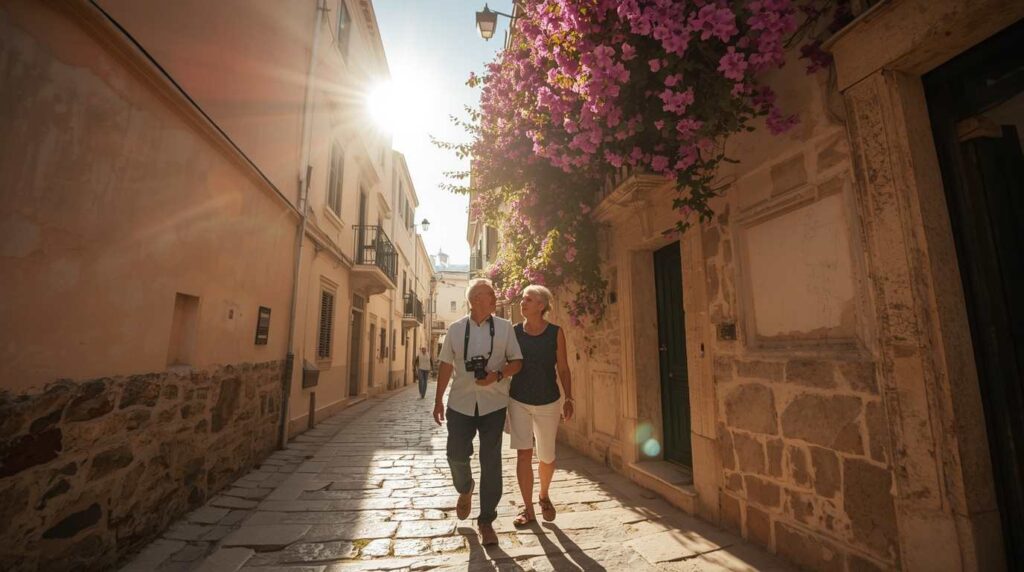
The Peloponnese peninsula — connected to the mainland but feeling entirely its own — offers ancient ruins (Epidaurus, Mycenae, Olympia), Byzantine towns (Mystras), dramatic coastline, and some of the lowest property prices in all of Greece. Nafplio — arguably the most beautiful small town in Greece, the country’s first capital — has a small but established expat community, lovely seafront, and Venetian architecture. Kalamata (the olive capital) is affordable, authentic, and increasingly connected. For seniors who want genuine Greek life rather than expat-enclave life, the Peloponnese is where it lives.
If you’re ready to explore this historic region, check out our full Nafplio & Peloponnese Travel Guide for Seniors, covering everything from ancient site access to the best local living spots.
Thessaloniki — Greece’s Second City, First-Rate Quality of Life
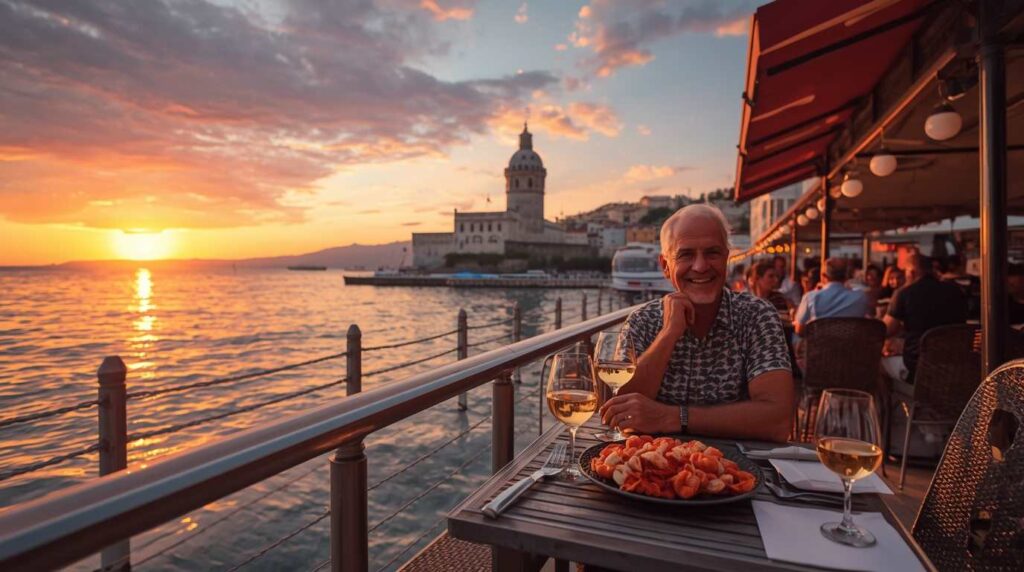
Thessaloniki is consistently voted the city Greeks most want to live in (over Athens) for its balance of culture, food, cost, and quality of life. Aristotle University gives it a young, vibrant energy. The food scene is considered by many Greeks to be better than Athens. Costs are 20–30% below Athens. It’s less known to American expats than Athens, which for some is the point. Healthcare is excellent, the waterfront is beautiful, and the Byzantine church circuit is world-class.
To help you plan your visit or long-term stay, we have compiled all the essential logistics, healthcare tips, and budget breakdowns in our latest article: Thessaloniki Travel Guide for Seniors.
Healthcare: The Public-Private Picture
Greece has a public healthcare system (ESY) that legal residents are entitled to access. The public system’s quality varies significantly: university hospitals in Athens and Thessaloniki are genuinely excellent, while smaller regional hospitals and island facilities range from adequate to limited. For specialized care, mainland major cities provide the best options.
Most American expats in Greece use a combination: private insurance for routine care and specialist visits (faster, English-speaking, higher quality in private clinics), and the public system as a safety net for serious hospitalization. Private health insurance for a couple in their 60s runs approximately €200–€400/month depending on coverage level and provider — still dramatically cheaper than US alternatives.
A practical consideration for island retirees: medical evacuation to a major hospital on the mainland may be required for serious conditions. This is a genuine logistics factor when choosing between island and mainland residence — factor it into the decision, especially if you have complex health needs.

🚨 Medicare Note: US Medicare does not cover care in Greece. Private health insurance in Greece or international health insurance must be in place before arrival. The Non-Dom visa application requires proof of health coverage. For the full picture on health insurance for Americans abroad, see the health insurance guide for Americans abroad.
Practical Realities: Language, Bureaucracy & Daily Life
Language: Better Than You Expect, Still Worth Learning
Greece has unusually high English proficiency among younger people — ranked consistently in the top 10 in Europe. In Athens, tourist areas, and major cities, English is genuinely widespread. In small villages, remote islands, and older-generation contexts, Greek is essential. Even if you can function in English for daily life, learning Greek — at least basic conversational Greek — opens relationships and experiences that English alone cannot. It also signals respect and earns genuine warmth from Greeks that the tourist experience never provides.
Bureaucracy: Plan for It, Don’t Fear It
Greek bureaucracy has improved significantly with digital services (the gov.gr portal has digitized many previously nightmarish processes) but remains genuinely complex. Getting your AFM (tax registration number), registering your residence, opening a bank account, navigating residency renewal — all involve multiple steps and sometimes multiple visits. A local accountant (logistis) is essential for tax matters. A local lawyer familiar with expat residency processes is strongly recommended for the initial setup. Budget €2,000–€3,000 for professional help through the initial registration process — it’s worth every euro.
The Greek Pace and What It Means for Daily Life
Greek daily life has a rhythm built around food, family, coffee, conversation, and evening walks (the volta). Lunch is the main meal (2–3pm). Dinner doesn’t begin until 9–10pm. Coffee at a kafeneio can last two hours and is genuinely about the conversation, not the caffeine. For Americans accustomed to efficiency-optimized days, this feels like radical decompression. For Americans seeking exactly that decompression — which is why most of them are reading this article — it feels like arriving somewhere they didn’t know they were looking for.
Frequently Asked Questions – Retire In Greece Guide Americans
Greece is one of the safest countries in Europe. The primary concerns are petty theft in tourist-heavy areas (Athens city center, famous island ports) and road safety outside major highways. Violent crime is extremely rare. Greek society has a strong culture of communal safety — older residents are particularly respected and looked after. Most American retirees in Greece report feeling very safe in their residential neighborhoods and daily routines. The economic hardships of the previous decade actually reinforced rather than diminished Greek community solidarity.
Portugal is the easiest: English everywhere, simpler visa, Atlantic rather than Mediterranean. Spain offers the most geographic variety and cultural depth with good English in cities. Greece offers the most dramatic combination of ancient history and Mediterranean lifestyle at the lowest cost — with the 7% tax as a meaningful financial incentive that neither Spain nor Portugal currently matches. The right answer depends on what specifically draws you: if it’s ease, Portugal. If it’s cultural richness, Spain or Greece. If it’s cost and tax efficiency with Mediterranean lifestyle, Greece is the underappreciated winner. This comprehensive retire in greece guide for americans in 2026 recommends visiting all three before deciding.
Yes — Americans can buy property in most of Greece without restriction. Border regions and certain islands designated as sensitive zones (near Turkey, some Aegean islands) have restrictions on non-EU buyers, so verify your target area’s status before proceeding. Greek property transactions involve a notary (symvolaiografos) and require an AFM number. Budget 10–12% above purchase price for transaction costs (transfer taxes, notary, legal fees, agent commission). The Greek property market has been recovering strongly since 2020 — particularly in Athens and coastal areas — so prices in desirable areas are significantly above the post-2008 lows.
Athens is approximately 10–11 hours from New York (direct flights operated by American Airlines and Olympic Air/Aegean). From the West Coast, expect 14–15 hours with a connection. Thessaloniki and Crete are accessible via Athens or connecting flights through European hubs (London, Frankfurt, Amsterdam). Budget €600–€1,200 for a round-trip transatlantic fare in shoulder season. Like all European retirement destinations, the distance from family is the most significant non-financial challenge — particularly compared to Mexico or the American Southeast.
Morning coffee at a kafeneio. The laiki (weekly open-air market) for produce. Afternoon reading or walking. Long lunches with wine. Afternoon rest. The volta in the evening. Dinner at 9 or 10. The pace is genuinely different — it’s not lazy, it’s human-scaled. Americans who thrive in Greece almost universally describe the transition as initially disorienting and ultimately one of the most valuable experiences of their lives. The ones who don’t thrive are usually those who wanted American efficiency with Greek scenery, rather than those willing to accept Greek time with American perspective.
The Country That Invented the Good Life
The ancient Greeks invented the concept of eudaimonia — a word usually translated as “happiness” but more accurately meaning “flourishing” or “the good life.” It wasn’t about pleasure or wealth but about living fully in accordance with your nature and values.
Modern Greeks have preserved something of that philosophy in how they actually organize daily life — the unhurried meals, the communal evening gatherings, the genuine interest in conversation with strangers, the cultural weight given to beauty, friendship, and quality of experience over efficiency and accumulation.
For seniors who have spent careers optimizing, producing, and achieving — and who now want to understand what they were optimizing toward — Greece has a particular kind of answer. It’s not the easiest country to live in. But it may be one of the most rewarding.
Explore more European retirement destinations:
Last reviewed and updated: June 6, 2026 by Ali Damar, Founder of Senior Gig Guide