
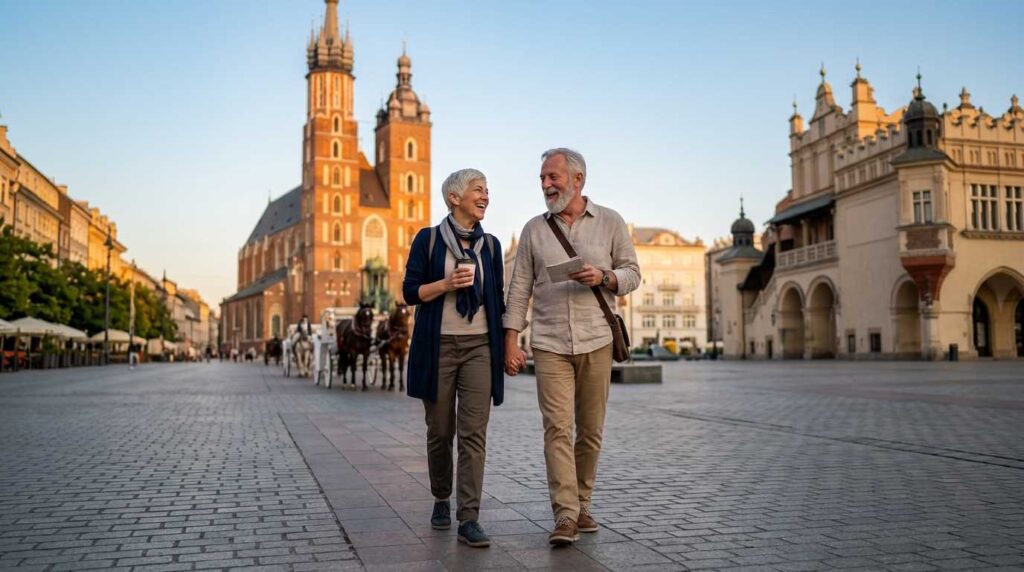
📋 Quick Summary: Is Krakow Right for You?
Krakow travel guide for seniors — the short version: Krakow, Poland is one of the most senior-friendly cities in Europe. It has a flat, walkable Old Town, modern low-floor trams, excellent private hospitals with English-speaking doctors, and a cost of living roughly 50% lower than cities like Paris or London. A comfortable retirement budget of $1,500–$2,000/month covers rent, food, healthcare, and leisure. This guide covers everything — from what to see in a week to what it takes to move there permanently.
Let’s be honest. Most travel articles about Krakow were written for 25-year-olds doing pub crawls. This one is different. Whether you’re planning a two-week vacation to explore a city you’ve always been curious about, or you’re seriously considering moving to Europe on your Social Security income, this Krakow travel guide for seniors gives you real, practical information — no fluff, no Instagram poses, no hostel recommendations.
Krakow is Poland’s former royal capital, and it is genuinely remarkable. Unlike Warsaw, which was almost completely destroyed in World War II and rebuilt in a more modern style, Krakow came through the war largely intact. That means the medieval streets, Gothic churches, Renaissance courtyards, and baroque facades you see today are the real thing — centuries old and meticulously preserved. The city holds UNESCO World Heritage status for its Old Town, and walking through it feels less like a museum tour and more like stepping into a living piece of history.
And here’s the part that matters most for Americans over 55: it is remarkably affordable, genuinely accessible, and surprisingly welcoming to English speakers. Let’s dig in.
Table of Contents
- Why Seniors From the U.S. Are Choosing Krakow in 2026
- Getting to Krakow: Flights, Trains & What to Expect at the Airport
- Best Neighborhoods to Stay In (And Which to Avoid)
- Top Senior-Friendly Attractions in Krakow
- A Relaxed 7-Day Senior Itinerary
- Food, Dining & The Real Cost of Eating in Krakow
- Getting Around: Trams, Taxis & Walking Tips
- Healthcare in Krakow: What Happens If You Get Sick?
- Could You Actually Retire in Krakow? Visas, Costs & Reality
- Packing List for Seniors Visiting Krakow
- Frequently Asked Questions
1. Why Seniors From the U.S. Are Choosing Krakow in 2026
There’s a quiet but growing trend among Americans over 55: skipping the expensive, overcrowded destinations like Rome, Barcelona, or Paris and heading instead to cities in Central and Eastern Europe that offer the same European magic at a fraction of the price. Krakow sits at the top of that list — and for very good reasons.
First, the financial picture. The Polish zloty (PLN) is not part of the eurozone, which means your U.S. dollars stretch considerably further here than in most of Western Europe. In 2026, roughly $1 equals about 4 PLN. A sit-down lunch at a traditional Polish restaurant might cost you $6–$10. A good bottle of local wine at a restaurant runs about $12. A comfortable, centrally located one-bedroom apartment rents for $600–$900 per month. These are not typos.
Second, the physical layout. Many European cities that Americans dream of visiting — Florence, Lisbon, San Francisco — are built on hills, with cobblestone streets that punish anyone with knee or hip issues. Krakow’s Old Town is almost entirely flat. The Main Market Square (Rynek Główny) is wide, open, and paved with smooth stones. The major attractions are close together. You can comfortably see the heart of the city on foot without a single significant climb.
Third — and this surprises many Americans — Poland is extremely safe. The U.S. State Department gives it a Level 1 travel advisory, which is the safest possible rating. Violent crime is genuinely rare, especially in tourist areas. Women traveling alone, couples, people using mobility aids — everyone feels comfortable here.
💡 Senior Travel Insight: Krakow’s Old Town is a UNESCO World Heritage Site, meaning heavy vehicle traffic is restricted inside it. This actually makes it more peaceful and safer for pedestrians than many other European city centers. You won’t be dodging motorbikes or rushing cars while sightseeing.
2. Getting to Krakow: Flights, Trains & What to Expect at the Airport
Getting to Krakow from the United States requires at least one connection, as there are no direct nonstop flights from U.S. cities to Kraków John Paul II International Airport (KRK). The most common connection points are Frankfurt, London Heathrow, Amsterdam, Vienna, and Warsaw. The total travel time from the East Coast of the U.S. typically runs 12–16 hours including the layover.
For seniors who prefer to break the journey, flying into Warsaw first and spending a night or two there before continuing to Krakow by train is a smart option. The LOT Polish Airlines high-speed train covers Warsaw to Krakow in about 2.5 hours, and it is comfortable, clean, and easy to navigate.
At Kraków Airport: What to Know Before You Land
The airport itself is modern and relatively small — which is a good thing. Baggage claim is quick, and the facilities are clean and well-labeled in English. From the airport to the city center, you have three practical options:
| Transport Option | Travel Time | Approx. Cost (USD) | Senior Suitability |
|---|---|---|---|
| Airport Train (Line 4) | 18 min to city center | $1.50 | ✅ Excellent — smooth, frequent, low-floor |
| Airport Bus (Line 208/252) | 40–50 min | $1.00 | ✅ Good — requires luggage handling on steps |
| Bolt/Uber Taxi | 20–30 min | $10–$15 | ✅ Best for those with heavy luggage or mobility needs |
| Official Taxi (KrakówTaxi) | 20–30 min | $20–$30 | ⚠️ Legitimate but pricier — always confirm meter is running |
⚠️ Scam Warning: Unofficial taxis at the arrivals exit sometimes approach travelers with fixed-price offers. These are almost always overpriced. Use the Bolt or Uber apps on your phone, or look for the official KrakówTaxi desk inside the terminal. The app-based rides are significantly cheaper and show you the fare before you get in.
3. Best Neighborhoods to Stay In (And Which to Avoid)
Choosing where to stay in Krakow significantly affects your experience. The city has distinct neighborhoods, and not all of them are equally convenient or comfortable for travelers over 55.
Old Town (Stare Miasto) — The Top Pick for Most Seniors
This is where you want to be, full stop. Staying inside or immediately adjacent to the Old Town puts every major attraction within a 10–20 minute walk. Streets are flat and pedestrian-friendly. There are cafes, pharmacies, supermarkets, and ATMs on virtually every block. Hotel quality here ranges from budget guesthouses to beautifully restored four-star properties in historic buildings. Prices reflect the location — expect to pay $80–$160 per night for a comfortable hotel — but the convenience for seniors is unmatched.
Kazimierz — Charming, Bohemian, and Very Walkable
Krakow’s historic Jewish district sits about a 20-minute walk south of the Main Square. It has a completely different character — quieter, more artistic, full of independent cafes, galleries, and some of the city’s most interesting restaurants. It’s also flat and very walkable. If you want a more local, less touristy base, Kazimierz is an excellent option. Accommodation here tends to be slightly cheaper than Old Town.
Podgórze — Skip It for a First Visit
This neighborhood across the river has some historical significance, particularly regarding the wartime history of the Jewish ghetto. However, it’s farther from most major attractions and less developed for tourism. For a short trip, it’s not a practical base. If you’re staying long-term or returning for a second visit, it’s worth exploring as a day-trip destination.
4. Top Senior-Friendly Attractions in Krakow
The Main Market Square (Rynek Główny)
At roughly 10 acres, this is one of the largest medieval market squares in all of Europe. The scale of it is genuinely impressive in person — photographs don’t capture it well. The square is entirely flat, surrounded by historic buildings, and filled with outdoor seating where you can sit comfortably and simply watch the city go about its day. At the center stands the Gothic Cloth Hall (Sukiennice), which now houses local craft vendors on the ground floor and a gallery of 19th-century Polish painting on the upper level, accessible by elevator.
Every hour, on the hour, a trumpeter plays a traditional melody called the Hejnał from the tower of St. Mary’s Basilica at one corner of the square. The melody cuts off abruptly — a tradition that dates back to the 13th century, commemorating a bugler who was shot while sounding the alarm for a Mongol invasion. Sitting at a cafe with a coffee, listening for the trumpet, is one of those small travel moments that stays with you.
Wawel Royal Castle
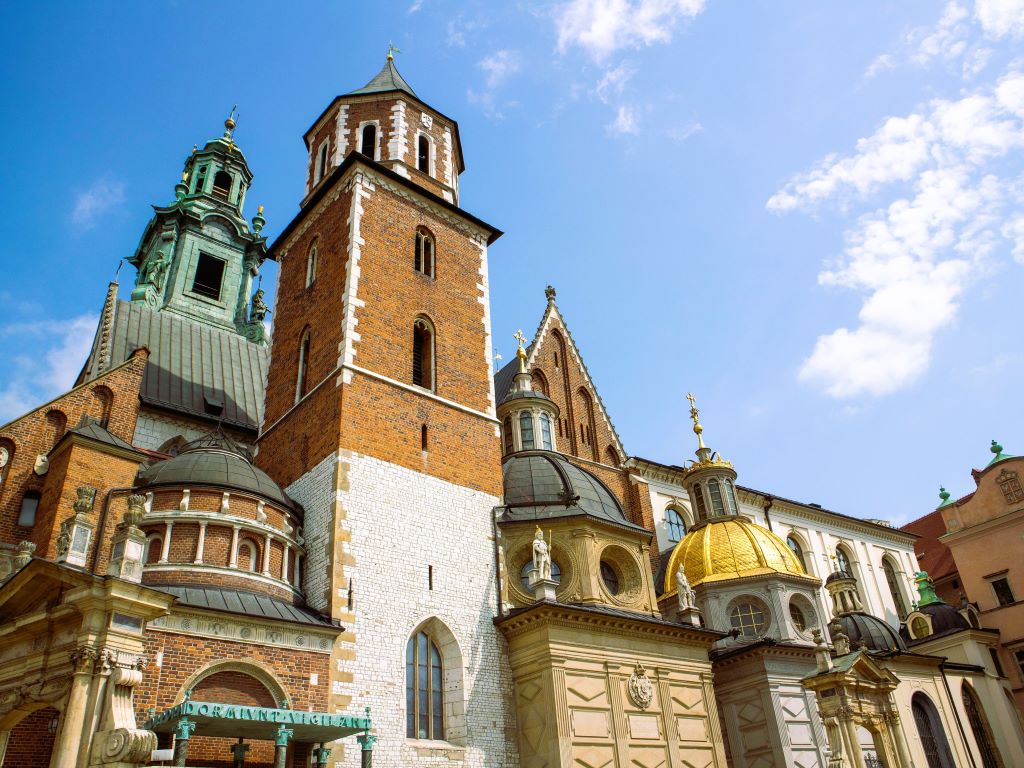
Krakow’s most famous landmark sits on a limestone hill overlooking the Vistula River. Yes, it’s on a hill — but the approach is less daunting than it sounds. Long, gradual ramps lead up to the main courtyard, and once you’re inside the castle complex, the ground is mostly flat and paved. The views of the river below are excellent. The castle itself houses several museums, including the Royal Private Apartments and the Crown Treasury, which contains the ceremonial sword used at Polish coronation ceremonies. Book tickets online in advance — they sell out on busy days — as the castle uses a timed-entry system that keeps crowds manageable.
💡 Practical Tip: Visit Wawel Castle first thing in the morning, ideally at opening (9:00 AM). The crowds are thinnest at that hour, the light on the courtyard is beautiful, and you’ll avoid the midday heat in summer. By 11:00 AM, tour groups begin arriving in large numbers.
Wieliczka Salt Mine
Located 20 minutes from the city center by train or taxi, the Wieliczka Salt Mine is one of the most unusual and spectacular sites in all of Poland. It is a massive underground complex — essentially a city built entirely from salt over 700 years — that includes chapels, statues, lakes, and even chandeliers carved from salt crystals. The standard tourist route descends more than 300 feet underground and involves several hundred steps.
However — and this is important for this guide — the mine offers a separate Accessible Route designed specifically for visitors with limited mobility. This route uses the mine’s elevator to reach the underground chambers, bypassing all the stairs. You must book this specifically when purchasing your ticket at wieliczka.eu. The air underground is naturally mineral-rich and cool, which many visitors find refreshing. It is a genuinely world-class site and absolutely worth the effort to visit.
Kazimierz — The Jewish Quarter
A leisurely flat walk from the Old Town brings you to Kazimierz, Krakow’s historic Jewish neighborhood. Before World War II, this area was home to a thriving Jewish community of around 60,000 people. Today, it is a beautifully preserved district of synagogues, Jewish cultural centers, independent bookshops, and atmospheric cafes. The Old Synagogue, the oldest surviving synagogue in Poland, now operates as a museum of Jewish history and culture. The exhibits are thoughtfully presented and not physically demanding to explore.
Auschwitz-Birkenau Memorial (Day Trip)
About an hour west of Krakow by shuttle bus or tour, the Auschwitz-Birkenau Memorial and Museum is one of the most important sites of the 20th century — and one of the most visited in all of Poland. A visit here is emotionally demanding and not suitable for everyone, but for many seniors who lived through or near the era of World War II, it carries profound personal significance. Tours are self-guided or guided, and the site is largely flat and accessible. The experience requires several hours and significant walking. Wear comfortable shoes and bring water. Guided tours that include transportation can be arranged through most Krakow hotels and tour agencies, with pick-up directly from your accommodation.
Planty Park — The Green Ring Around the Old Town
Few visitors know about this, but Krakow’s Old Town is encircled by a beautiful garden park called Planty. Where the old city walls once stood, there is now a ring of green space — paths, benches, flower beds, and old trees — about 4 kilometers around. It’s flat, quiet, and perfect for a morning walk. On sunny days, locals bring their dogs and grandchildren here. It connects all the major gates and entry points into the Old Town and is never far from wherever you are in the city center.
5. A Relaxed 7-Day Senior Itinerary
This itinerary is paced for comfort — no early morning rushes, no days packed with 12 activities. Each day has a clear focus, time built in for rest, and suggestions for the best places to eat nearby.
Day 1 — Arrival & Getting Your Bearings
Check in, rest, and take a gentle evening stroll around the Main Market Square. Sit at one of the outdoor cafes, order a traditional Polish beet soup (barszcz) and a glass of local wine, and watch the city at dusk. Listen for the hourly trumpet from St. Mary’s Basilica. No agenda, no museums — just arrival.
Day 2 — The Main Square & Cloth Hall
Morning: Explore the Cloth Hall, browse local crafts, and visit the underground Rynek Underground museum (requires some stairs but has elevators for most sections). Afternoon: St. Mary’s Basilica — the interior is breathtaking and requires minimal physical effort. Evening: Dinner in the Old Town.
Day 3 — Wawel Castle
Start at 9 AM. Take the gradual ramp up to the castle. Visit the Royal Private Apartments and the Crown Treasury. Walk to the Wawel Cathedral. Have lunch at a restaurant near the river at the base of the castle hill. Afternoon free — this is a good day to rest, as the castle involves considerable walking.
Day 4 — Kazimierz & Jewish Heritage
Take a flat 20-minute walk or a 5-minute taxi to Kazimierz. Visit the Old Synagogue museum. Explore Szeroka Street, which is lined with cafes and restaurants. Lunch at one of the Jewish-style restaurants on Szeroka. Afternoon: Walk across the Father Bernatek Footbridge to Podgórze for a view of the river. Taxi back to the hotel.
Day 5 — Wieliczka Salt Mine Day Trip
Book the Accessible Route (elevator-based) in advance at wieliczka.eu. Take the train (4 PLN each way) from Krakow Główny station, 18-minute ride. Spend 3–4 hours in the mine. Return to Krakow for a late lunch. Rest afternoon.
Day 6 — Slow Day & Planty Park
Morning walk along Planty Park — the full loop is about 4 km and takes roughly 60–80 minutes at a leisurely pace. Stop at a cafe along the way. Afternoon: Visit one of the city’s smaller museums (e.g., the Czartoryski Museum, home to Leonardo da Vinci’s “Lady with an Ermine”) at your own pace. Evening: Splurge on dinner at one of Krakow’s excellent upscale restaurants.
Day 7 — Shopping & Final Stroll
Morning: Shop for souvenirs — Polish amber jewelry, hand-painted ceramics, linen goods. These are genuinely beautiful and not overpriced. Afternoon: One final coffee on the Main Square before departure or an evening flight.
6. Food, Dining & The Real Cost of Eating in Krakow

Polish cuisine doesn’t get the attention it deserves internationally, but travelers consistently discover that it is hearty, flavorful, and enormously satisfying. The food culture here revolves around slow-cooked meats, fermented vegetables, thick soups, and dumplings — comfort food at its most elemental. And the prices, by American standards, are genuinely astonishing.
| Meal / Venue Type | What You Get | Price Range (USD) |
|---|---|---|
| Bar Mleczny (Milk Bar) | Traditional cafeteria — soup, main dish, side, and drink | $4 – $8 |
| Casual Traditional Restaurant | Pierogi, żurek soup, pork loin, bread — full sit-down meal | $10 – $18 |
| Old Town Cafe | Coffee + traditional apple cake (szarlotka) | $4 – $7 |
| Mid-Range Restaurant | 3-course dinner with house wine or craft beer | $18 – $30 |
| Upscale / Fine Dining | Full tasting menu with Polish wines | $40 – $65 |
| Supermarket Weekly Shop | Full grocery run for one person (7 days) | $30 – $50 |
Must-Try Polish Dishes
If you’re new to Polish food, here’s a quick primer on what to order. Pierogi are the country’s most iconic dish — crescent-shaped dumplings stuffed with potato and cheese, meat, or sweet cheese and served boiled or pan-fried with caramelized onions and sour cream. Żurek is a thick, sour rye soup often served in a bread bowl with a hard-boiled egg and white sausage — extraordinary on a cold day. Bigos is a slow-cooked hunter’s stew of cabbage, sauerkraut, and mixed meats. Szarlotka (Polish apple cake) belongs on every table.
Tipping culture in Poland is different from the U.S. A gratuity of 10% is considered generous. Rounding up the bill or leaving 5–10 PLN for a simple lunch is entirely appropriate. The 20–25% American standard does not apply here.
7. Getting Around: Trams, Taxis & Walking Tips
Within the Old Town, you will spend most of your time on foot — and that’s perfectly fine given the flat terrain. But getting between neighborhoods, or reaching sites outside the center, is where Krakow’s public transport shines.
Trams
Krakow has an excellent tram network. The newer trams in the fleet are low-floor, meaning there is no step to board — you walk directly on from the pavement level. This is a genuine quality-of-life improvement for anyone with knee, hip, or balance concerns. A single tram ticket costs about $0.75 from a machine at the stop (or $1 if purchased on board). A 24-hour pass costs roughly $3. There is a notable policy worth knowing: riders over 70 years old travel free on all public transport with a valid ID proving their age.
Taxis and Rideshare Apps
Bolt (the European equivalent of Uber) operates extensively in Krakow and is the recommended option for app-based rides. The fares are transparent, fixed before you get in, and very affordable. A 15-minute ride across the city typically costs $4–$7. The app works identically to Uber and accepts international credit cards. Uber also operates here but Bolt generally has more drivers and shorter wait times.
Walking Tips for Seniors
The Old Town pavement is made of cobblestones in some areas — not the rough, uneven kind you’d find in Rome or Lisbon, but smoother and more manageable. However, if you use a cane, walker, or have significant balance concerns, take note: some side streets have older, less even surfaces. Sticking to the main pedestrian areas is always smoother. Wear supportive, cushioned shoes regardless of your fitness level — you will walk more than you expect, and your feet will thank you.
8. Healthcare in Krakow: What Happens If You Get Sick?
This is the question every traveler over 55 needs an honest answer to — and the good news is that Krakow’s healthcare situation is genuinely solid.
Poland has a national public health system (NFZ). As a tourist from the U.S., you won’t have access to this unless you’re registered as a resident. However, the city has numerous excellent private clinics and hospitals where English-speaking physicians are readily available. A consultation with a specialist at a private clinic typically costs $30–$70, which is dramatically less than U.S. out-of-pocket costs. Common medications are widely available at pharmacies (apteka) — you’ll see one on almost every block — and prices are a fraction of American rates.
Key Medical Facilities Near the Old Town
Several private medical centers operate close to the city center, including Medicover and LUX MED, both of which have English-speaking staff, modern equipment, and appointment systems that accept walk-ins for urgent needs. The main public hospital (Szpital Uniwersytecki) handles emergencies for all patients, including foreigners, and is a fully equipped modern facility.
⚠️ Insurance Is Non-Negotiable: Your standard U.S. Medicare coverage does NOT apply outside the United States. Before traveling to Poland, you must secure a travel insurance policy that covers emergency medical care and, if necessary, medical evacuation. Many good options exist specifically for travelers over 60. Check our article on health insurance for seniors traveling abroad for a side-by-side comparison of current plans.
9. Could You Actually Retire in Krakow? Visas, Costs & Reality
This section is for the readers who came here with a bigger question in the back of their mind: not just “Can I visit Krakow?” but “Could I actually live there?” The answer is a serious yes — with some important caveats.
The Cost of Living Picture
| Monthly Expense | Budget (Modest) | Comfortable |
|---|---|---|
| Rent (1BR, central Krakow) | $550 – $700 | $750 – $1,100 |
| Groceries | $150 – $200 | $200 – $300 |
| Dining Out (2–3x week) | $80 – $120 | $150 – $250 |
| Public Transport Pass | $12 – $20 | $20 – $30 |
| Private Health Insurance | $80 – $120 | $150 – $250 |
| Utilities (electricity, internet, phone) | $80 – $120 | $100 – $150 |
| Entertainment & Culture | $50 – $80 | $100 – $200 |
| Total Monthly (estimate) | $1,002 – $1,360 | $1,470 – $2,280 |
The implication of these numbers is significant: a typical Social Security benefit of $1,500–$2,000 per month covers a comfortable lifestyle in Krakow. This is not the case in most Western European cities, where the same benefit would barely cover rent alone.
Visa Options for American Retirees
Poland is a member of the European Union’s Schengen Zone. As an American citizen, you can enter Poland without a visa and stay for up to 90 days within any 180-day period. This is commonly used for extended travel — spend three months in Krakow, return to the U.S. or travel outside Schengen for 90 days, then return.
For longer-term residency, the process becomes more involved. Poland does not yet offer a dedicated “retiree visa” category like some countries (Panama, Portugal). The standard path for Americans wishing to stay longer than 90 days is to apply for a Temporary Residence Permit (Karta Pobytu), which requires proof of sufficient financial resources (typically $1,200–$1,500 per month minimum), health insurance coverage, and a fixed address. After five years of continuous legal residence, permanent residency becomes available.
💡 Polish Heritage Connection: Americans with Polish ancestry have an additional option worth investigating. Poland allows citizenship by descent, and the country permits dual citizenship. If even one of your parents or grandparents was a Polish citizen, you may be eligible for Polish citizenship — which would grant you full EU residency rights. This process is bureaucratic but achievable, and several Krakow-based immigration lawyers specialize in helping Americans navigate it.
The Reality of Daily Life for American Expats
There is a growing and active expat community in Krakow, particularly in the Kazimierz and Old Town neighborhoods. English is widely spoken among younger Poles, and most restaurant menus in tourist areas are available in English. That said, learning basic Polish phrases (please, thank you, excuse me, where is the pharmacy?) is both respectful and practically useful for interactions outside the tourist zone. The city has several English-language social groups and organizations for expats, including Internations Krakow chapters and regular meetups.
The city’s cultural life is rich and affordable. Opera tickets start at $10–$20. The Philharmonic Orchestra holds regular concerts. Museums are inexpensive (typically $3–$8 per entry), and many offer free admission on certain days of the week. For seniors interested in lifelong learning, the Jagiellonian University — one of the oldest universities in the world, founded in 1364 — offers public lectures and cultural events open to the community.
10. Packing List for Seniors Visiting Krakow
Krakow’s climate is continental — four distinct seasons, with warm summers (June–August can reach 80–85°F) and cold winters (November–February regularly drop below freezing). The following list is tailored for a 7–14 day visit in spring or fall, which is the ideal time to visit:
| Category | What to Pack | Why It Matters in Krakow |
|---|---|---|
| Footwear | Cushioned walking shoes (waterproof if possible) | You will walk 5–8 miles per day on stone pavement |
| Medications | 90-day supply of any prescription drugs | U.S. prescriptions aren’t valid in Poland |
| Documentation | Passport, insurance cards, travel insurance policy | Needed for tram age verification and medical care |
| Clothing | Layers — light jacket for evenings even in summer | Evenings cool off quickly in spring and fall |
| Cash | $50–$100 in PLN for arrival days | Cards work almost everywhere; cash for tips and WCs |
| Power Adapter | Type E/F European adapter | Polish outlets are different from U.S. |
| Phone Setup | International data plan or eSIM card | You’ll need Bolt/maps/translation apps constantly |
11. Frequently Asked Questions (FAQ)
Yes. Poland has a U.S. State Department Level 1 rating (the safest). Violent crime is extremely rare. Solo travelers and seniors report feeling very secure. Just follow standard precautions against pickpockets in crowded areas.
You need Zloty (PLN). Dollars are not accepted for daily purchases. While Visa and Mastercard are widely used, keep some cash for small shops. Use city ATMs or “kantors” (exchange offices) for the best rates; avoid airport exchanges.
Late April–June and September–October. You’ll enjoy mild weather ($60–75°F$) and fewer crowds. July and August are busy and warmer, while December is cold but famous for its magical Christmas market.
Mostly. The Old Town is flat and modern trams are low-floor accessible. Major sites like the Salt Mine have accessible routes. However, some historic buildings may have narrow stairs, so it’s best to check specific venues in advance.
Minimal. English is widely spoken in hotels, restaurants, and tourist zones, especially by those under 45. For off-the-beaten-path spots, a translation app works wonders. Learning “Dziękuję” (Thank you) goes a long way with locals.
Yes. A comfortable lifestyle (rent, dining, and healthcare) typically costs $1,200–$1,800 per month. Most American retirees find that their Social Security benefits provide a much higher standard of living here than in the U.S.
You can stay in the Schengen Zone (including Poland) for 90 days within any 180-day period visa-free. For longer stays, you must apply for a Temporary Residence Permit, which requires proof of health insurance and sufficient income.
Helpful External Resources
- Official Poland Tourism Portal — trip planning, events, regional guides
- U.S. Embassy in Warsaw — emergency consular services for American citizens in Poland
- AARP Travel Benefits — member discounts on travel insurance and bookings
Related Reading on SeniorGigGuide
- Health Insurance for Seniors Traveling or Living Abroad
- Cyber Safety Guide for Seniors: Protect Yourself on Public Wi-Fi
- Morning Exercises for Seniors: Stay Mobile for Long Travel Days
- Panama City for American Seniors: Visiting, Living & Retiring
- Ljubljana Travel Guide for Seniors
This guide was researched and updated in April 2026. All prices are approximate and based on current exchange rates ($1 ≈ 4 PLN). Visa regulations are subject to change — always verify with the Polish consulate or embassy before making residency plans.
Last reviewed and updated: May 2, 2026 by the SeniorGig Team.