AI Prompt Engineering for Seniors is rapidly emerging as one of the most powerful career pivots available to professionals over 50 — and the data in 2026 makes it impossible to ignore. While many still assume that artificial intelligence belongs exclusively to young coders in Silicon Valley hoodies, a quiet revolution is unfolding. Seasoned professionals with decades of domain expertise are discovering that they are, in many ways, better positioned than anyone else to thrive in this new discipline. The age of AI does not sideline experience — it rewards it.
This guide will walk you through exactly what prompt engineering is, why your professional background gives you a structural advantage, how to get started, which tools to use, and how to turn this skill into real, flexible income in 2026 and beyond.
What Is AI Prompt Engineering — And Why Does It Matter in 2026?
At its core, prompt engineering is the art and science of communicating effectively with artificial intelligence tools to get the most accurate, useful, and business-relevant outputs possible. Think of it as learning to give very precise, well-structured instructions to an extraordinarily capable assistant who needs clear direction to perform at its best.
This is not a niche academic skill. According to Coursera, the global prompt engineering market is growing at a compound annual growth rate of 32.8% between 2024 and 2030, driven by growing automation and the expanding reach of generative AI across every major industry. SQ Magazine reports that the market is expected to reach $1.52 billion in 2026 alone — nearly doubling from its 2024 value of $850 million.
More importantly, the skill of prompt engineering is evolving beyond a standalone job title and becoming a core competency embedded in hundreds of existing professional roles — from consulting and content strategy to healthcare administration and financial services. This shift is precisely what makes it so valuable for senior professionals who already hold credibility in a specific industry.
As Refonte Learning explains, prompt engineering is becoming as foundational as knowing how to use the internet was in the early 2000s — those who develop fluency early gain a lasting advantage over those who wait.
The Wisdom Advantage: Why Seniors Excel at AI Prompt Engineering
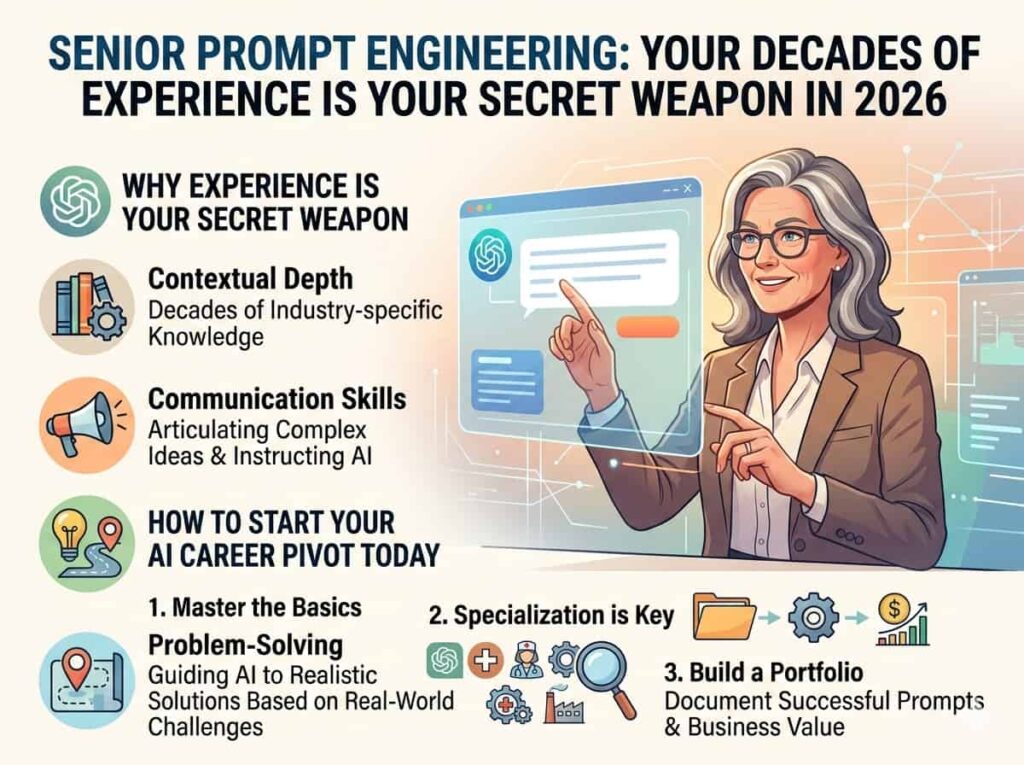
Here is the insight that the mainstream tech conversation consistently misses: prompt engineering is not primarily a technical skill — it is a communication and reasoning skill. And communication and reasoning are exactly where experienced professionals shine.
Let’s break down the specific advantages that seniors bring to this field:
1. Decades of Domain Expertise
Effective prompt engineering requires deep contextual understanding of the subject matter you are working in. A prompt written by someone who has spent 30 years in financial services, healthcare administration, or operations management will produce dramatically more useful outputs than one written by a recent graduate who has only read about those fields in textbooks.
AI models like Claude, ChatGPT, and Gemini are trained on enormous volumes of general information. But they need you to provide the specific context, the right framing, and the relevant constraints that make their output actionable in a real business setting. Your career history is literally the raw material for better prompts.
2. Superior Communication and Clarity
Research consistently shows that clarity in prompts reduces irrelevant AI outputs by up to 42% and that contextual details boost response accuracy by 30%. These are communication skills — the ability to be precise, to anticipate misunderstanding, and to provide the right level of detail without overwhelming the system.
Professionals who have managed teams, written executive reports, negotiated contracts, and presented to boards have honed exactly these skills over decades. You already know how to communicate for results.
3. Business Acumen and Problem-Solving
One of the most underrated aspects of prompt engineering is knowing what question to ask. Junior practitioners often know how to use the tools but lack the business judgment to direct them toward problems that actually matter. Seniors bring pattern recognition from multiple market cycles, an understanding of organizational dynamics, and the ability to distinguish between a surface symptom and a root cause.
This strategic thinking is what separates a prompt engineer who produces interesting outputs from one who produces transformative business value.
4. Trustworthiness and Professional Credibility
Clients and companies increasingly need people who can not only use AI tools but also verify their outputs, catch errors, and apply ethical judgment. Experienced professionals bring exactly this kind of accountability — a quality that younger practitioners, however technically skilled, are still building.
The Real Landscape of AI Prompt Engineering Jobs for Seniors in 2026
It’s worth being realistic and balanced here. The job title “Prompt Engineer” has evolved considerably since the early AI boom of 2023. As industry analysts have noted, the standalone prompt engineer role is becoming less common as a job title — but this is actually good news for senior professionals.
What’s happening is that prompt engineering skills are being absorbed into broader, more senior, and higher-paying roles. Companies are not hiring “prompt engineers” — they are hiring AI Content Strategists, AI Consultants, AI Integration Managers, and Fractional Chief AI Officers. These are roles that require exactly the blend of domain expertise, communication ability, and business judgment that experienced professionals possess.
The median total pay for prompt engineering-adjacent roles in the United States sits around $126,000 per year according to Coursera, with senior and leadership-level positions earning up to three times more than junior roles. For freelancers, rates of $100–$150 per hour are well within reach for professionals who combine domain expertise with AI fluency.
This is the model that works for seniors: don’t compete on technical depth with 25-year-olds — compete on industry knowledge, client relationships, and strategic value that no junior practitioner can replicate.
Want to explore the broader landscape of income opportunities? Our guide to profitable ChatGPT jobs for seniors covers a wide range of AI-powered income streams worth exploring alongside prompt engineering.
Step-by-Step: How to Start Your AI Prompt Engineering Journey Today
The path from “curious about AI” to “generating income with AI prompt engineering” is more accessible than most seniors realize. Here is a structured approach that works.
Step 1 — Build Foundational Fluency (Weeks 1–4)
Start by spending 20–30 minutes per day with the major AI tools: Claude, ChatGPT, and Google Gemini. Don’t just use them passively — experiment actively. Give them the same task described in three different ways and compare the outputs. Notice how adding more context, specifying a tone, or constraining the format changes what you receive.
Keep a simple document where you log which approaches produced the best results. This is the beginning of your prompt library — a personal asset that will become increasingly valuable as you develop it.
Our ChatGPT guide for seniors is a great starting point if you are new to these tools, and our Claude AI for seniors guide covers the AI tool that many professionals consider the most capable for nuanced, complex work.
Step 2 — Choose Your Specialization (Weeks 5–8)
This is where your senior advantage becomes decisive. Rather than trying to be a generalist AI helper, identify the specific industry or function where you have the deepest expertise and focus your prompt engineering practice there.
Examples of powerful specializations for seniors:
Niche Opportunities in Healthcare and Finance
- Healthcare AI Prompt Specialist: Nurses, doctors, hospital administrators, and pharmaceutical professionals who can verify and refine AI-generated clinical content, patient communications, and compliance documentation.
- Financial Services AI Content Strategist: Banking, insurance, and investment professionals who can guide AI toward compliant, accurate, and client-appropriate financial content.
- Legal and Compliance AI Reviewer: Attorneys and paralegals who can review and refine AI-generated legal documents, contracts, and compliance reports.
- Executive Communications AI Specialist: Experienced leaders who can produce board-level presentations, strategic memos, and leadership communications with AI assistance.
- Operations and Supply Chain AI Analyst: Operations professionals who can use AI to model scenarios, draft procedures, and optimize processes in their specific industrial context.
For a deeper look at how to identify and position your niche, see our article on finding the right consulting niche as a senior. The same logic applies directly to AI prompt specialization.
Step 3 — Learn Advanced Prompting Techniques (Weeks 8–12)
Once you have basic fluency and a clear specialization, it’s time to develop more sophisticated techniques. The most valuable ones for professional applications include:
- Few-Shot Prompting: Providing examples of the type of output you want before asking the AI to produce something new. This dramatically improves consistency and quality.
- Chain-of-Thought Prompting: Asking the AI to work through its reasoning step by step before delivering a final answer. This is especially powerful for analytical and problem-solving tasks where accuracy matters.
- Role Prompting: Instructing the AI to adopt a specific professional persona or perspective. For example, “Act as a senior compliance officer reviewing this document for regulatory risk.”
- Constraint-Based Prompting: Defining what the AI should NOT do as clearly as what it should. This reduces unwanted tangents and keeps outputs focused and on-brand.
- Iterative Refinement: Treating each AI response as a draft rather than a final product, and using follow-up prompts to systematically improve it.
Step 4 — Build a Portfolio of Real Results
You need to be able to show, not just tell, what you can do with AI. Start building a portfolio of before/after examples: here is the business problem, here is the prompt strategy I used, here is the output, and here is the business value it created.
Anonymize any client or employer information appropriately, but document your results systematically. This portfolio becomes your most powerful sales tool when approaching clients or employers.
Our guide on building a global portfolio as a senior expert provides excellent frameworks that apply directly to AI-related work.
Essential AI Tools for Senior Prompt Engineers in 2026
You do not need to master dozens of tools. Focus on a small set that deliver the most value for professional work.
Claude (Anthropic)
Claude has earned a strong reputation for nuanced, long-form professional content — particularly for tasks requiring careful reasoning, compliance sensitivity, or sophisticated writing. Its large context window makes it especially useful for working with lengthy documents, contracts, and reports. Our Claude AI guide for seniors will get you up to speed quickly.
ChatGPT (OpenAI)
The most widely recognized AI assistant, ChatGPT remains a powerful tool with a vast ecosystem of integrations. Its strength lies in versatility — it handles everything from drafting emails and reports to data analysis and creative content. See our ChatGPT guide for seniors for a practical introduction.
Google Gemini
Gemini integrates directly with Google Workspace tools — Docs, Sheets, Gmail, and Drive — making it particularly valuable for professionals who work within the Google ecosystem. Our Gemini AI guide for retirees covers its unique strengths in detail.
Canva AI and Design Tools
For professionals who produce visual content, presentations, or marketing materials, AI-powered design tools have become indispensable. See our guide on making money with Canva for seniors to understand how design AI and prompt engineering work together.
For a comprehensive overview of the best AI tools available for senior freelancers, our best AI tools for senior freelancers in 2026 is the most complete resource we have published on the topic.
How to Monetize Your AI Prompt Engineering Skills
There are several distinct paths to generating income with AI prompt engineering skills, and the best one for you depends on your professional background, your risk tolerance, and how much time you want to commit.
Path 1: Freelance AI Consulting
The most direct path for experienced professionals is to offer AI consulting services to businesses in your former industry. You are not selling “prompt engineering” as a technical service — you are selling AI-assisted strategic expertise in a domain where you have decades of credibility.
Typical services might include: auditing a company’s current AI usage and recommending improvements, building custom prompt templates for a specific business function, training internal staff on effective AI use, or delivering AI-assisted content and analysis on a retainer basis.
Platforms like Upwork, Fiverr, and Freelancer.com are all viable channels for finding initial clients, with Upwork generally offering the best opportunities for high-value, experienced professionals.
Path 2: AI-Enhanced Consulting in Your Former Field
Rather than pivoting entirely into “AI consulting,” many seniors find greater success by integrating AI prompt engineering into their existing consulting practice. If you are already a senior consultant, adding AI-powered delivery dramatically increases your output speed, scope, and value — without requiring you to rebrand or rebuild your client base from scratch.
This approach, often called fractional leadership, is one of the fastest-growing models for senior professionals in 2026.
Path 3: AI Content Creation and Editing
The demand for human editors who can review, verify, and refine AI-generated content is enormous and growing. Businesses generate vast quantities of AI-assisted content but need experienced professionals to ensure accuracy, tone, compliance, and quality. Our guides on AI content editing jobs for seniors and AI copywriting for senior consultants cover this opportunity in depth.
Path 4: Digital Products and Prompt Libraries
Once you have built a refined library of effective prompts for your specialty area, that library itself becomes a saleable digital product. Prompt packs, AI workflow templates, and industry-specific prompt guides are increasingly sought after on platforms like Etsy and Gumroad. Our article on selling digital products with AI for retirees explores this model in detail.
Positioning Yourself: LinkedIn and Personal Branding for AI Prompt Engineering
Your professional reputation is your most powerful marketing asset, and in 2026, LinkedIn is the primary channel where that reputation becomes visible to potential clients and employers.
Update your LinkedIn headline to reflect your AI capabilities. Instead of “Retired Healthcare Executive,” consider something like “Healthcare AI Consultant | AI-Powered Operations Strategy | 30+ Years Industry Experience.” This positions you at the intersection of credibility and currency — exactly where the market is paying premiums.
Our comprehensive guides on LinkedIn optimization for professionals over 50 and building a LinkedIn newsletter as a senior authority will help you develop a digital presence that converts profile views into client conversations.
Consider also the broader opportunity in personal brand monetization — as an AI-fluent expert in a specific field, your personal brand can support multiple revenue streams simultaneously.
Practical Prompt Engineering Tips for Professionals Over 50
Based on the experiences of senior professionals successfully making this transition in 2026, here are the most actionable insights we have gathered:
- Start with problems you know deeply. Your first and best prompts will be in areas where you have intuitive knowledge of what “good” looks like. Use that expertise as your testing ground before branching out.
- Treat AI as a junior colleague, not a search engine. The professionals who get the most value from AI are those who engage with it conversationally — providing context, asking follow-up questions, pushing back on weak outputs, and iterating toward excellence.
- Document everything. Every effective prompt you write is intellectual capital. Build a personal library organized by use case and refine it continuously. This library is what makes you more valuable over time, not less.
- Don’t apologize for your experience. Some seniors worry that clients will not take them seriously as “AI professionals.” In reality, the combination of domain expertise and AI fluency is exactly what sophisticated clients are looking for and struggling to find.
- Verify outputs rigorously. Your professional credibility depends on accuracy. Always review AI-generated content with the same critical eye you would apply to any junior colleague’s work. This is a feature, not a burden — it’s what makes your work trustworthy.
- Invest in ergonomics and setup. If you are going to work with AI tools daily, your physical environment matters. Our ergonomic home office guide for seniors offers practical setup advice that protects your health during extended computer work.
The Ethics Dimension: A Senior Advantage
One of the most underappreciated aspects of AI prompt engineering in a professional context is the ethical dimension. As AI tools become more powerful, the question of how to use them responsibly — in ways that are accurate, fair, unbiased, and legally compliant — is increasingly urgent for businesses.
Senior professionals, who have navigated regulatory environments, compliance requirements, professional codes of conduct, and organizational ethics throughout their careers, bring an invaluable perspective here. You understand that the output of an AI tool is not just a technical artifact — it is a professional work product that carries real-world consequences.
Our article on ethical AI for senior experts and IP protection covers the specific considerations that experienced professionals need to keep in mind as they integrate AI into their work.
This is not an obstacle to using AI — it is a competitive advantage. Clients and employers are increasingly seeking AI practitioners who bring both capability and trustworthiness to the table.
Getting Your First Client: A Realistic Timeline
One of the most common questions we receive from seniors exploring AI prompt engineering is: “How quickly can I actually start earning?” The honest answer is that with focused effort, a realistic timeline looks like this:
- Month 1–2: Building foundational fluency, completing your first 50+ hours of practice with AI tools, identifying your specialization, and updating your LinkedIn profile.
- Month 2–3: Developing your first portfolio pieces, reaching out to your existing professional network about AI-assisted services, and completing your first paid project (even a small one) to establish a track record.
- Month 3–6: Scaling through referrals, building your online presence, and establishing a pricing structure that reflects your expertise level.
Our practical guide on landing your first consulting client as a senior applies directly to this journey and provides concrete scripts and strategies for the outreach process.
If you are working toward a specific monthly income goal, our article on making $1,000 a month online as a senior in 2026 offers a grounded and realistic framework for the early stages of this transition.
Conclusion: Your Experience Is the Edge AI Can’t Replace
The story of AI Prompt Engineering for Seniors in 2026 is ultimately a story about the enduring value of hard-won expertise. In an era where everyone has access to the same AI tools, the differentiator is not who has the tool — it is who has the judgment to use it well.
Bridging the Gap: Wisdom Meets Technology
Thirty years of professional experience cannot be replicated by a language model, a certification program, or a fresh graduate’s enthusiasm. It is the result of thousands of decisions made under pressure, lessons learned from failures as much as successes, and a deep intuitive understanding of how businesses, institutions, and people actually work.
That experience, combined with the ability to fluently direct powerful AI tools, creates a professional profile that the market is actively searching for and not finding enough of. The question is not whether there is opportunity here. The question is whether you are ready to claim it.
Your Next Steps: Starting the Journey
Start today. Open Claude, ChatGPT, or Gemini, and give it a task from your area of expertise. Notice what it does well and what it gets wrong. Refine your prompt and try again. This simple practice, repeated consistently over weeks and months, is where the journey begins — and where the wisdom advantage starts to compound.
For a broader strategic view of all the opportunities available to professionals over 50 in the current economy, our complete guide to mastering AI as a senior competitive edge in 2026 is the most comprehensive starting point we offer.
And whenever you are ready to take the next step — whether that means setting up your freelance profile, defining your consulting niche, or building your first digital product — the Remote Jobs for Seniors Ultimate Guide covers the full range of paths available to you.
The future of work belongs to those who combine wisdom with adaptability. In 2026, that combination has never been more valuable — or more achievable.
Frequently Asked Questions (FAQ)
No. Prompt engineering is primarily about structured communication and logical reasoning in natural language (like English). While understanding how AI works is helpful, your ability to explain complex business contexts is far more important than writing code.
Seniors bring decades of “domain expertise.” AI needs specific context to give accurate results. A professional with 30 years of experience knows the right terminology, industry regulations, and strategic nuances that a younger person might miss, leading to much higher quality AI outputs.
Each has strengths. Claude is often preferred for nuanced, long-form professional writing and complex reasoning. ChatGPT is excellent for versatility and creative tasks, while Gemini excels when integrated with Google Workspace (Docs, Sheets). For seniors, learning to use all three is the best strategy.
With consistent practice of 20-30 minutes a day, you can build foundational fluency in about 4 weeks. Transitioning into paid consulting or specialized roles typically takes 3 to 6 months, depending on how you leverage your existing industry network.
Yes. In 2026, the market values the combination of AI fluency and industry authority. Senior-level AI-adjacent roles can earn significant salaries, and freelance consultants often charge between $100 and $150 per hour by solving specific business problems with AI.